
By Ajaz Rashid
The recently concluded Rajya Sabha elections in Jammu and Kashmir have been nothing short of historic, being the first such exercise since the abrogation of Article 370 in 2019 and the first since the restoration of the Union Territory’s legislative assembly. The contest, conducted after nearly a decade-long hiatus, provided a crucial glimpse into the region’s shifting political landscape and the new power equations taking shape in post-Article 370 Jammu and Kashmir.
While the National Conference secured three of the four Upper House seats, the Bharatiya Janata Party demonstrated its enduring relevance and expanding influence by clinching one seat despite numerical odds in the Assembly. The outcome, though numerically tilted in the NC’s favor, underscored the BJP’s growing political reach and its capacity to disrupt established regional blocs through strategic planning and disciplined management.
A Contest That Tested Alliances
The elections were held to fill four Rajya Sabha seats allocated to Jammu and Kashmir. After the 2019 constitutional changes and the subsequent dissolution of the Assembly, the Union Territory had gone years without representation in the Upper House. With the return of the legislative process in 2025, the polls were widely seen as a litmus test for the revived democracy and its evolving alignment with India’s national political narrative.
The NC, led by Chief Minister Omar Abdullah, entered the contest with clear numerical advantage, commanding 41 MLAs backed by Congress with seven, PDP with two, CPI(M) with one, and six Independents. The BJP, with its 28-member legislative presence, faced an uphill task. Yet, the results told a more layered story of political ingenuity and cross-party influence.
The Results at a Glance
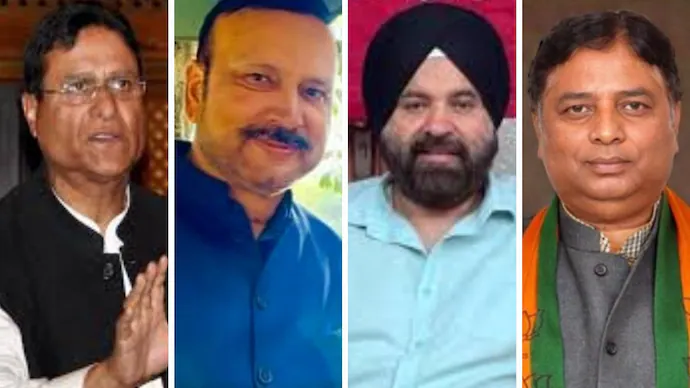
The National Conference won three of the four seats. Choudhary Mohammad Ramzan of NC defeated BJP’s Ali Mohammad Mir securing 58 votes. Sajad Ahmad Kichloo of NC triumphed over BJP’s Rakesh Mahajan with 57 votes. G. S. Oberoi, the first Sikh from J&K to enter the Rajya Sabha, marked a symbolic moment for the party and the Sikh community.
The fourth seat went to BJP’s Sat Paul Sharma who secured 32 votes, notably higher than the party’s numerical strength of 28 MLAs in the Assembly. This unexpected success hinted at cross-voting from outside the BJP ranks, reflecting not only cracks within the opposition bloc but also the BJP’s ability to transcend regional and party boundaries through strategic outreach.
The Symbolism Behind the BJP Win
Though the BJP secured only one of four seats, its victory carried political weight disproportionate to the numbers. Sat Sharma’s success against a combined opposition front reflected the BJP’s consistent ability to perform beyond its legislative strength, a pattern observed in several states where disciplined cadre strength and strategic alliances have compensated for numerical disadvantages.
The cross-voting in Sharma’s favor reportedly from Independents and even disenchanted opposition members underscored growing fissures within the anti-BJP alliance. More importantly, it reinforced the BJP’s narrative that Jammu and Kashmir’s politics is moving beyond the old guard of dynastic regional parties and towards issue-based, development-driven engagement within India’s democratic mainstream.
Political Reactions
Omar Abdullah celebrated the NC’s majority victory as a restoration of regional representation, but the BJP’s performance clearly rattled the opposition’s sense of control. The NC’s leadership hinted at frustration over the cross-voting episode accusing unnamed Independents of betrayal, which in turn revealed cracks in the much-touted united opposition front.
For the BJP, the victory was not just symbolic but strategic. Senior party figures framed the result as evidence of the party’s growing ideological acceptance in the Union Territory and its deepening connection with grassroots aspirations. Party leaders stated that even in the face of combined opposition and numerical disadvantage, the BJP stood firm on its development agenda and nationalist vision.
A Test of Post-370 Politics
The 2025 Rajya Sabha elections were the first high-stakes political event in Jammu and Kashmir since the abrogation of Article 370, a reform that fundamentally redefined the region’s relationship with the Union of India. The elections were not merely about numbers but about narratives. Regional parties sought to reclaim relevance under a restored legislative setup while the BJP aimed to consolidate the ideological and administrative transformation it initiated in 2019.
While the NC’s sweep reflected short-term regional consolidation, the BJP’s performance offered a longer-term signal that Jammu and Kashmir’s political discourse is gradually shifting from identity politics to governance and development. Even limited victories achieved under adverse arithmetic reveal expanding pockets of trust for the BJP across communities and regions, especially in Jammu and select parts of south Kashmir.
Candidate Selection
Both the NC and the BJP fielded candidates that embodied their distinct political messages. The NC focused on balancing regional and community representation, bringing in figures like Ramzan and Kichloo with deep local bases and Oberoi as a gesture toward minority inclusion. The BJP adopted a broader national vision. Sat Paul Sharma, a respected figure from Jammu, was projected as a voice of development and integration. The BJP’s inclusion of candidates like Rakesh Mahajan and Ali Mohammad Mir reflected its outreach to diverse communities, aiming to break the perception of regional exclusivity in Kashmir’s politics.
The Broader Message
In a region long dominated by narratives of special status and autonomy, the BJP has consistently positioned itself as the party of governance, accountability, and integration. Its performance in this election, though modest in raw numbers, reaffirmed the resonance of that approach.
Observers note that BJP’s governance record in Jammu, from improved infrastructure to welfare distribution and corruption crackdowns, has helped the party sustain a loyal base even in politically fluid environments. The party’s consistent messaging on peace, progress, and empowerment appears to be gradually reshaping voter expectations across the Union Territory.
Beyond the Numbers
The four new Rajya Sabha members will play a key role in shaping J&K’s representation in national policymaking. Debates on statehood restoration, administrative reforms, and regional development funding are expected to gain momentum in the Upper House.
For the BJP, Sat Paul Sharma’s entry ensures that Jammu and Kashmir’s voice in Parliament will include a perspective aligned with national priorities of stability, economic growth, and inclusive development.
Political analysts believe the results could also serve as a precursor to the next Assembly and Lok Sabha elections, where the BJP is likely to build on its growing presence and leverage internal fractures within opposition alliances. The NC’s apparent dominance today may not translate into long-term advantage. The BJP’s disciplined strategy and its ability to attract non-traditional allies make it a force that cannot be underestimated.
The National Context
When compared with other 2025 Rajya Sabha outcomes across India, the J&K results fit into a familiar pattern of the BJP maintaining or expanding its influence even where local arithmetic appears unfavorable.
In Uttar Pradesh the BJP nearly swept all 10 seats, while in Assam it secured both Rajya Sabha positions. Even in regions like Maharashtra and Tamil Nadu, where alliances fluctuate, the BJP’s strategic clarity ensured either representation or decisive impact on the outcome. Against that backdrop, the J&K result, with one seat wrested from a hostile arithmetic, further validated the party’s reputation for disciplined political maneuvering and sustained growth.
A New Chapter in J&K’s Political Journey
The 2025 Rajya Sabha polls have reaffirmed that Jammu and Kashmir’s political space is no longer confined to its traditional binaries of autonomy versus integration. The BJP’s steady rise from a marginal player two decades ago to a formidable national force in J&K mirrors the region’s gradual transition toward political normalization and democratic consolidation.

While the NC celebrated its short-term gains, the BJP walked away with a deeper victory that reinforces its ideological commitment and administrative confidence in steering J&K’s future. The message from these polls is clear: Jammu and Kashmir’s new political order is being reshaped not by legacy politics but by performance, perseverance, and a growing belief in integration within the national mainstream.
Leave a Reply