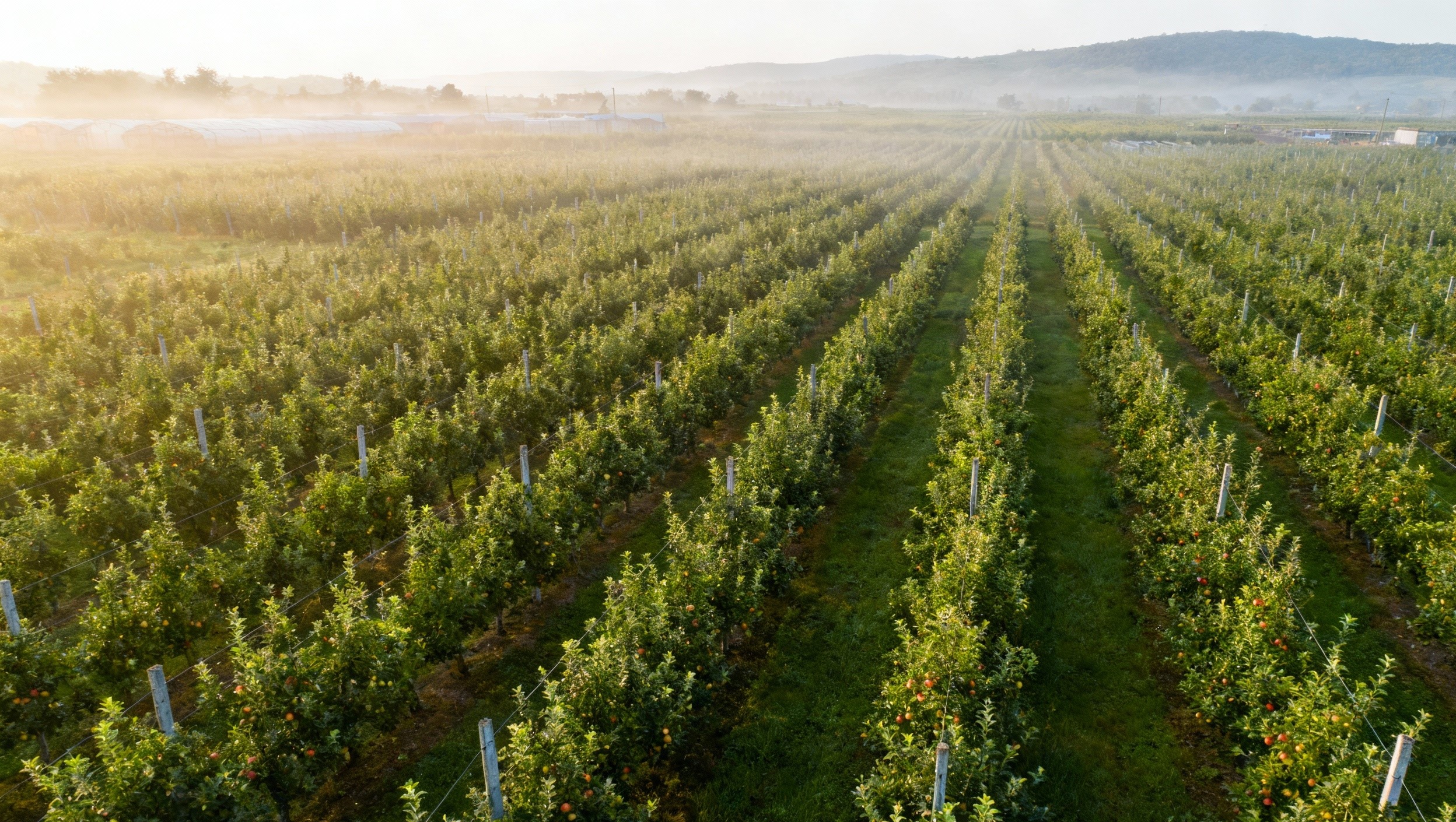
Once seen only in higher belts, apple trees now cover former paddy fields in low-lying Kashmir villages — reshaping the Valley’s agricultural landscape.
By Jahangeer Ganaie
With demand for traditional apple varieties remaining comparatively low in the market, more growers in Kashmir are switching to high-density apple cultivation, especially in low-lying areas where paddy land is now being rapidly converted into orchards. The shift marks a remarkable transformation in the Valley’s agrarian landscape, where the golden paddy fields once symbolized rural prosperity.
Growers from several parts of Kashmir said that until a few years ago, many areas had no history of apple orchards. But after a few farmers experimented with high-density apple varieties and recorded remarkable success — both in production and returns — more and more people started moving from paddy cultivation to horticulture. “Earlier, we never thought that this land could produce apples at all,” the growers said, adding that “after seeing the results on some private plots, almost everyone has now started planting high-density varieties.”
High-density apple farming was introduced in Kashmir after 2015. Unlike traditional apple trees that take nearly a decade to bear fruit, these trees start yielding in the first or second year and reach full production by the fourth or fifth year. Moreover, they are harvested earlier — in August and September — avoiding the risks of untimely November snowfalls that often devastate conventional orchards.
Farmers say the early harvest window, combined with protective measures such as hail nets and modern irrigation systems, has made this cultivation system not just efficient but also financially secure. “People have noticed the advantages of high-density apples. We have now prepared another 12 kanals and will convert that too into a high-density orchard,” said Mohammad Amin Dar, a farmer from a low-lying area of Shopian who has already planted high-density apples on eight kanals of land. “These trees need less labour and inputs, yet the fruit is of superior quality — uniform colour, uniform size, and better grade. That is why they fetch double the rates compared to traditional apples.”
The success of farmers like Dar has spurred a massive conversion movement across the Valley. In Pulwama’s Lassipora area, high-density cultivation has become a buzzword among farmers. “Hundreds of kanals of paddy land are being converted into these orchards now because the economics are simply better,” said Farooq Ahmad, another grower. “Thousands of high-density plants are being planted this year alone.”
Varieties like Jeromine, King Roat, Gala Scarlet, Red Velox, Scarlet Spur-II, Super Chief, Redlum Gala, Auvi Fuji, RD 11, Syncho Gala, Terex Gal, Z1, and SS2 are among the most popular cultivars currently being grown under the high-density model in Jammu and Kashmir. These imported varieties are known for their colour uniformity, early yield, and longer shelf life — features that appeal to both domestic and export markets.
Officials in the horticulture department describe the ongoing shift as a structural transformation in Kashmir’s rural economy. “This entire approach is transformative,” said a senior horticulture official. “It is attracting attention from apple experts across India. Farmers are embracing it because they clearly see the higher productivity potential and financial returns.”
The government, too, has been encouraging the trend through financial incentives and technical support. According to official data, more than 1,000 hectares of land have already been brought under high-density apple cultivation in Jammu and Kashmir. Plans are underway to expand the coverage to 5,500 hectares in the next few years. The horticulture department is currently offering a 50 per cent subsidy for farmers who either establish new or convert existing orchards to high-density systems.
High-density plantations follow a modern, technology-driven model that involves specialized rootstocks, drip irrigation, fertigation, and scientific pruning techniques. These orchards are not just more productive but also more manageable, as the trees grow in controlled dimensions — allowing easier spraying, harvesting, and maintenance. The controlled canopy structure ensures better sunlight penetration, improving both the yield and the quality of fruit.
The idea of high-density farming in Kashmir traces back to 2015 when the then Chief Minister, Mufti Mohammad Sayeed, inaugurated the first such orchard at Bamdoora in Anantnag. That moment marked the beginning of a new era in Kashmir’s horticulture sector — one that promised greater returns on smaller landholdings and reduced dependency on traditional crops vulnerable to climatic uncertainty.
Kashmir, often described as the apple bowl of India, produces on average over 20 lakh metric tonnes of apples every year — a figure that, in good seasons, touches 25 lakh metric tonnes. According to the J&K Economic Survey (2017), nearly half of the Valley’s population is directly or indirectly dependent on the apple industry. More than 3.5 lakh hectares of land are currently under apple cultivation, making it one of the largest employment-generating sectors in the region.
Horticulture contributes around 9.5 per cent to Jammu and Kashmir’s Gross Domestic Product (GDP) and generates about 8.5 crore man-days of employment annually. The sector is not only an economic mainstay but also a lifeline for thousands of rural families.
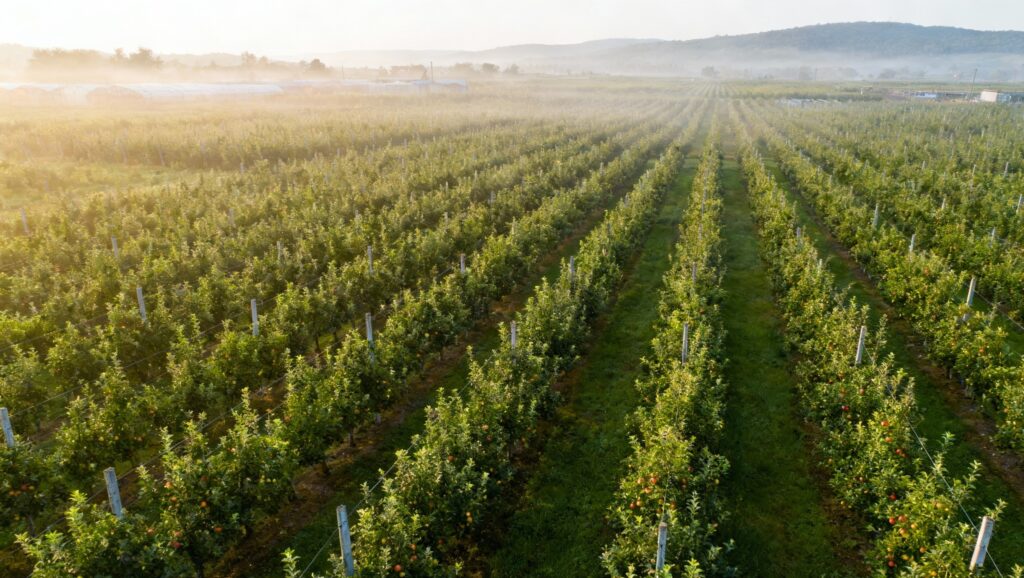
As the Valley witnesses the gradual disappearance of paddy fields in certain low-lying belts, the high-density apple revolution represents a complex but inevitable transition. On one hand, it brings modernity, efficiency, and prosperity to the rural economy; on the other, it signals a cultural shift — redefining Kashmir’s agricultural identity from a grain-producing to a fruit-driven landscape.
For now, the optimism among orchardists is hard to miss. The glistening red apples hanging from compact, perfectly aligned trees across converted farmlands have become symbols of change — and of a future where science and tradition merge to sustain Kashmir’s most iconic industry.
The views expressed in this article are solely those of the author and do not necessarily reflect the opinions or views of this newspaper
Leave a Reply