History of J&K would have been different if Sardar Patel had been given full responsibility for its integration in 1947: LG
By Ajaz Rashid
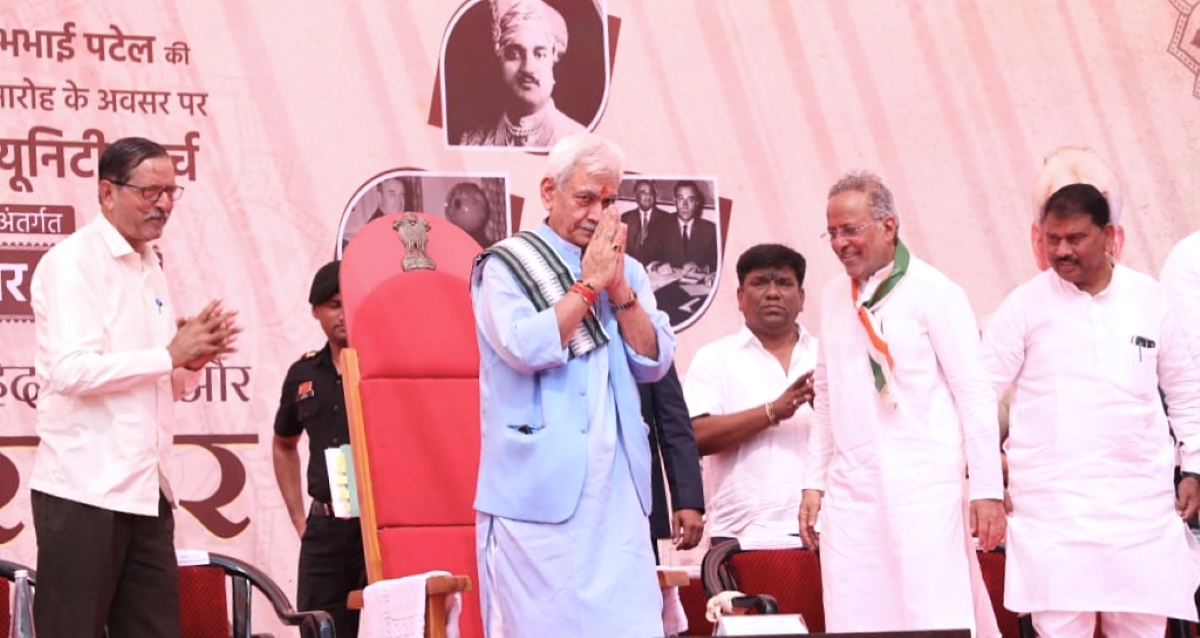
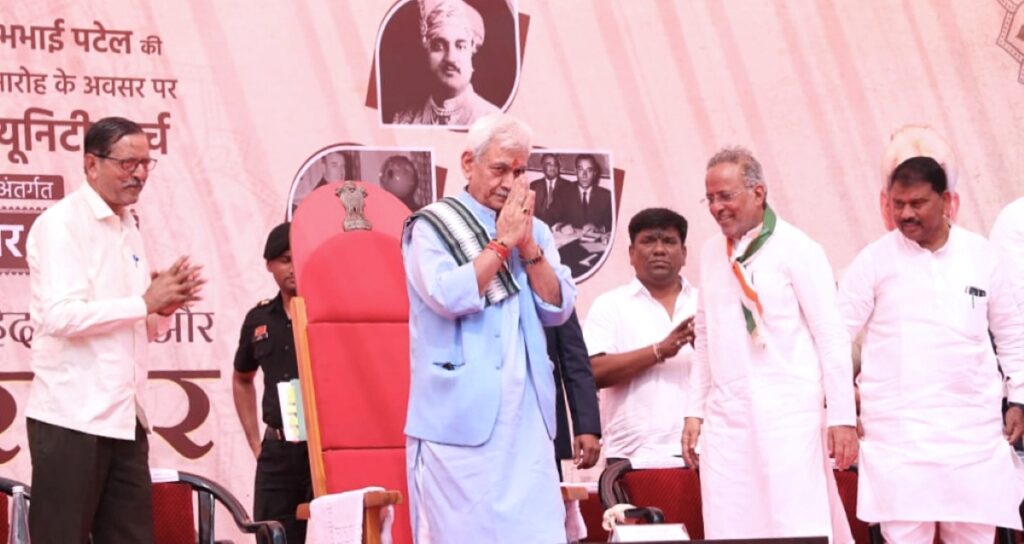
At Vadodara on Thursday, Lieutenant Governor Manoj Sinha joined the National Padyatra of the Sardar@150 Unity March, invoking Sardar Vallabhbhai Patel’s enduring vision of unity and nation-building. In a keynote address titled “Kashmir, Hyderabad and Sardar,” the LG hailed Patel’s decisive role in integrating princely states—especially Hyderabad—and shaping a stable, united India. Praising the Prime Minister’s “One Nation” reforms as modern instruments of cohesion, Sinha urged the youth to uphold the three pillars that bind the country together: shared values, shared identity and a common national purpose. Calling Patel the architect of modern India, the LG said his integrity, courage and resolve continue to inspire the nation’s march towards strength, self-reliance and development.
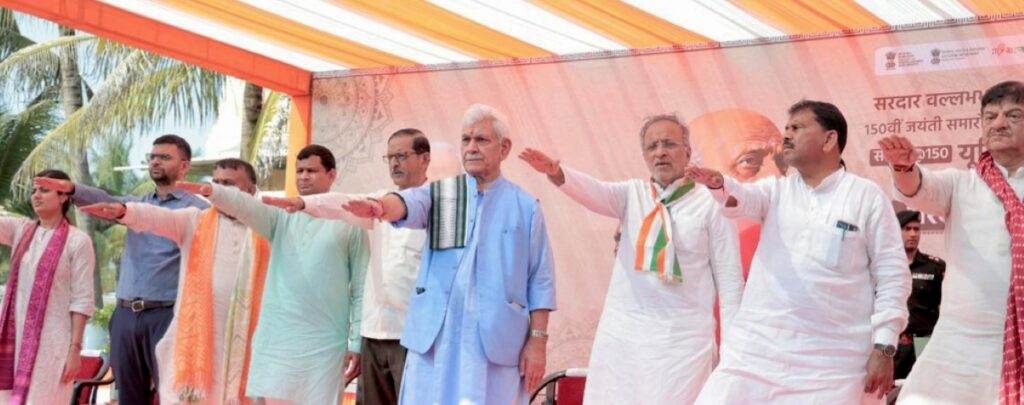
Lieutenant Governor, Manoj Sinha on Monday joined the “Sardar@150 Unity March (Padyatra)” at Vadodara, Gujarat. The National Padyatra, which began at Sardar Patel’s family home in Karamsad, will cover nearly 190 km in 11 days, and will conclude at the Statue of Unity on 6th December. Addressing the event on the theme “Kashmir, Hyderabad and Sardar”, the Lieutenant Governor said Sardar Vallabhbhai Patel would have ensured complete and irreversible integration of Jammu Kashmir if he had handled its affairs.
“History of J&K would have been different if Sardar Patel had been given full responsibility for its integration in 1947,” the Lieutenant Governor said.
The Lieutenant Governor said despite not directly handling Jammu Kashmir, Sardar Patel ensured that it remained an integral part of India. From the very beginning, Sardar Patel had said that we will not give even an inch of Jammu Kashmir to Pakistan.
“Sardar Patel had opposed the then Prime Minister Jawaharlal Nehru’s policy towards Jammu Kashmir. He was also against taking the issue to the United Nations. In one of his public rallies Sardar Patel had categorically said about complete integration of Jammu Kashmir and his decisive action would have altered the course of history,” the Lieutenant Governor said.
The Lieutenant Governor, in his address, observed that Sardar Patel’s vision of unity, ideals and values of equality and social justice continue to shape the growth of our nation.
“As an architect of modern India, Sardar Patel symbolises India’s self-confidence, self-respect and its bravery. His embodying values of integrity, decisiveness, selfless service continue to inspire us to build a strong, self-reliant and developed India,” the Lieutenant Governor said.
The Lieutenant Governor said Prime Minister Narendra Modi is fulfilling the dreams and vision of Sardar Patel.
“With abrogation of Article 370, he has weaved entire India in the thread of unity and realized the resolution of one flag, one constitution and one leader in one country,” the Lieutenant Governor said.
The Lieutenant Governor highlighted that Hon’ble Prime Minister’s initiatives- ‘One Nation, One Tax’, ‘One Nation, One Ration Card’, ‘One Nation, One Health Card’, ‘One Nation, One Grid’, ‘National Education Policy’, ‘PM Gati Shakti’, ‘Kashi-Tamil Sangamam’ and various other programmes have strengthened the unity of the country.
The Lieutenant Governor called upon youth to strengthen the pillars of Unity.
“There are three important pillars of unity – shared values, shared identity and a common purpose act as a unifying force for sustained progress and development,” the Lieutenant Governor said.
How Patel Built the Foundations of Modern India
Sardar Vallabhbhai Patel’s legacy is often framed through the dramatic political consolidation of post-Partition India, but his developmental contributions run far deeper—shaping the administrative, institutional and social foundations of the modern Republic.
Patel’s nation-building journey began long before 1947. As a leading figure in the freedom movement, he organised peasants in Gujarat through the Kheda and Bardoli Satyagrahas, pioneering a participatory model of grassroots mobilisation. These campaigns not only strengthened India’s civil resistance but also laid early templates for rural empowerment and local governance.
After Independence, Patel emerged as the chief architect of national integration. His swift, strategic unification of over 560 princely states through diplomacy and decisive action prevented territorial disintegration and ensured the formation of a cohesive Indian Union—a prerequisite for any developmental strategy. The integration of states like Hyderabad, Junagadh and others created stable administrative units that allowed economic planning and governance to take root.
Patel’s work as India’s first Home Minister and Deputy Prime Minister was equally transformative. He reorganised civil services, creating what would become the Indian Administrative Service (IAS) and Indian Police Service (IPS). These institutions were designed to be impartial instruments of governance, capable of implementing development policies uniformly across the newly formed nation. Many historians argue that without this administrative backbone, India’s early Five-Year Plans and welfare schemes would have struggled to take hold.
Patel also oversaw major initiatives related to refugee rehabilitation after Partition—one of the largest human resettlement efforts in history. His clear directives and organisational discipline helped restore order, enabling millions of displaced families to rebuild their lives and contribute to India’s economic activity.
A strong advocate of cooperative farming and agrarian reform, Patel believed India’s development depended on empowering rural communities. His support for cooperative movements, particularly in Gujarat, eventually set the stage for institutions like Amul, which would revolutionise India’s dairy sector and become models of community-led economic growth.
Beyond administration and agriculture, Patel championed national infrastructure. He pushed for unified communication networks, standardised rail services, and integrated economic systems—efforts that quietly stitched together India’s logistics and trade architecture in the early years of the Republic.
In essence, Sardar Patel’s developmental legacy lies in the systems he built, the unity he secured, and the administrative discipline he institutionalised. While others drafted India’s political visions, Patel ensured the country had the stability, structure and coherence needed to pursue them. His imprint remains visible today in India’s civil services, its federal unity, and its enduring belief in strong, decisive governance as a vehicle for development.
Leave a Reply