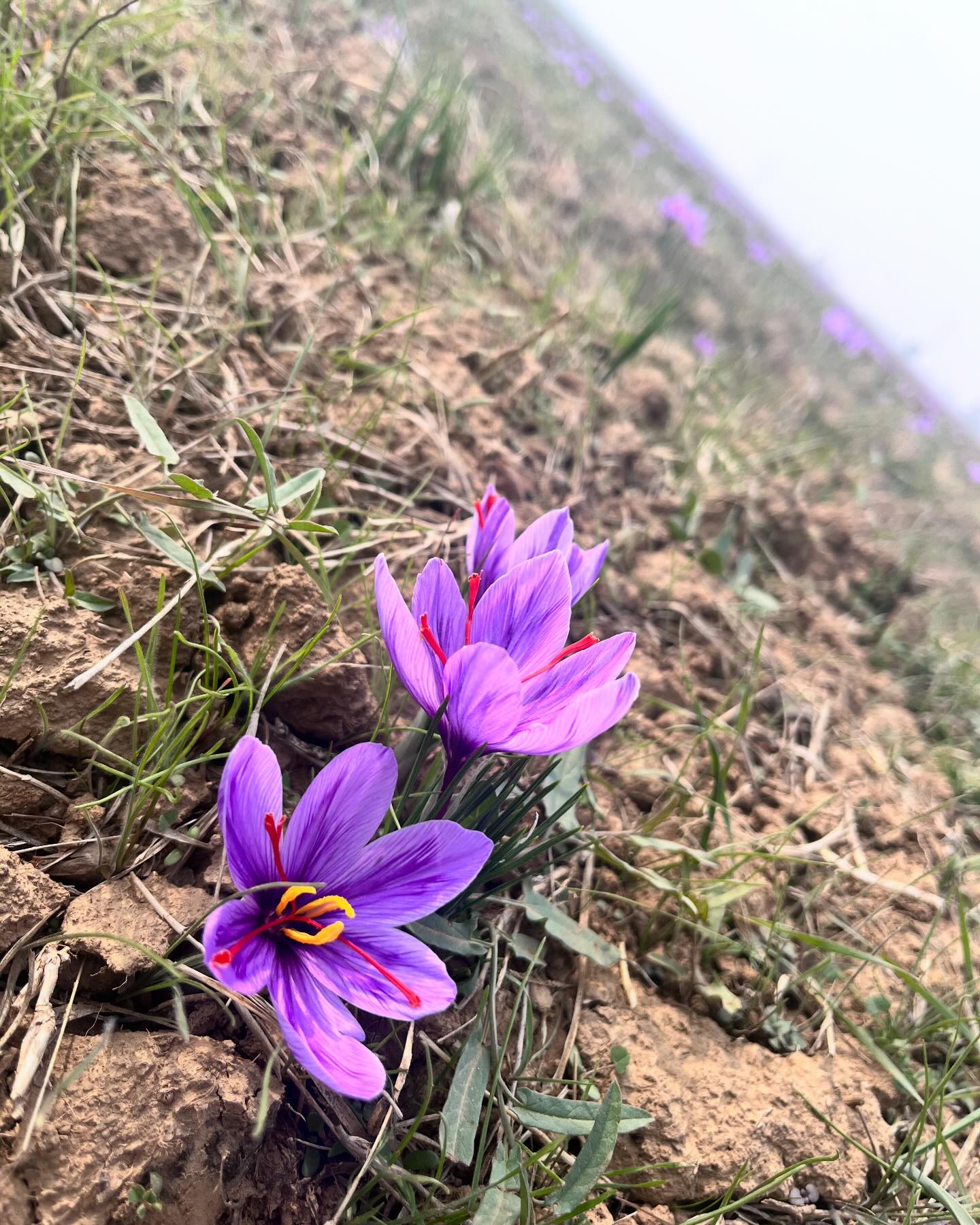
A disastrous season leaves Kashmir’s saffron growers staring at empty fields and a fading legacy. This is the year Pampore’s purple turned pale.
By Jahangeer Ganaie
In the sun-baked plateau of Pampore, where autumn usually unfurls a purple-tinged carpet of saffron blossoms, despair has taken root instead. Growers in Kashmir’s famed saffron belt say 2025 has turned out to be among the worst cultivation years they have seen in decades — a season defined by failed expectations, collapsing yields, and a deepening crisis that threatens the very survival of the Valley’s most iconic crop.
Across Lethpora, Chandhara, Khrew, and the surrounding hamlets, farmers describe the same grim landscape: outdoor saffron fields that barely flowered, indoor cultivation units sitting idle, and corms — the mother bulbs of the crop — shrinking in quality and vanishing from the local market. The result is a widespread sense of alarm in a region that has built centuries of tradition, livelihood, and identity around the world’s most precious spice.
Growers said that the outdoor harvest this year has bordered on catastrophic. For many, production has hit the lowest point seen in several generations, with flower density dropping so sharply that entire fields yielded only a fraction of what they normally do. Years of unpredictable weather, declining soil health, and unchecked corm depletion have converged into what some farmers call an agricultural emergency.
Ironically, the alternative that many had hoped would ease their burden — indoor saffron cultivation — also collapsed before it could begin. Over the past few years, the shift to indoor farming had emerged as a ray of hope in Pampore. Using controlled environments, growers believed they could bypass erratic temperatures, dry spells, and inadequate irrigation. But this season, even that lifeline slipped out of reach.
“We were hopeful that indoor cultivation would help us recover from the losses caused by erratic weather, but unfortunately, there were no quality corms available this season,” said Ghulam Nabi, a saffron grower from Lethpora. “The corms available in the market were of poor quality, and planting them would have meant wasting both money and effort.”
For farmers like Nabi, the inability to shift indoors is not just an inconvenience — it is a financial blow. Indoor cultivation requires a heavy initial investment in racks, trays, temperature controls, and storage units. Without good corms, the entire setup remains unused, leaving growers in deeper debt.
The crisis, they say, traces back to a combination of natural and human-induced pressures. The prolonged summer dryness, followed by sudden and poorly timed rains, has altered the soil’s nutritional composition. Saffron, a crop sensitive to even subtle environmental fluctuations, responds quickly to such disruptions. But this year, the damage appears to have been far more severe.
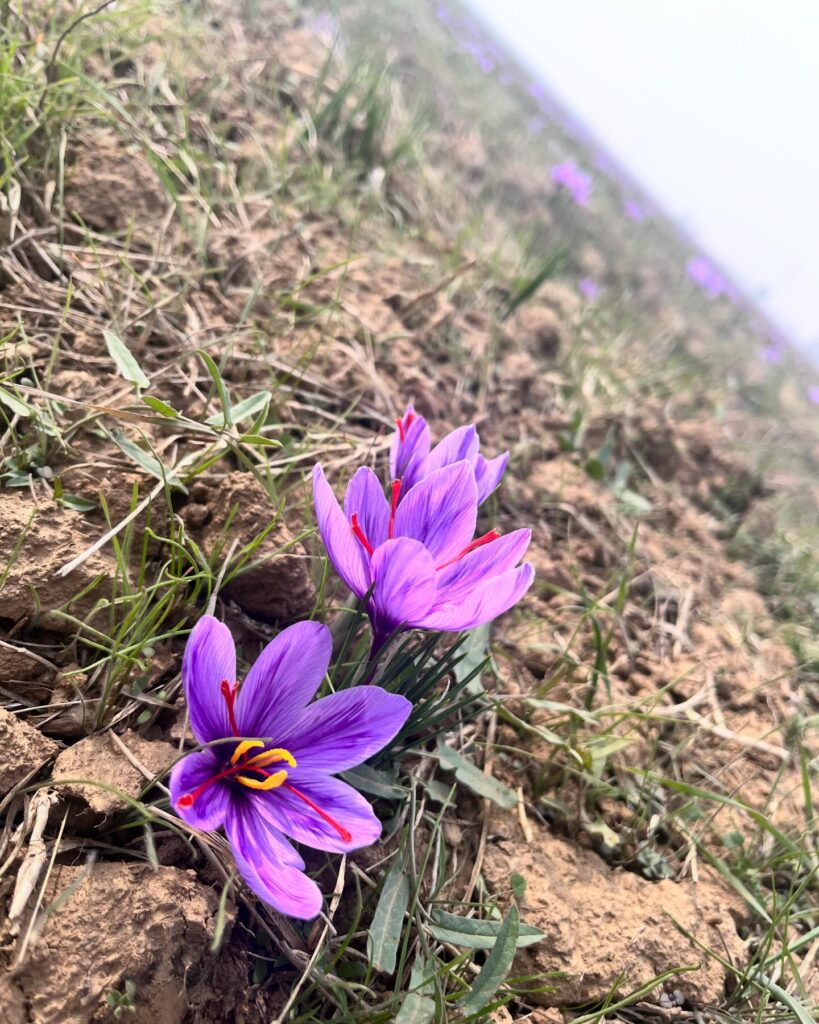
“Our corms have lost their vigour. They are getting smaller and weaker every year. Without good-quality corms, both outdoor and indoor cultivation are becoming impossible,” said Abdul Ahad from Khrew. His assessment is echoed across the pampas-like fields of saffron where farmers now dig up bulbs that are visibly shrinking — a sign of stress, disease, or nutrient depletion.
But to the growers, climate alone is not to blame. A significant share of the frustration stems from what they call the “silent drain” of corms leaving the Valley. According to them, the large-scale sale of Kashmir’s saffron corms to outside buyers has resulted in a dual crisis — local shortages and a fall in quality. As the best corms exit the region for better prices, farmers are left with substandard stock that weakens the crop cycle year after year.
“The government has stopped the sale, and there is a need for stricter action to fully stop the sale of corms outside Kashmir. These corms are part of our heritage and economy — their outflow will only accelerate the decline of this industry,” said Manzoor Ahmad, a cultivator from Chandhara.
This drain, farmers argue, has been quietly undermining Kashmir’s saffron ecosystem. With fewer high-quality corms available locally, multiplication slows down, and the biological base of the crop shrinks. As the bulb stock deteriorates, so does the entire cultivation cycle — from flowering patterns to spice quality and eventually the income of thousands who depend on it.
Experts and agricultural scientists have been warning for years that Kashmir’s saffron heritage is at a turning point. The famed Karewas — the elevated terraced lands ideal for saffron — have been steadily eaten away by urban sprawl, highway expansions, and construction. Water scarcity has intensified in recent decades, reducing the natural moisture that the crop depends on. And while government interventions like the Saffron Mission once brought hope, farmers say the optimism has faded as key structural issues remain unaddressed.
Agricultural experts point out that saffron corms need systematic renewal, disease monitoring, and scientifically managed multiplication cycles. Without this, bulbs degenerate over time — becoming exactly what Pampore’s farmers are now describing: smaller, weaker, and unproductive. This year’s crisis, they argue, is not an aberration but the culmination of years of neglect layered over climate unpredictability.
Growers are now urging the government to turn its attention to what they see as the root of the crisis: the absence of a reliable, high-quality corm supply system. They want dedicated corm multiplication centres, government-managed germplasm banks, and research units that can develop disease-resistant corm varieties suitable for Kashmir’s shifting climate.
“If steps are not taken now, saffron, which once brought global recognition to Kashmir, will soon become just a memory,” said a local saffron association member.
Once a flourishing industry producing nearly 16 metric tonnes annually, Kashmir’s saffron output has been steadily slipping. Many farmers who once supported their families comfortably through saffron sales now speak of mounting loans, reduced acreage, and a future full of uncertainty. The decline has also rippled through local markets, where traders, processors, and small-scale workers feel the pinch of shrinking harvests.
In Pampore today, the crisis is visible not just in barren fields but also in the anxiety etched across the faces of growers who have never known another livelihood. For them, saffron is not just a crop — it is the Valley’s pride, a cultural anchor, and the economic backbone of entire communities. And as the 2025 season draws to an end with almost nothing to show, the fear is that Kashmir might be edging dangerously close to losing the jewel that once put it on the world map. (KNO)
Leave a Reply