By Rayees Ahmad Kumar
In the expanding landscape of contemporary Kashmiri literature, especially within the delicate realm of children’s poetry, the voice of Shafkat Aziz Hajam has emerged as one of the most consistent and wide-reaching. A resident of the border district of Kupwara in north Kashmir, Shafkat has quietly but steadily built a reputation that now stretches across continents. His poems frequently appear in prestigious international magazines and anthologies, and his submissions are regularly selected in global poetry contests. Beyond print, his recitations and lyrical pieces have travelled through digital corridors, voiced by children from Asia, Africa and Europe, indicating a resonance that crosses linguistic and cultural barriers. Many of his poems have been translated into multiple world languages, further demonstrating the universal accessibility of his themes and the simplicity of his craft.
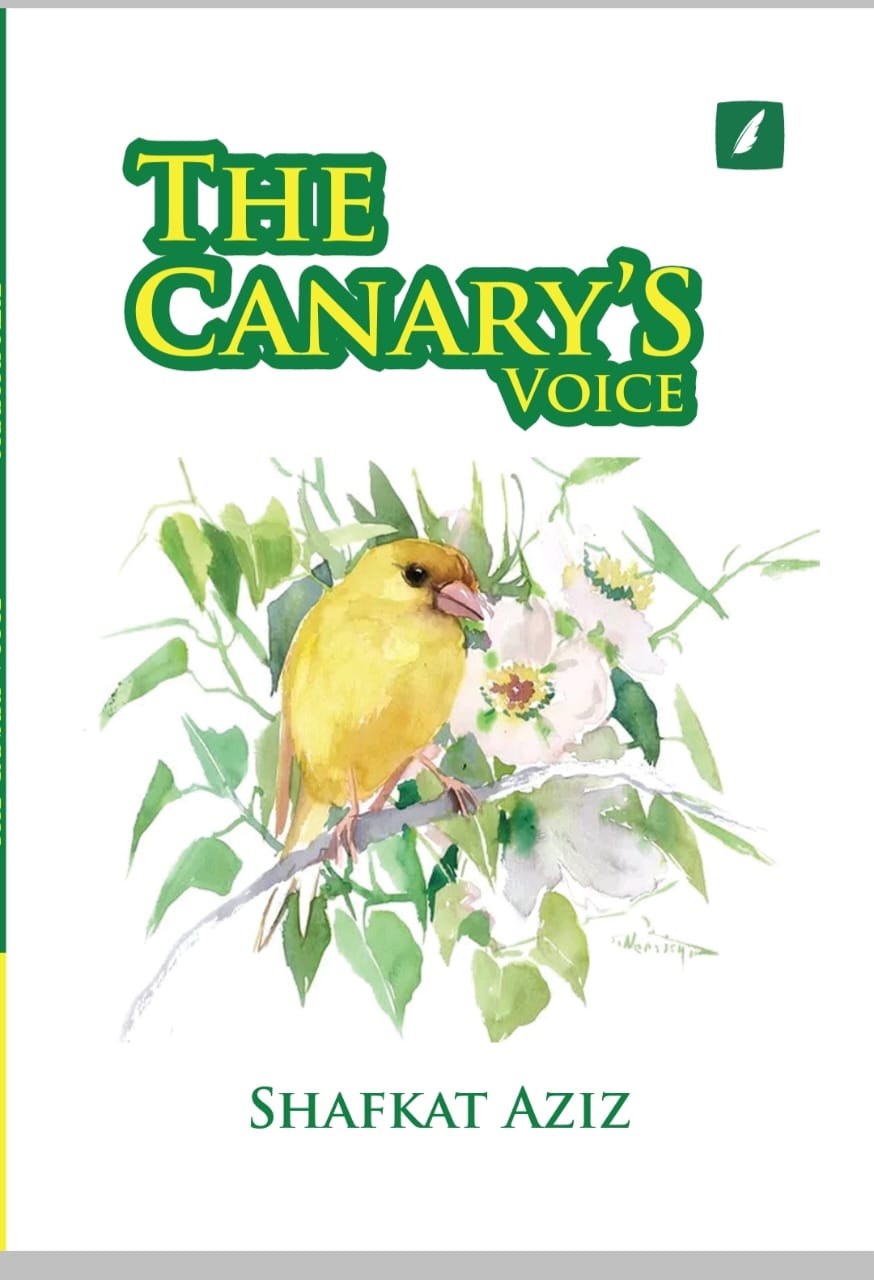
Shafkat has always shown a natural inclination toward children’s Islamic literature, dedicating much of his creative energy to producing lyrical, tender poetry for young readers. His latest work, Canary’s Voice, published by Wular Publishing House in Anantnag, reflects this passion with remarkable clarity. The book spans 84 pages and contains 72 poems written specifically for children—gentle verses that introduce early Islamic concepts, moral principles and spiritual reflections through simple vocabulary and playful rhyme. The cover of the book, attractively designed and inviting to young eyes, announces from the outset that this is a work meant to delight as much as it instructs.
The collection opens with glowing words from literary voices across South Asia and the Middle East. In the foreword, Dr. Zainul Hussain of Azad Narang Inter-College in Bareilly praises the “tremendous effort” behind the compilation and the “magnificent inking prowess” that carries the collection. Dr. Fizza Younis from Pakistan, in her note of appreciation, remarks that though she does not know Shafkat personally, she has come to understand him through his writing — and that “nothing speaks more about a person than the words they write from their heart.” From Egypt, poet and English language teacher Hamida Foud acknowledges the spiritual depth of the poems, noting how Shafkat gently emphasizes the value of time, the blessings of Allah’s mercy, and the comfort that comes from aligning one’s life with divine satisfaction.
The poems begin with a simple call to remember Allah in moments of joy and sorrow, a theme that recurs throughout the collection. Shafkat uses miniature poetic forms to help children absorb foundational Islamic teachings. Poems such as Allah Is One, I Am a Muslim, Allah Hates Liars, Ask Only Allah, and A True Muslim are written with an economy of words but an abundance of clarity. Their rhythms and imagery are crafted for easy memorization, making them accessible to even the youngest readers. In these verses, the poet’s mission becomes clear: to embed ethical and spiritual understanding in the early years of a child’s development.
Many of the poems draw a natural bridge between spiritual learning and day-to-day experience. Works like O Allah for Hajj and My Dear Teacher help children understand the significance of religious practice while cultivating gratitude toward those who guide and nurture them. Hate the Shaytan and Come to Masjid encourage the development of prayer habits and moral discipline, while Fear Allah and Shower Upon Me Your Mercy read like gentle morning invocations, perfectly suited for use in school assemblies or at home before starting the day.
The poem When Allah Wishes introduces the idea of divine will through the natural world, using images of rain, snow, wind and crops to illustrate how even the smallest movement in nature follows a higher command. Shafkat grounds theological concepts in the environments children understand, making faith feel intimate rather than abstract. In O Allah, I Have No Words, he adopts the voice of a child expressing gratitude for divine protection and guidance. O Dear Allah You Know captures the pure innocence of a child who neither harms nor hates—a portrait of innate goodness that reflects the ideal of early spiritual upbringing.
While the collection is deeply rooted in Islamic teachings, Shafkat also turns his attention to nature and imagination—landscapes that children naturally inhabit. If I Were a Bird invites young readers into a world of boundless freedom, where birds glide over gardens and fields unconstrained by human borders or responsibilities. Poems such as Singing Birds and O Dear Butterfly express the instinctive affection children feel toward living creatures, written with a sense of wonder that mirrors a child’s gaze. On page 66, O Dear Rainbow captures the excitement of children who rush outdoors after a rain shower to glimpse the seven-coloured arc stretching across the sky — a moment of pure thrill translated into simple, lyrical language.

Several poems focus on character-building and social values, gently nudging children toward empathy, peace and responsibility. Let’s End Strife asks young readers to abandon conflict, echoing universal principles found in all major religions. Read the Holy Quran encourages children to seek comfort, wisdom and peace through scripture. In O Dear Teacher and Come to School, Shafkat emphasizes the transformative power of education and the foundational role of teachers in shaping young minds. The poems I Am a Princess and I Am a Prince capture the innocent dreams and self-image of four-year-old boys and girls, reaffirming their imagination, joy and sense of identity.
Throughout Canary’s Voice, Shafkat Aziz Hajam demonstrates a rare ability to write for children without condescension. His poems are filled with moral clarity but never preachy, gentle yet purposeful, spiritual but always grounded in imagery and rhythm that children can feel and understand. His language remains deliberately simple, his ideas clear, and his emotional tone warm and nurturing.
Within Kashmir’s literary circles, Shafkat is already celebrated as a young poet whose work has been widely published and anthologized. He has been lauded for his sincerity, his prolific output and his ability to blend emotional intelligence with poetic discipline. Canary’s Voice reinforces his standing as one of the most promising voices in children’s Islamic literature today. It is more than a collection of rhymes—it is a carefully crafted companion for young minds, a resource for parents and teachers, and a tender introduction to faith, morality and imagination.
If Shafkat continues to write with the passion and perseverance that mark this collection, there is little doubt that his voice will rise even further, perhaps reaching audiences far beyond those already touched by the canary-like softness and clarity of his verse.
The views expressed in this article are solely those of the author and do not necessarily reflect the opinions or views of this newspaper
Leave a Reply