History remembers him as the founder of Islam in Kashmir, but Shah-i-Hamdan brought more than faith to the Valley.
By Rayees Ahmad Kumar Kumar
In Kashmir’s rich history, few threads are as vibrant or enduring as the legacy of Hazrat Amir Kabir Mir Syed Ali Hamdani (RA). Often revered as the founder of Islam in the Valley, his influence transcends mere religious conversion; he is credited with a cultural and architectural renaissance that reshaped the region’s identity. Known affectionately to history as Shah-i-Hamdan (The King of Hamdan) and Amir-i-Kabir (The Great Commander), his arrival in Kashmir was not a solitary event but a civilizational shift, brought about by a leader and his devoted retinue of elite “Comrades of Sayeds.”
To fully grasp the magnitude of his influence, one must look back to his origins in Persia. Born on October 21, 1314 AD, in the historic city of Hamdan, Shah-i-Hamdan hailed from a lineage that commanded both secular and spiritual respect. His parents, Syed Shahabuddin and Syeda Fatima, were direct descendants of the Holy Prophet (PBUH), and with his father serving as the administrator of Hamdan, the young Syed was raised in an environment of nobility. However, his upbringing was deeply rooted in asceticism and scholarship rather than administrative power. Under the guardianship of his maternal uncle, Syed Alluddin Simnani, and later his spiritual mentor, Sheikh Sharfudin Mazdaqani, Shah-i-Hamdan memorized the Holy Quran and was initiated into the Kubrawi order of Sufism. This rigorous spiritual training prepared him for the missionary journeys that would eventually lead him to the Himalayas.
While the young Syed was absorbing spiritual knowledge in Persia, the Valley of Kashmir was enduring a period of profound darkness. The early 14th century was a time of devastation for the region, marked most notably by the brutal invasion of the Tatar warlord Zulchu (Zulchi). Historical records suggest the destruction unleashed by Zulchu was so absolute that, following his eight-month reign of terror, he departed in 1320 AD leaving a city where only eleven families reportedly survived. In the power vacuum that followed, Rinchan Shah, a Buddhist prince from Ladakh, ascended the throne. It was during Rinchan’s reign that the seeds of Islam were first sown by Syed Sharfudin Abdul Rehman Suharwardi, known as Bulbul Shah, a traveler from Turkistan. Rinchan Shah accepted Islam at Bulbul Shah’s hands, taking the name Sadruddin. Yet, the consolidation of the faith and the wholesale cultural transformation of Kashmir awaited the arrival of the traveler from Hamdan.
Against this backdrop of reconstruction, Shah-i-Hamdan did not rush his mission. He first sent his cousins, Syed Tajuddin Simnani and Mir Syed Hussain Simnani, to the Valley to assess the socio-political landscape. Following their reconnaissance, he undertook three historic visits to Kashmir that would change its destiny. His first arrival was recorded in 1372 AD. With a small group of fewer than a hundred companions, he was received by Sultan Qutubuddin, as the ruling King Sultan Shahabuddin was away on an expedition in Attock. After a six-month stay, during which the Sultan became his disciple, Shah-i-Hamdan departed for Makkah.
It was his second visit in 1380 AD that proved to be the turning point in Kashmir’s history. This time, he was accompanied by a massive entourage of 700 Sayeds—scholars, artisans, and theologians. This large group settled on the banks of the River Jhelum in an area then known as Allaudin Pora. For thirty months, Shah-i-Hamdan traveled the length and breadth of the Valley, propagating the teachings of Islam while his companions likely introduced the Central Asian arts and crafts that Kashmir is famous for today. His third and final visit occurred in 1384 AD, but his health began to fail after less than a year. Departing via Ladakh, he left a spiritual footprint even in that high-altitude desert, constructing a mosque in Shey village—the first Muslim site of worship in the region.
As the party traveled toward Turkistan, they reached Kunnar, where King Khazar Shah pleaded with the saint to stay as a royal guest. But destiny had other plans. On January 19, 1385 AD, Shah-i-Hamdan passed away. While initially buried in Swat due to harsh winter conditions, his body was later moved to Koulab on July 4, 1385, fulfilling his final wish. His family rests there with him, but his spirit remains indelibly etched in the Kashmiri landscape through a distinct architectural heritage. Wherever Shah-i-Hamdan walked, he established a network of Khanqahs—hospices that served as centers for community life and worship. Notable among these are the Khanqah Faizpanah in Tral, Khanqah-i-Amirya in Pampore, and the shrines in Wachi and Monghama.
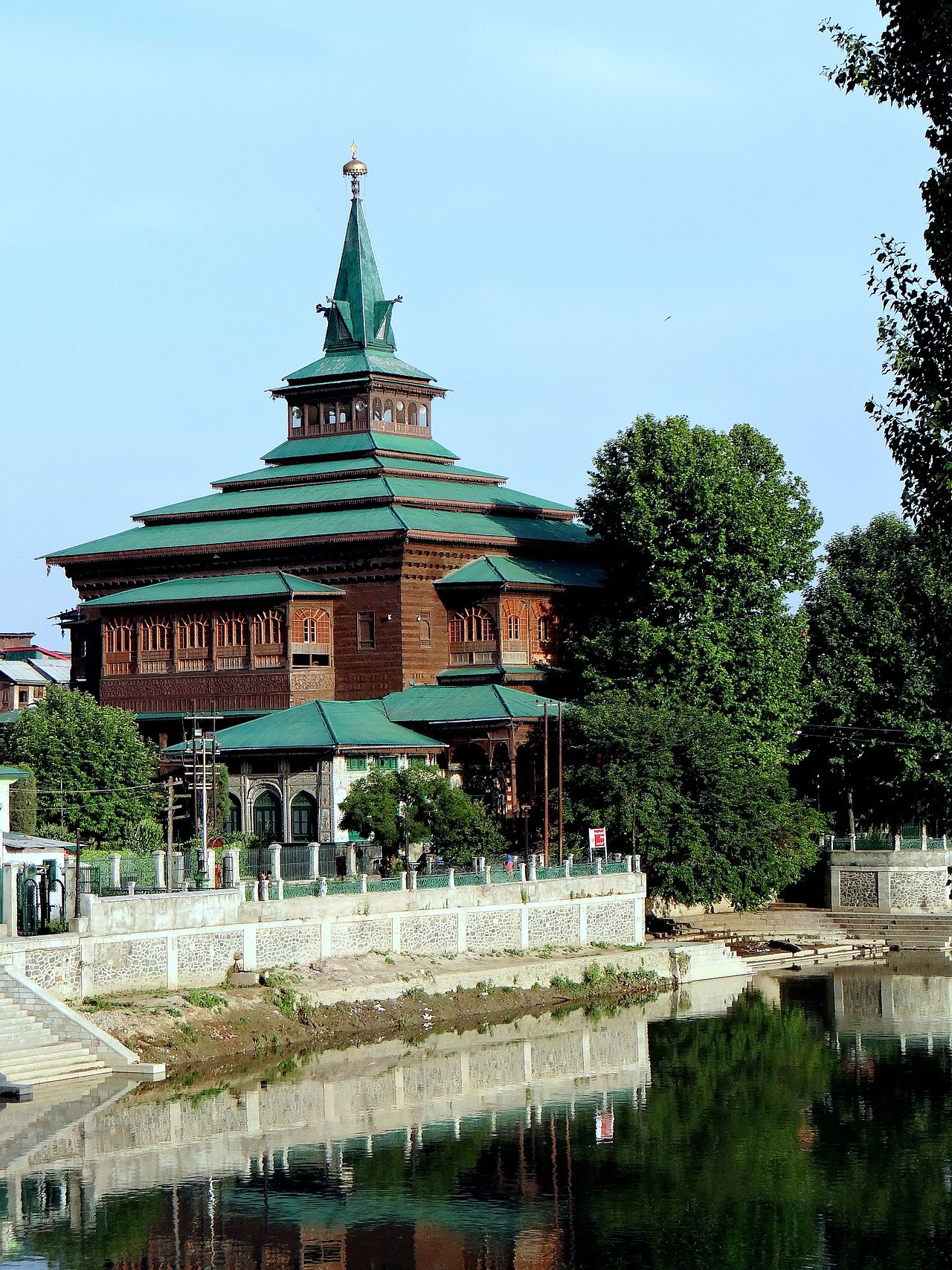
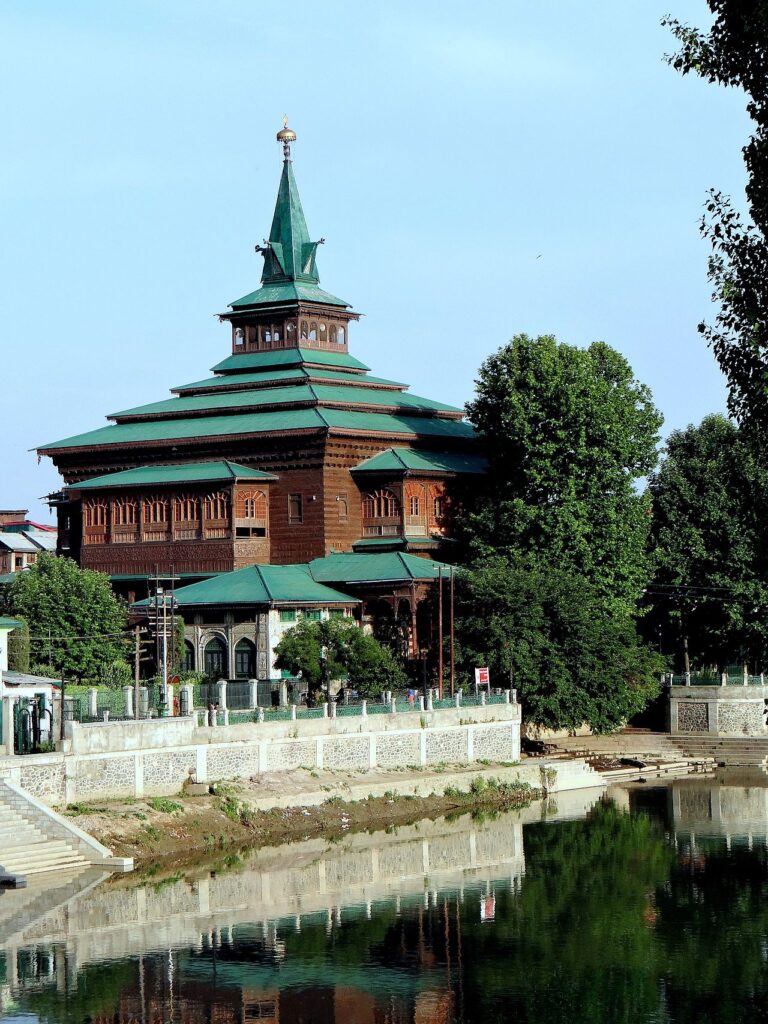
However, the crown jewel of this legacy is the Khanqah-i-Moula in Srinagar. More than just a place of worship, the Khanqah-i-Moula stands as a six-hundred-year-old testament to Kashmir’s architectural ingenuity. The structure is distinctively Central Asian, utilizing a blend of timber, sculpted stone, and small bricks. The foundation was laid by Shah-i-Hamdan himself on the very spot where he and his 700 disciples had offered prayers. The task of completing this grand project fell to his son, Mir Mohammad Hamdani (RA), who arrived in the Valley during the reign of Sultan Sikandar. Construction began in 1396 AD and was completed by 1399 AD, made possible through the generosity of Sultan Sikandar and the support of Seh Butt. Mir Mohammad Hamdani did not merely finish a building; he continued his father’s mission, extending the network of mosques to every corner of the Valley and cementing the transition of Kashmir into a hub of Islamic culture. Today, the Khanqah-i-Moula remains a symbol of the moment Kashmir opened its doors to the world, embracing a new faith and a new civilization brought by the Great Amir from Hamdan.
The views expressed in this article are solely those of the author and do not necessarily reflect the opinions or views of this newspaper
Leave a Reply