Can Kashmir’s Vanishing Blue Veins Be Saved?
For centuries, the Kashmir Valley has been defined by the rhythm of its waters. From the sweeping expanse of Wular Lake to the intricate, willow-lined veins of the Jhelum River, the region’s identity is as much liquid as it is solid. But today, a quiet crisis is unfolding across this Himalayan landscape. The “blue” in the “emerald valley” is fading, as a combination of shifting climates, rapid urbanization, and decades of ecological neglect threatens to silence the springs and shrink the lakes that have sustained life here since the time of the Mughal emperors.
However, as the year 2025 draws to a close, a new narrative is emerging. It is one of urgent restoration and a race against time to ensure that the water bodies of Kashmir do not become mere footnotes in history books.
A Landscape in Transition
The statistics are sobering. Recent environmental reports by India Water Foundation indicate that Jammu and Kashmir has lost a staggering portion of its wetland area over the last decade. Data presented in the “Status of Wetlands 2025” report suggests that nearly 40% of India’s wetlands have vanished over three decades, with Kashmir being one of the most visible theaters of this decline.
In Srinagar alone, more than 50% of water bodies have been lost in the last century. Once-pristine marshes that acted as natural “sponges” during the monsoon—soaking up excess runoff and preventing floods—have been replaced by concrete clusters and silted plains. This ecological thinning was most painfully felt during the 2014 floods, a disaster that remains etched in the collective memory of the valley.
“Kashmir is essentially a flood plain,” explains a local researcher while speaking to a local Kashmir Based Newspaper. “When you remove the wetlands like Hokersar and Hygam, you remove the valley’s insurance policy. We aren’t just losing water; we are losing our defense system.”
The Struggle of Dal and Wular
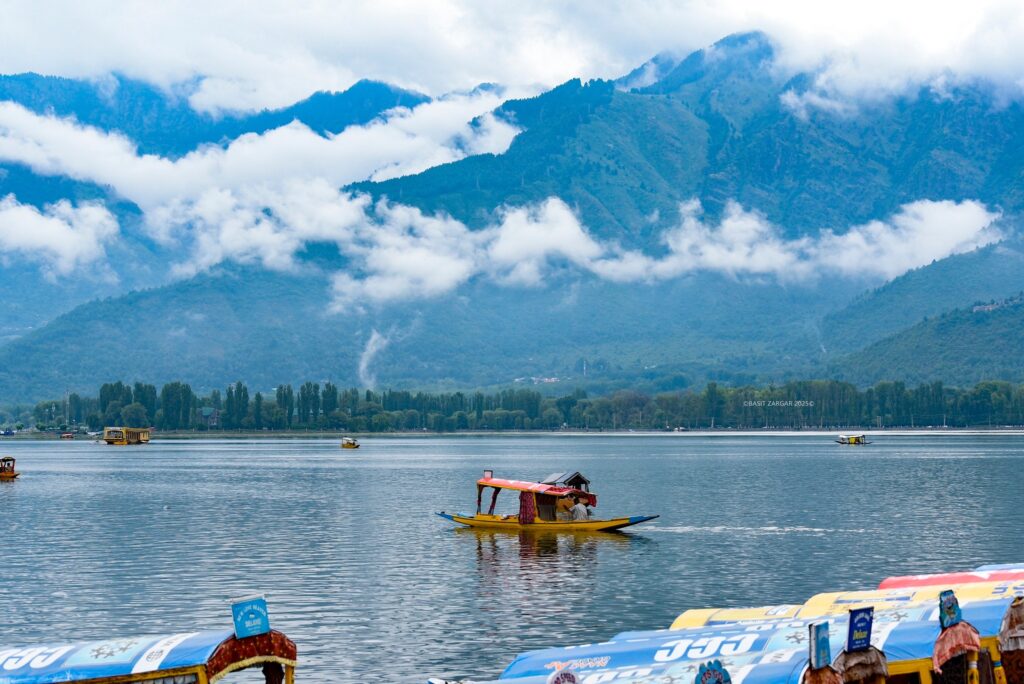
The two crown jewels of the valley, Dal Lake and Wular Lake, exemplify the struggle.
Dal Lake, the face of Kashmir’s tourism, has faced a long-standing battle with eutrophication—a process where excessive nutrients from sewage lead to rampant weed growth, depleting oxygen for fish. As of early 2025, the J&K Lake Conservation and Management Authority (JKLCMA) reported that while the lake remains a Grade ‘B’ water body, it is under constant pressure from the 1,200 houseboats and the sprawling settlements on its periphery.
Further north, Wular Lake, once one of Asia’s largest freshwater lakes, has seen its open-water area shrink significantly due to siltation and the historic planting of millions of willow trees which, while economically productive, disrupted the lake’s natural hydrology.
The Year of the Great Restoration
Recognizing the scale of the challenge, the government has pivoted toward a “mission-mode” approach. The 2024-25 and 2025-26 budget cycles have seen record allocations for water body rejuvenation.
- The Wular Revival: In March 2025, the government announced an allocation of ₹25 crore specifically for infrastructure and eco-tourism development around Wular Lake. More importantly, the Wular Conservation and Management Authority (WUCMA) has successfully restored 5.0 square kilometers of critically silted area by dredging over 78 lakh cubic meters of silt. This has notably increased the lake’s water-holding capacity for the first time in years.
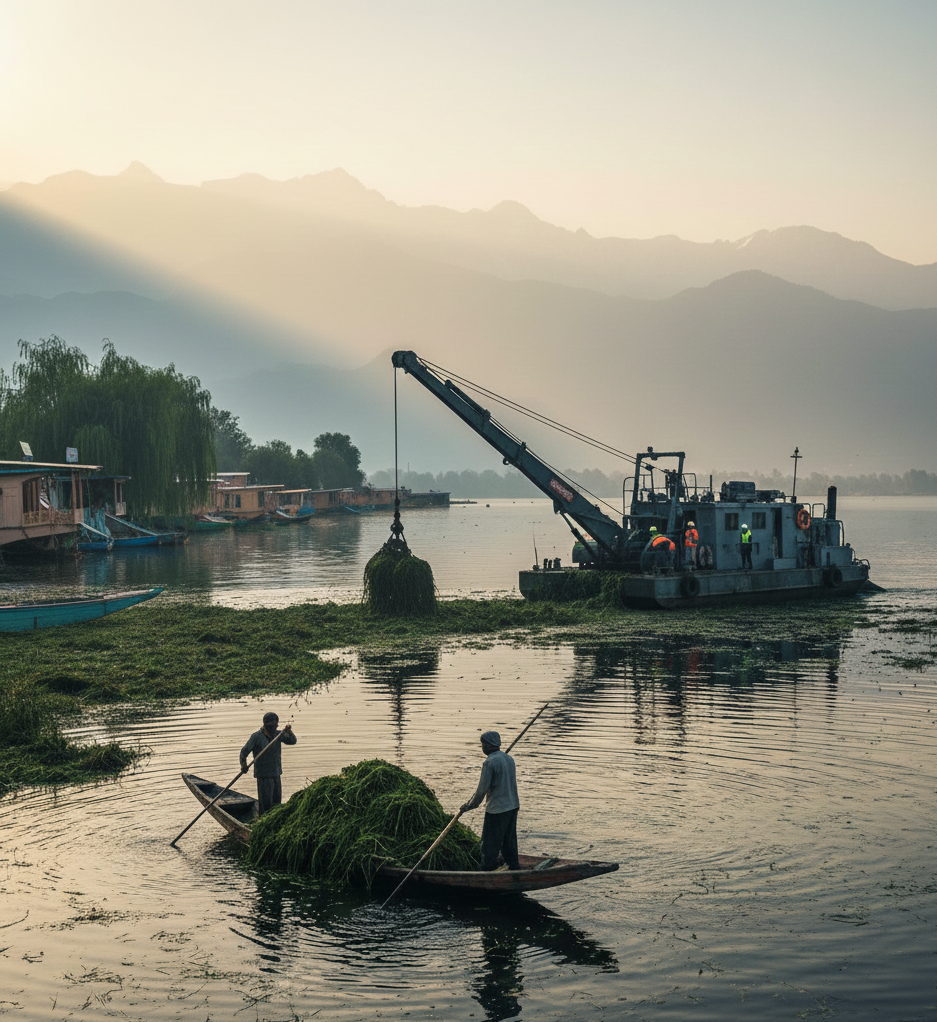
- The Dal Deep-Clean: In Srinagar, a massive dredging operation is currently underway. In a report submitted to the Legislative Assembly earlier this year, authorities detailed the cleaning of over 5,000 meters of navigation and outflow channels. Today, over 36 million liters per day (MLD) of sewage are being diverted to Treatment Plants (STPs), with more capacity in the pipeline to ensure the lake “breathes” again.
- AMRUT 2.0 and Beyond: Smaller, “forgotten” water bodies are also getting a second life. Under the AMRUT 2.0 mission, over ₹6 crore was sanctioned in late 2025 for the rejuvenation of Khuwansar and Sheikh Sar in Sumbal, and the Branwari storage tank in Kupwara. These projects aim to desilt and fence these bodies, protecting them from further encroachment.
The Climate Wildcard
While engineering and funding can address pollution and silt, the “Climate Wildcard” remains the hardest to manage. The Kolahoi Glacier, the primary source of the Jhelum, is retreating at an accelerated pace.
“The snowline is moving upward,” says an expert on Himalayan cryosphere. “We have lost nearly 25-30% of our glacier mass in sixty years. This means the streams run fast in the spring but vanish by mid-summer.”
This erratic flow has led to the drying up of over 250 natural springs across the valley. For the villagers who rely on these nags (springs) for drinking water, the extinction of a spring is more than an environmental data point—it is a threat to their ancestral way of life.
Conservation Through Community
The government’s 2025 strategy focuses on a crucial shift: making the local community the “guardians” of the water rather than just observers.
In Wular, the government has engaged local youth as “eco-guides” and is transforming villages like Zurimanz and Watlab into hubs for sustainable Shikara tourism. In the Dal, there is a push to fit houseboats with modern bio-digesters. The philosophy is simple: if the water thrives, the economy thrives.
“We cannot save the lake by keeping the people away from it,” says a senior official from the Forest and Environment Department. “We have to show the community that a clean Wular or a healthy Jhelum provides more fodder, more fish, and more tourists than a silted-over plot of land ever could.”
The Road Ahead
The “extinction” of Kashmir’s water bodies is no longer a certainty; it is a choice. The path taken in 2025—marked by scientific dredging, strict demarcation of boundaries using GPS technology, and massive investment in sewage infrastructure—suggests that the tide may be turning.
However, environmentalists caution that “cosmetic beautification” is not enough. The goal must be the restoration of the natural water cycle. This means protecting the high-altitude catchments, reforesting the hills to prevent siltation, and ensuring that every drop of sewage is treated before it meets the river.
As the sun sets over the Dal, casting a golden hue on the newly cleared navigation channels, there is a sense of cautious optimism. The blue veins of Kashmir are fragile, but they are pulsing with new effort. The story of the valley’s water is currently being rewritten—not as a tragedy of loss, but as a testament to resilience and restoration.
Leave a Reply