Against the backdrop of mountains, orchards, and border villages, a poetic symposium in Kupwara turned a remote classroom into a vibrant space for verse, reflection, and cultural exchange.
By Rayees Ahmad Kumar
Kashmir has long occupied a cherished place in literature and memory for its natural beauty and temperate climate. Poets and writers across generations have returned to the valley in their imagination, drawn by its green meadows, flowing rivers, and clear waters that mirror the surrounding mountains. Spread across ten districts, the valley’s geography is as varied as its cultural life. North Kashmir, comprising Bandipora, Baramulla, and Kupwara, forms the frontier region, with Kupwara sharing the longest stretch of the Line of Control at nearly 170 kilometres. Carved out of the erstwhile Baramulla district in 1979, Kupwara lies at the extreme northern edge of Jammu and Kashmir, about 110 kilometres from Srinagar, nestled between the Pir Panchal and Shams Bari ranges. These mountains cradle lush pastures and alpine meadows that sustain cattle and sheep and are crossed by historic passes such as Sadhna, Farkiyan Gali, and Nagmarg, which open into the scenic valleys of Karnah, Keran, and Drass areas.
Despite its strategic location and rugged terrain, Kupwara remains one of the most visually arresting parts of the valley, though it often stays outside the regular cultural circuits. My own familiarity with this frontier district was limited until a recent invitation arrived from Showkat Saqib Poshpoori, president of the Cultural Forum Kupwara, who had taken the initiative to organise a poetic symposium at Dream World Educational Institute in Allachizab. The idea of poets from across Kashmir gathering in a border district to celebrate language and verse was compelling enough to draw me there.
The journey itself offered a reminder of Kashmir’s quiet elegance. Leaving early in the morning, I reached Qazigund railway station well before the Baramulla-bound train departed. From Sopore, a shared sumo carried passengers towards Kupwara along a well-maintained road flanked by apple orchards heavy with fruit and expansive paddy fields stretching towards the hills. The forty-kilometre drive passed quickly, the landscape unfolding in calm layers of green and grey. By midday, Kupwara town came into view, unhurried yet lively, reflecting the rhythm of a district that balances remoteness with resilience.
After a brief pause for tea and directions, another short drive took me to Allachizab, where the school campus had been transformed into a hub of literary activity. Volunteers were busy with final arrangements as guests arrived from different parts of the valley. The warmth of the reception was immediate and genuine, underscoring the enthusiasm with which the local community had embraced the event.
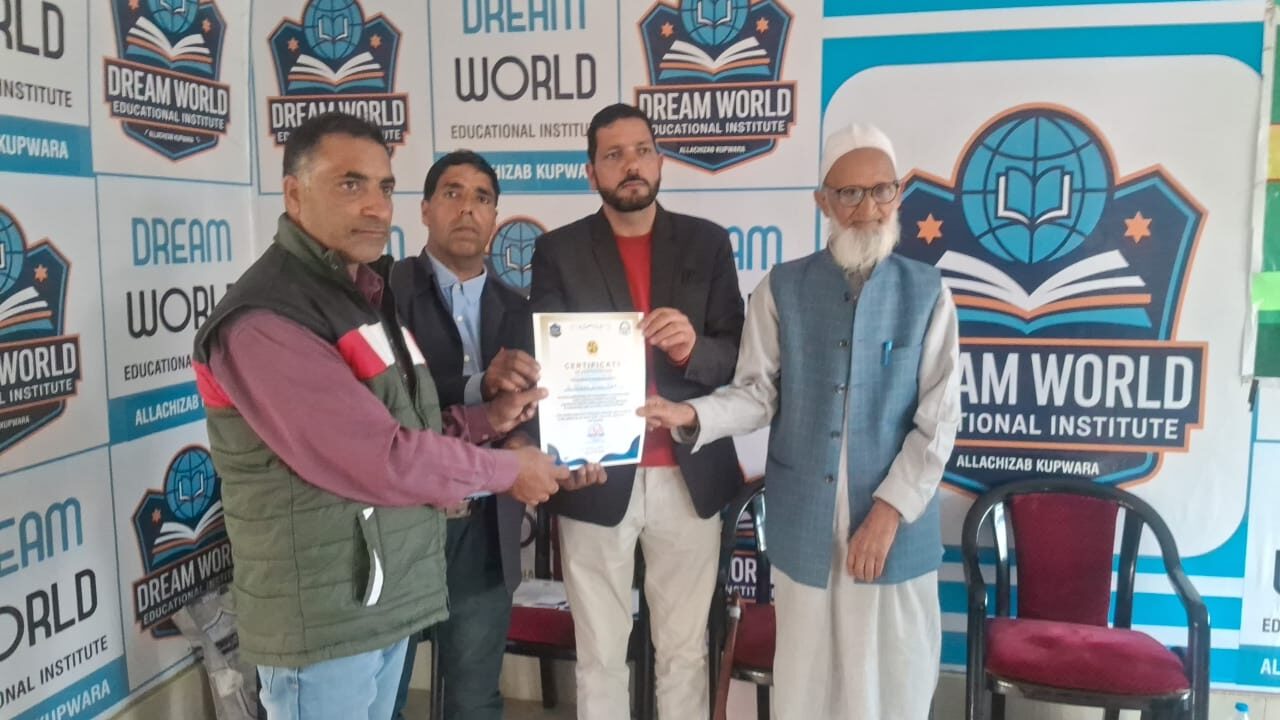
In keeping with Kashmir’s cultural traditions, the programme opened with a recitation from the Quran by a young student, followed by translations into English, Urdu, and Kashmiri. The blend of languages set the tone for an evening rooted in tradition yet open in expression. This was followed by a naat rendered with confidence and feeling by two students, drawing appreciative attention from the audience. The presidium was then announced, with noted poet and academician Abdul Aziz Mastana presiding over the function, the school principal Naseer Ahmad Bhat as chief guest, and myself accorded the role of guest of honour.
What followed was a rich sequence of poetic voices that reflected the diversity of North Kashmir. Abdul Hameed Kataria from the border village of Teetwal opened the recitations, his cheerful delivery and melodic cadence immediately engaging the audience. Aliyas Arman from the Lolab valley presented a thoughtful and evocative poem that drew upon the lyrical tradition associated with the region, known for inspiring some of the finest verses in Kashmiri and Urdu poetry. Nazir Parwana followed with a carefully crafted romantic Kashmiri ghazal that resonated across the hall and earned sustained applause.
Showkat Saqib Poshpoori himself took the stage with a reflective poem in Kashmiri that carried echoes of the progressive literary tradition of the valley, inviting listeners to reflect on contemporary realities through a classical lens. Aadil Tariq Lolabi recited a ghazal on life that balanced philosophical depth with emotional clarity, while Masoom Maqbool offered an odic poem dedicated to Allachizab, weaving local imagery into a broader cultural narrative. The audience responded warmly as Moomin Bashir and Syed Wasil presented their verses, each adding a distinct tonal quality to the evening.
Another poem by Aadil Tariq Lolabi, this time on the significance of time, drew particular appreciation for its introspective approach and stylistic maturity. When my turn came, I recited an ode to the chinar, a tree that stands as a cultural and emotional symbol of Kashmir, linking memory, landscape, and identity. The programme also featured recitations by Rahat Falahi, Ghulam Hassan Banhama, and Ghulam Rasool Malik Trehgami, rounding off a line-up that reflected both experience and emerging talent.
Beyond the poetry, the event carried a larger message about the role of educational institutions in sustaining literary culture. In their concluding remarks, Abdul Aziz Mastana and Naseer Ahmad Bhat emphasised the importance of holding such programmes within schools to cultivate sensitivity, expression, and critical thinking among students. They assured continued institutional support for future initiatives aimed at nurturing a reading and writing culture.
As the symposium drew to a close, Showkat Saqib Poshpoori thanked the poets, guests, students, and organisers for their collective effort in making the programme a success. His initiative stood as a reminder that even in frontier districts often defined by geography and security concerns, literature continues to find space to breathe, connect, and inspire. In Kupwara, amid mountains and meadows, poetry once again proved its quiet power to bring people together and affirm a shared cultural inheritance.
The views expressed in this article are solely those of the author and do not necessarily reflect the opinions or views of this newspaper
Leave a Reply