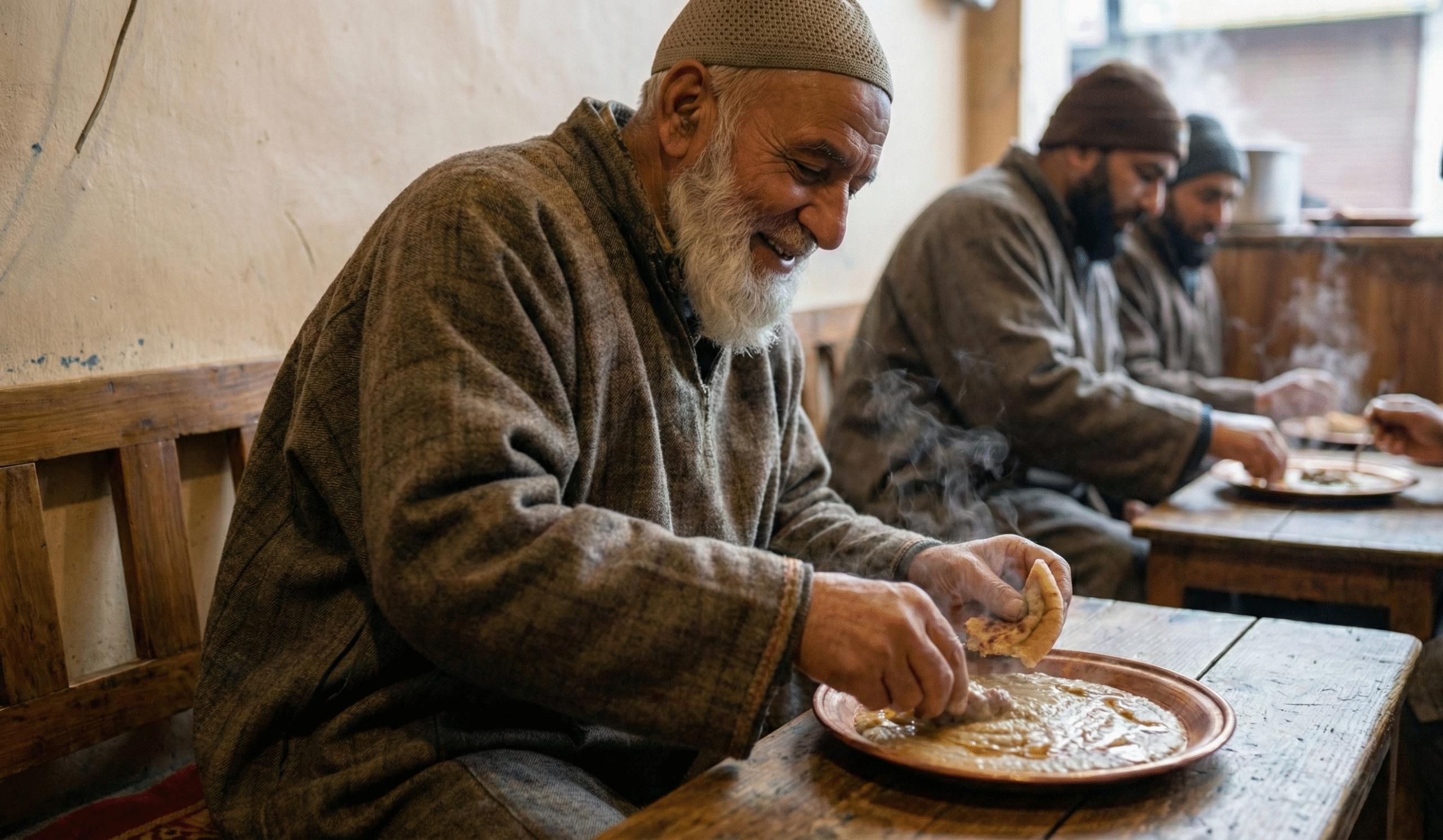
The Silk Road didn’t just bring goods; it brought flavors. Discover how Persian traders influenced one of Kashmir’s most iconic dishes. It’s a story of history, heritage, and the 40 harshest days of winter.
By Aubaid Akhoon
As the first heavy snows of Chillai Kalan—the harsh, forty-day period of intense cold—descend upon the Kashmir Valley, a transformation occurs within the labyrinthine alleyways of downtown Srinagar. While the city shivers under a blanket of white, a centuries-old culinary ritual begins to stir in the pre-dawn darkness, promising not just sustenance, but a spiritual fortitude against the biting frost. This is the season of Harisa, a dish that is far more than a mere breakfast; it is a cultural institution, a winter survival strategy, and a flavorful testament to a history that stretches back through the mists of time along the Silk Road.
To the uninitiated, the name might conjure images of the fiery red pepper paste native to North Africa. However, the Kashmiri Harisa is a distinct, mild, and profoundly comforting entity—a glutinous, slow-cooked pottage of meat, rice, and spices that shares its lineage with the famous Harisa of South Iran. The connection is not coincidental; it is a culinary echo of the Persian influence that permeates Kashmiri culture. In the bustling markets of South Iran, artisans known as Harisa-Paz or Harisa-Gar still meticulously boil bruised wheat to a perfect consistency, enriching it with mutton, butter, and cinnamon. It is a masterpiece of texture and patience, qualities that were carried over the mountain passes by Persian-speaking traders and travelers who traversed the Silk Road, threading through Leh to connect Persia with the verdant valley of Kashmir.
The pedigree of this dish is ancient and distinguished. Culinary historians trace the first written mention of Harisa to the 10th century, appearing in the pages of Kitabul Tabik (The Book of Cooking) by Abu Muhammad Ibn Sayyar, a text dating back to the Abbasid Caliphate. From these early Arab kitchens, the dish migrated, evolving in texture and technique as it traveled across the Middle East and Central Asia. In Kashmir, the specific genesis of the dish is often attributed to the 14th-century influence of Mirza Hyder Duglat of Yarkand, a noble who brought Central Asian customs to the region. Yet, it was during the era of Afghan rule in Kashmir that Harisa is believed to have calcified into its present, indispensable form—a breakfast of champions designed to fuel the body for the arduous winter day ahead.
To witness the creation of this gastronomic gem is to observe a labor of love that defies the modern demand for instant gratification. The preparation is a nocturnal marathon that begins in the early afternoon, long before the customers awake. In the dimly lit kitchens of Srinagar’s old city, the Harisa-gor (makers) select the finest cuts of mutton, chopping them with a rhythmic precision. By 10:00 PM, while the rest of the valley retreats under heavy quilts, the meat is placed into colossal earthen pots to embark on a slow-cooking journey. It is joined by a porridge of short-grained Kashmiri rice, water, and a symphony of aromatic spices: fennel seeds, cinnamon sticks, green and black cardamom, cloves, and crisply fried local shallots.
As the night deepens, the magic happens. Around 1:00 AM, the narrow-necked earthen vessels are sealed, trapping the steam and flavors, allowing the ingredients to meld in hermetic harmony. The cooks take a brief respite, but the work is far from over. As the winter clock strikes 4:30 AM, the pots are unsealed, releasing a cloud of redolent steam that wafts through the shuttered streets. The skeletal remains of the bones, now stripped clean by hours of heat, are carefully removed. What remains is transferred to large copper vessels for the most physically demanding phase of the process: the pounding.
This is the defining moment of Kashmiri Harisa. The mixture is beaten relentlessly with a long wooden masher until the distinct grains of rice and fibers of meat surrender their individual identities, fusing into a smooth, homogenous paste. The climax of this culinary theater involves the addition of smoking-hot mustard oil, which is kneaded into the blend until the texture reaches a specific, velvety elasticity. It is a process that requires both strength and finesse, a craft passed down through generations of families who guard their specific spice blends and techniques with fierce pride.
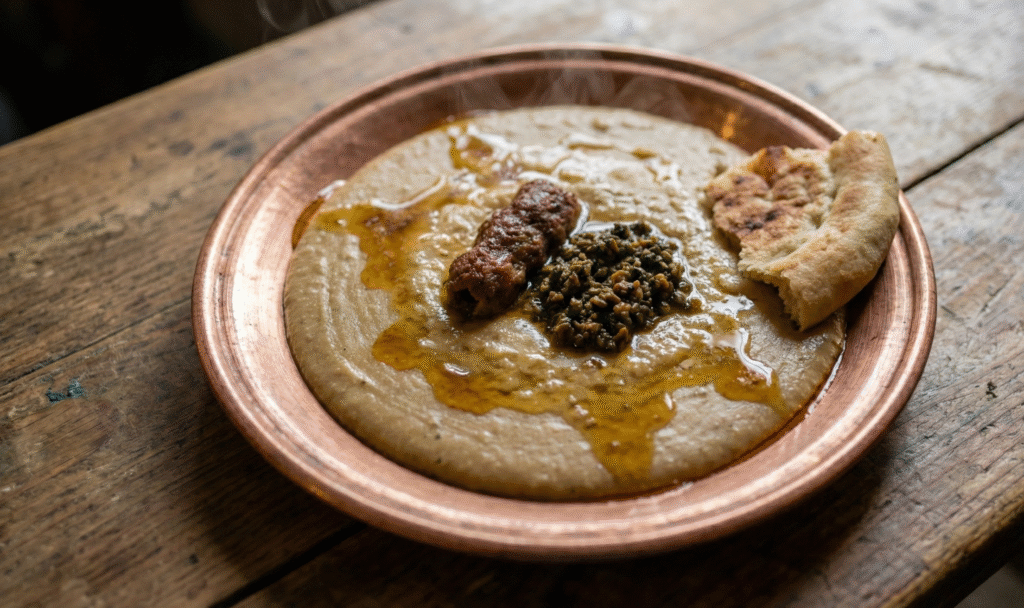
By daybreak, the establishments are hives of activity. Harisa is not a dish for the late riser; the finest pots are often scraped clean by 10:00 AM. Served on copper plates, the dish is a study in textures. A proper serving is never complete without its traditional accouterments: a sizzling temper of seasoned mustard oil, a succulent mutton kebab, and a topping of methi-maaz—finely minced sheep’s entrails simmered in ghee and fenugreek, which adds a complex, earthy bitterness to cut through the richness of the porridge. It is scooped up with pieces of girda, a tandoor-baked bread that acts as the perfect vessel.
For the true connoisseurs—the elders who have frequented these shops for decades—the prize is the phuher (or Harisa Phur), the golden-brown, caramelized crust gently scraped from the base of the pot. Rich, crunchy, and smoke-infused, it is a delicacy within a delicacy, often reserved for favored patrons or those lucky enough to ask at the right moment.
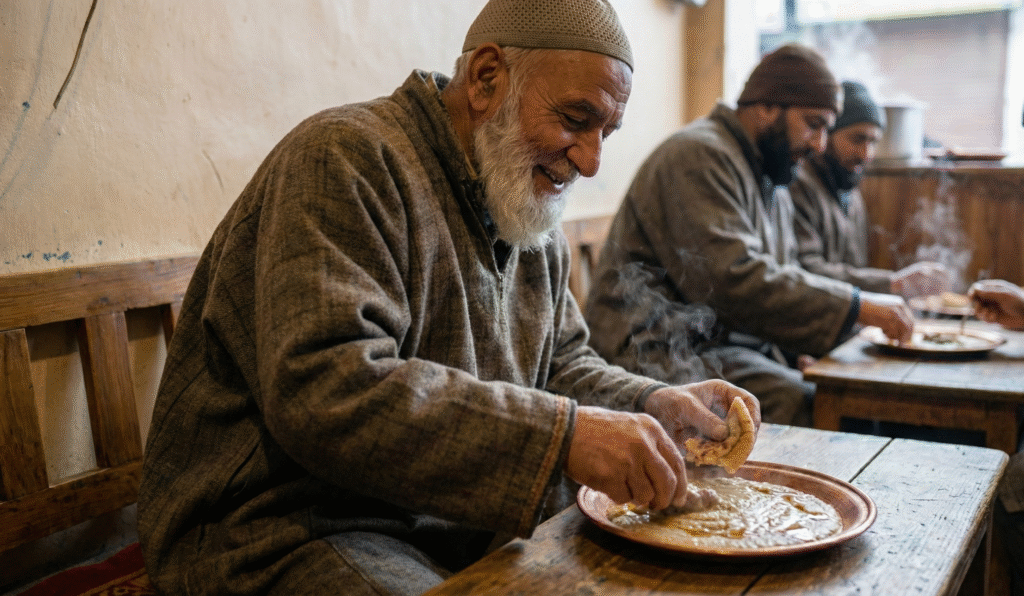
While modern cafes in the posh uptown neighborhoods of Srinagar have begun to incorporate Harisa into their winter menus, offering a sterilized version of the experience, the soul of the dish remains in the downtown “shab-deg” shops. Here, amidst the steam and the clatter of copper, strangers sit shoulder to shoulder on wooden benches, united by the warmth of the food and the camaraderie of the season. It is a social equalizer, enjoyed by the wealthy and the working class alike.
Ultimately, Kashmiri Harisa serves as a poignant reminder that food is rarely just about nutrition. It is an edible artifact of history, preserving the legacy of the Silk Road and the Afghan influence in every bite. As the wintry chill envelops the valley and the fog settles over the Dal Lake, the redolent essence of Harisa drifting through the bazaars offers a comforting continuity. It tells the story of a people who have learned not just to endure the winter, but to celebrate it, turning the coldest months into a season of warmth, community, and unparalleled flavor.
The views expressed in this article are solely those of the author and do not necessarily reflect the opinions or views of this newspaper. The author can be reached at [email protected]
Leave a Reply