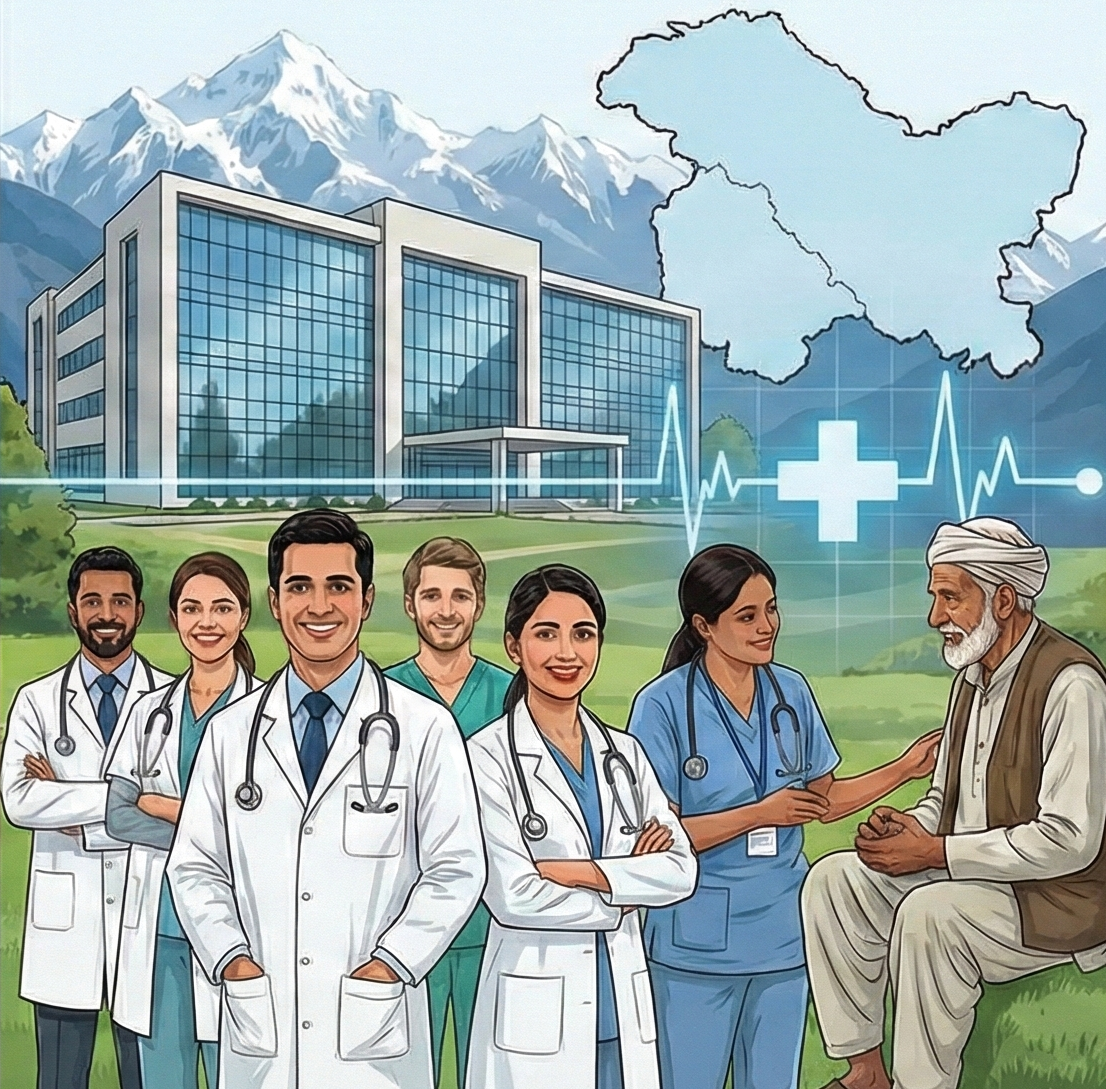
From village wellness centres to world-class tertiary hospitals, J&K is steadily emerging as a medical hub, reducing patient migration and strengthening health outcomes through large-scale infrastructure and human resource expansion.
By Ajaz Rashid
For decades, the narrative surrounding healthcare in Jammu & Kashmir was one defined by geography and scarcity. In the remote folds of the Pir Panjal or the far-flung reaches of Kupwara, a medical emergency often meant a perilous journey to Srinagar or Jammu, and for complex cases, an expensive exodus to Chandigarh or Delhi. The tyranny of distance, compounded by harsh winters and difficult terrain, often dictated patient outcomes. However, a quiet but massive revolution has been unfolding across the Union Territory, fundamentally altering this equation.
Over the past few years, Jammu & Kashmir has been the canvas for one of the most aggressive healthcare infrastructure expansions in the country. Through strategic interventions by the Ministry of Health & Family Welfare (MoHFW) and sustained support from the Government of India, the region is shedding its image as a healthcare deficit zone. It is steadily positioning itself as an emerging medical hub, characterized by a sophisticated “hub-and-spoke” model that connects village-level wellness centres to world-class tertiary institutions.
The Twin Pillars of Excellence
At the apex of this transformation stands the establishment of two All India Institutes of Medical Sciences (AIIMS), a move that signals the integration of J&K into the nation’s elite healthcare map. This serves as a definitive statement that high-quality healthcare is a right, not a privilege reserved for metropolitan India.
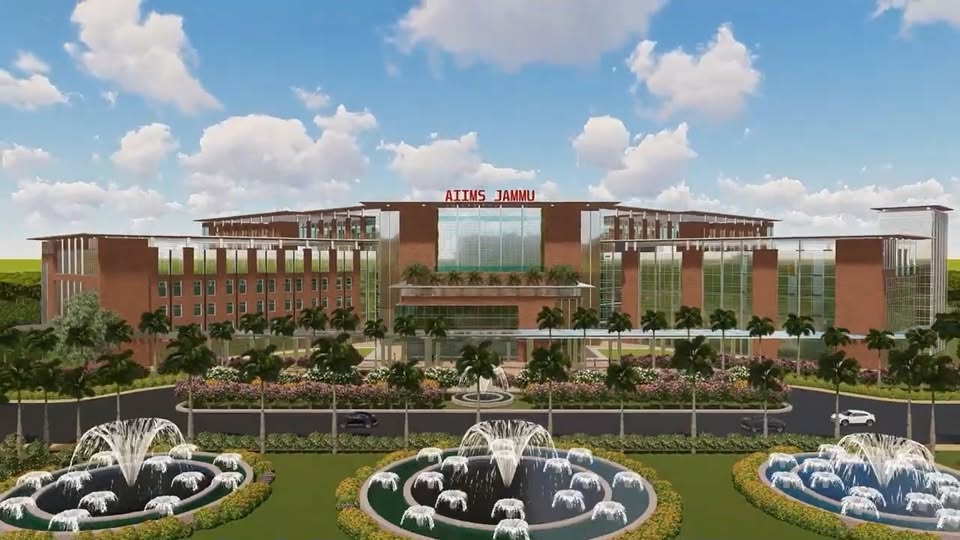
AIIMS Jammu, which is now fully operational, serves as the southern anchor of this new ecosystem. It has introduced advanced diagnostic, surgical, and critical care facilities that were previously unavailable in the region. The impact is already visible; the stream of patients seeking referrals to institutions outside the UT is being stemmed. More than just a hospital, AIIMS Jammu has emerged as a centre of excellence for medical education and research, promising to churn out homegrown solutions for regional health challenges.
Complementing this is AIIMS Kashmir, currently nearing completion and slated to become operational by the end of the year. Once the doors open, it is expected to revolutionize advanced healthcare in the Valley, specifically in super-specialties such as oncology, cardiology, and neurology. Together, these two institutions represent a long-term investment in equitable healthcare, ensuring that regardless of whether a patient is in the plains of Samba or the highlands of the Valley, world-class care is within reach.
Decentralizing Care
While AIIMS grabs the headlines, the true structural shift lies in the democratization of medical education and secondary care. The days when the Government Medical College (GMC) in Srinagar and its counterpart in Jammu were the sole titans of healthcare are over. The administration has successfully operationalized a decentralization strategy that has seen the number of medical colleges triple.
From a mere four institutions a few years ago, the UT now boasts twelve medical colleges. This expansion has taken root in districts that were historically underserved, including Anantnag, Baramulla, Kupwara, Kathua, Doda, Udhampur, and Rajouri.
The significance of placing medical colleges in these specific locations cannot be overstated. A medical college in a place like Doda or Rajouri does more than teach students; it functions as a tertiary care hospital for the district, bringing specialists, advanced diagnostics, and emergency services to the doorstep of border and rural populations. It anchors the local healthcare system, reducing the load on the capital cities and ensuring that critical time is not lost in transit during emergencies.
Furthermore, the state has embraced a holistic approach by strengthening traditional systems of medicine. The establishment of AYUSH institutions, including the Government Ayurvedic College, Government Unani College at Ganderbal, and the Government Homeopathic College at Kathua, offers the public diverse and affordable healthcare options, integrating ancient wisdom with modern delivery systems.
Homegrown Healers
Infrastructure without manpower is merely concrete; it is the human capital that breathes life into a healthcare system. Historically, J&K suffered from a chronic shortage of doctors and specialists, a gap that is now being aggressively bridged through a historic increase in medical education capacity.
The figures are startling. The number of MBBS seats in the UT has surged from 500 to 1,725, an addition of over 1,200 seats. This ensures that the next generation of doctors serving J&K will largely be sons and daughters of the soil, familiar with the local language and cultural nuances.
Perhaps even more critical for the quality of care is the expansion of postgraduate and super-specialty seats, which have risen from 513 to 802. In a move to facilitate continuous learning for in-service doctors, Diplomate of National Board (DNB) seats have witnessed an exponential rise from a negligible 20 to 438. This allows doctors already working in the system to receive advanced training without leaving the UT, creating a cycle of constant upskilling.
The ecosystem is further supported by a massive push in allied health education. Recognizing that doctors are only one part of the equation, the administration has ramped up B.Sc. Nursing seats from 685 to over 3,000, and Paramedical seats from 78 to nearly 1,900. With the introduction of M.Sc. Nursing programmes, the region is ensuring a steady supply of highly trained nurses, technicians, and pharmacists—the essential backbone of effective healthcare delivery.
Fortifying the Grassroots
While super-specialty hospitals handle the complex cases, the war against disease is often won or lost at the primary level. The government’s strategy has been to saturate the grassroots with accessible care points.
The transformation of primary healthcare is best exemplified by the expansion of Health & Wellness Centres. Their numbers have skyrocketed from 130 to 3,166. These are not just dispensaries; they are the first point of contact for comprehensive primary care, focusing on preventive health, screening, and management of chronic conditions at the village level.
To ensure that financial constraints do not debar access to medication, the network of Jan Aushadhi Kendras has been expanded from 47 to 307, providing quality generic medicines at affordable prices. For patients battling chronic and critical illnesses like cancer or kidney disease, 24 AMRIT Pharmacies have been established to reduce the crushing burden of out-of-pocket expenditure.
Connectivity, a perennial challenge in the mountainous terrain of J&K, has been addressed through the expansion of the ambulance fleet. The 102/108 service now operates 489 vehicles. In remote, hilly terrains where every minute counts, this strengthened emergency response network is proving to be a lifesaver, effectively bridging the distance between a patient in distress and the nearest hospital.
Concrete Commitments
Several large-scale infrastructure projects, currently in advanced stages of development, underscore the scale of this modernization drive. Supported by the Government of India, these projects target specific demographic vulnerabilities.
Maternal and child health has received a significant boost with the construction of a 243-bed modern Labour Block at SMGS Hospital in Jammu and a 100-bed Mother & Child Hospital in Lamberi, Rajouri. The latter is particularly significant as it caters to border populations who have long operated under the shadow of volatility. Additionally, a 125-bed district-level facility in Budgam is nearing completion, promising to decapitate the healthcare pressure in that district.
Under the PM-ABHIM scheme, the focus has shifted to resilience against future health crises. Seventeen Critical Care Blocks are being established across the UT, designed to enhance emergency services and ensure that the healthcare system can withstand shocks, be they pandemics or mass-casualty events.
Specialized healthcare has also seen targeted interventions. The operationalization of State Cancer Institutes and Bone & Joint Hospitals in both Jammu and Srinagar, alongside a fully functional 500-bed Pediatric Hospital in Srinagar, ensures that specific high-burden diseases are treated in dedicated, state-of-the-art facilities. Even the transient but massive population of pilgrims is being cared for, with 100-bed hospitals established at Baltal and Chandanwari to serve those undertaking the Amarnath Yatra.
The Verdict in Data
The true measure of these billions of rupees in investment and tons of concrete is, ultimately, human life. On this front, the data suggests that the reforms are working.
The health indicators of Jammu & Kashmir have shown a marked improvement, reflecting the cumulative impact of these initiatives. The Infant Mortality Rate (IMR) has seen a sharp decline from 22 to 14, a statistic that represents thousands of newborns surviving who previously might not have. Furthermore, the Sex Ratio at Birth has improved from 927 to 976, a societal and medical victory that underscores significant progress in maternal and child healthcare.
A Model for the Future
The narrative of healthcare in Jammu & Kashmir has shifted from one of desperation to one of aspiration. The comprehensive expansion, spanning from the high-tech corridors of AIIMS to the village Wellness Centre has positioned the UT as a model for healthcare transformation in India.
Backed by robust support from the central government, these initiatives have done more than just address existing gaps; they have laid a foundation for a self-reliant, resilient, and equitable system. As new colleges churn out doctors and new hospitals open their doors, the people of Jammu & Kashmir are witnessing the fulfillment of a vital promise: accessible, affordable, and reliable healthcare, comparable to the best in the country. The “Emerging Medical Hub” is no longer just a slogan; it is a rapidly crystallizing reality.
Leave a Reply