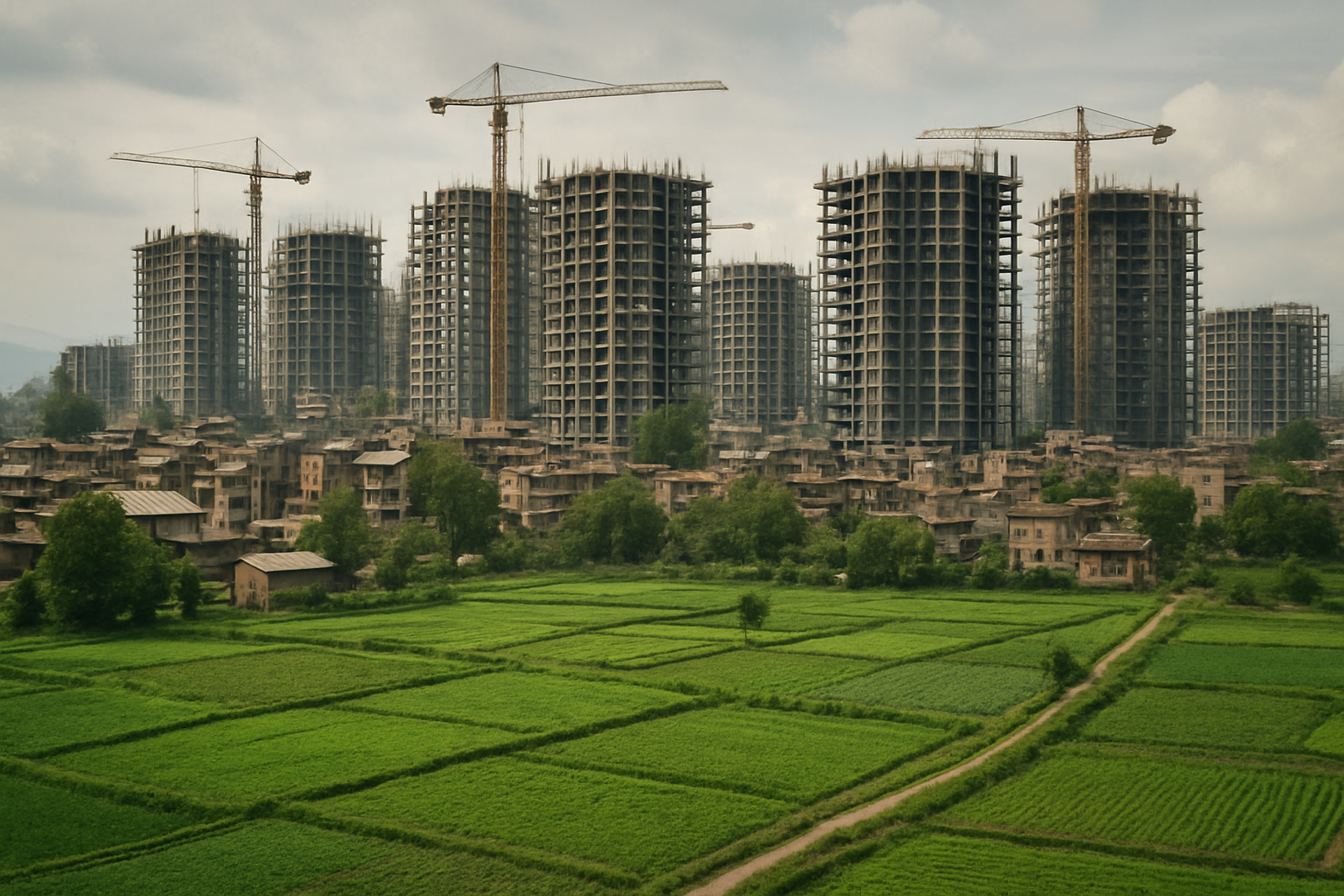
Unregulated construction is swallowing Kashmir’s farmland, reshaping its landscape and future.
By Ajaz Rashid
The landscape of Jammu and Kashmir is undergoing a profound shift—one that is visible in the fast-rising concrete structures, disappearing paddy fields, and orchard land flattened to make way for shopping complexes and residential colonies. What was once a region defined by its vast agricultural valleys and ancient irrigation systems is now caught in a race toward unplanned urbanization. And in this race, farmland is losing.
Over the past decade, Jammu & Kashmir has witnessed an unprecedented conversion of agricultural land, reshaping both its geography and its economy. Fresh data from government departments and independent studies reveals an alarming pattern: more than 40,000 hectares of agricultural land have vanished in ten years. is threatening food security, rural livelihoods, and environmental stability.
A Region Losing Its Fields
The latest figures from the Directorate of Economics & Statistics show only 6.8 lakh hectares of land currently under cultivation, a sharp decline from over 8 lakh hectares in the early 2000s. The region is losing 3,000 to 4,000 hectares annually to non-agricultural use.
Budgam, Pulwama, Baramulla, Anantnag, and parts of Jammu’s expanding peripheries have emerged as hotspots of unchecked land conversion. Revenue records and building permission data show a spike in applications for commercial and residential construction on what was, until recently, highly productive farmland. Satellite imagery adds another layer to the story: multi-storey buildings, clustered colonies, and roadside malls now dominate what once were orchards and rice paddies.
Farmers, planners, and environmental scientists all echo the same concern—J&K is sleepwalking into a land-use crisis.
The Lure of a Quick Profit
A booming real-estate market is one of the most potent drivers of this transformation. Near Srinagar, land prices have skyrocketed—doubling in the past three years—creating irresistible incentives for landowners to sell. Developers tout this surge as evidence of economic growth, arguing that J&K is finally catching up with the infrastructure and housing demands of a changing society.
But beneath the glittering promise of malls and gated colonies lies a more complex, often painful reality.
Rural households—especially small farmers—often sell their land without long-term planning. Once the money is spent, they struggle to find stable work. Sharecroppers and landless labourers, dependent on fields now erased from the map, lose their only source of income.
“We see a profit in the short run, but what happens after that?” asks Ghulam Rasool, an orchardist. Pointing to a row of newly built warehouses, he recalls, “Three years ago, this entire stretch was full of apple and walnut trees. Our youth now do odd jobs. Farming is being lost as a tradition.”
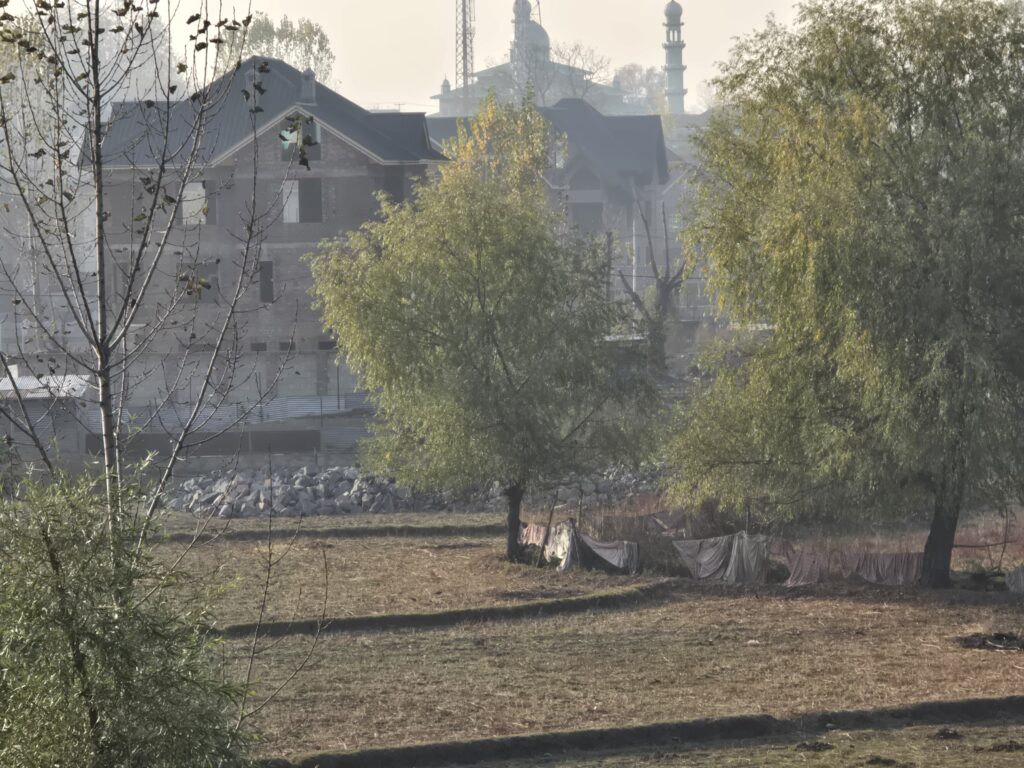
In Jammu’s R S Pura belt, paddy farmer Brijesh Kumar describes how land conversion usually begins “piecemeal”—a small residential plot here, a warehouse there—until an entire agricultural zone morphs into unplanned settlement. “We are losing the fields quietly, silently,” he says, “and with them, our future.”
Urban Aspiration, Rural Uncertainty
Part of the construction boom stems from an aspirational shift. More families are seeking modern housing; institutions—universities, private hospitals, coaching hubs—are expanding; and migration to urban clusters is increasing. Yet J&K’s planning mechanism has not kept pace.
Urban planners warn that poorly executed township policies, delays in updating land-use maps, and a fragmented governance structure have made enforcement nearly impossible. In many cases, homeowners bypass complex zoning approvals through bribes or collusion with officials. The result is a construction pattern that is chaotic, horizontal, and environmentally damaging.
Environmental Fallout
The environmental implications are profound. Wetlands and open fields—once critical for groundwater recharge—are being rapidly built over. The loss of these natural buffers increases the risk of flooding, especially in low-lying areas of Srinagar. The memory of the 2014 floods, where encroachments and blocked drainage intensified destruction, remains a stark warning. Yet construction continues unabated along floodplains and water channels.
Climate experts argue that the shrinking of agricultural and green areas is altering local microclimates. Heat retention has increased around urban clusters, rainfall patterns are shifting, and the region’s hydrological balance is being disrupted.
Food security, too, is under quiet threat. Kashmir, renowned for its apples, rice, and saffron, is steadily increasing its dependence on food imports. Despite improved technologies, the net sown area has stagnated in many districts. With the population rising and farmland shrinking, a critical question looms: will J&K be able to grow enough to feed itself in the coming decades?
Is Sustainable Development Still Possible?
Experts argue it is—but the window is narrowing.
There is growing consensus around the need for a multi-pronged strategy, combining enforcement with incentives:
- Complete modernization of land records, with digital maps accessible to the public
- Transparent and accountable building permissions, subject to community and environmental review
- Incentives to preserve farmland, such as tax breaks, crop insurance expansion, and assured procurement
- Vertical housing models to reduce land consumption
- Stronger coordination among revenue, agriculture, environment, and planning bodies
Unless these systemic reforms are implemented, the economic and ecological costs will accumulate rapidly.
A Landscape at a Crossroads
The current trajectory of land-use change in Jammu and Kashmir is more than an administrative challenge—it is a cultural turning point. Fields and orchards are not only economic assets; they are part of the region’s identity, folklore, and shared memory.
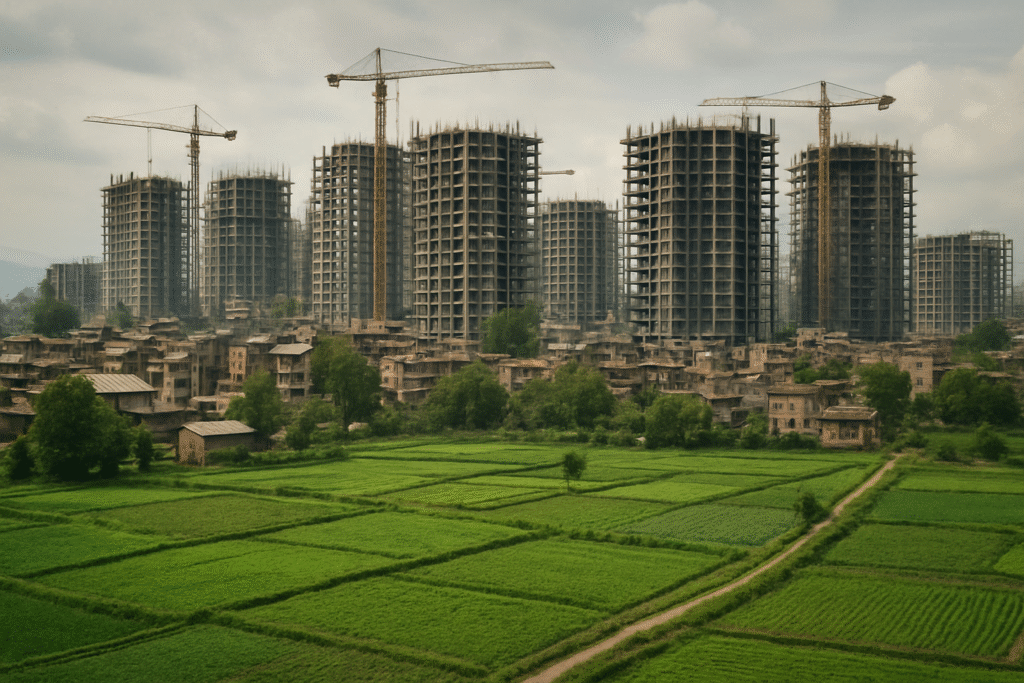
If the present pace of unregulated construction continues, J&K risks losing not just its agricultural base but the social fabric woven through rural life. The concrete rising across former paddy plains symbolizes both aspiration and anxiety—a push toward progress that may, if left unchecked, undermine the very foundations of sustainable growth.
The region stands at a decisive moment. J&K can choose to shape its urban transition with vision, planning, and ecological prudence—or continue drifting toward a future where unplanned concrete jungles eclipse the storied landscapes that once defined it.
What emerges in the next decade will determine whether the region’s development story is one of balance and foresight—or a cautionary tale written atop fields that once fed its people.
Leave a Reply