India welcomed Russian President Vladimir Putin with a Kashmiri-infused state banquet and high-level talks aimed at reinforcing defence, energy and trade cooperation.
By Sameer Ahmad
Russian President Vladimir Putin’s two-day state visit to India concluded on Friday last week with a grand vegetarian state banquet at Rashtrapati Bhavan, where Doon Chetin made with Kashmiri morels and Sheermal from the Valley added a regional flourish to an otherwise pan-Indian culinary showcase. The visit, Putin’s first to India since Moscow launched its military offensive in Ukraine in 2022, underscored both sides’ intent to stabilise long-term strategic ties amid a shifting global order.
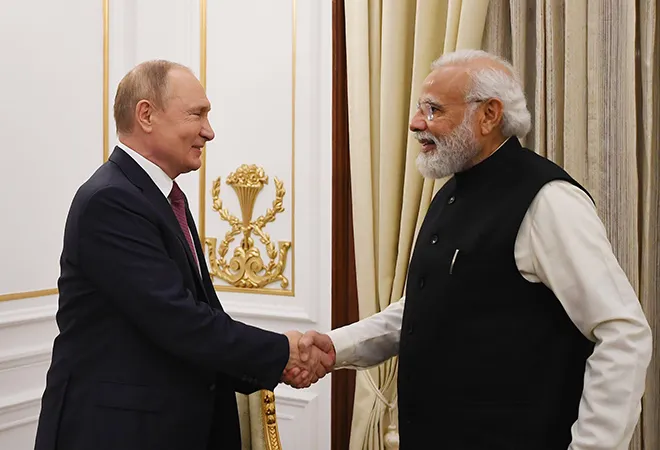
Putin arrived in New Delhi to a warm personal reception from Prime Minister Narendra Modi at the Palam Technical Area. The two leaders exchanged a long handshake and a hug before boarding the same vehicle, driving together to the Prime Minister’s residence at Lok Kalyan Marg for a private dinner—an unusually informal gesture that set the tone for the visit. The stopover also signalled an attempt by both sides to project continuity and trust in a relationship that has faced new geopolitical pressures.
Ceremonial Welcome and Key Meetings
On Friday morning, President Droupadi Murmu accorded Putin a ceremonial welcome at Rashtrapati Bhavan. The Russian President inspected a joint military guard of honour before joining Modi at Hyderabad House for summit-level talks. Officials said the discussions covered defence cooperation, nuclear energy, trade diversification, connectivity projects, and regional security—including the situation in Afghanistan, West Asia and the Indo-Pacific.
India reiterated its longstanding position calling for “dialogue and diplomacy” to end the conflict in Ukraine, while Russia pushed for deeper engagement on energy, industrial supplies, and technology cooperation. The leaders also reviewed progress on pending defence projects, including joint manufacturing initiatives under the “Make in India” framework, and discussed the expansion of rupee-ruble payment mechanisms to ease bilateral trade imbalances.
Putin later visited Rajghat and laid a wreath at the Mahatma Gandhi memorial—a symbolic gesture that Russia has upheld across decades of high-level visits.
Gifts That Spoke of Craft and Culture
As part of the traditional exchange of gifts, Modi presented Putin with items that blended India’s artisanal heritage with regional diversity. These included high-grade Assam black tea, handpicked Kashmiri saffron, a handcrafted silver horse, and a finely decorated tea set. Putin also received a Russian-language edition of the Bhagavad Gita, a nod to Indo-Russian cultural scholarship dating back to the Soviet era.
The gifting assortment echoed themes of craftsmanship, symbolism, and regional pride—particularly the inclusion of Kashmiri saffron, among India’s most prized spices and one that has historically found markets in Russia and Central Asia.
A Pan-Indian Banquet With a Kashmiri Heartbeat
The state banquet hosted by President Murmu on Friday evening became one of the standout moments of the visit, with Rashtrapati Bhavan unveiling an exclusively vegetarian menu that showcased regional cuisines from Kashmir to Kerala.
Among the most distinctive dishes was ‘Gucci Doon Chetin’, a delicacy made of stuffed Kashmiri morels—rare Himalayan mushrooms known for their earthy flavour—served with walnut chutney. The appetiser spread also featured Kaale Chane Ke Shikampuri, pan-grilled kebabs paired with mint sauce and sheermal, a lightly sweet saffron bread with deep roots in Kashmiri and Awadhi culinary traditions. A vegetable jhol momo inspired by Russian pelmeni added a fusion touch in honour of the visiting delegation.
The meal opened with ‘Murungelai Chaaru’, a comforting moringa leaf and moong bean broth, before moving to a main course centred on Zafrani Paneer Roll cooked in a saffron-infused sauce. Other dishes included Palak Methi Mattar Saag, Achaari Baingan, Tandoori Bharwan Aloo, and Yellow Dal Tadka, accompanied by dry-fruit saffron pulao and an array of Indian breads such as lachha paratha, missi roti, and magaz naan.
Dessert was a combination of Badam ka Halwa and Kesar-Pista Kulfi, complemented by fresh fruits. Traditionally festive snacks like murukku and gur sandesh were also placed on the table. A colourful set of beverages—ranging from pomegranate and orange coolers to carrot-ginger and beetroot juices—rounded off the dinner.
A Visit Amid Global Reconfigurations
The timing of the visit carried diplomatic weight. It came as major powers reposition themselves amid ongoing conflict in Ukraine, Middle East tensions, sanctions on Russia, and widening fractures between the West and Moscow. India, which has maintained a calibrated neutral stance, continues to source discounted Russian crude while increasing its exports of pharmaceuticals, chemicals, and agricultural products to Russia.
Bilateral trade crossed USD 65 billion in 2023–24, driven primarily by India’s crude imports, though India has repeatedly emphasised the need for correcting the trade imbalance and boosting exports. The two leaders reviewed steps to push trade towards sectors such as food processing, machinery, strategic minerals, and renewable technologies.
The visit also aimed to revive momentum in defence cooperation, once the strongest pillar of the partnership. While Russia remains India’s largest defence supplier, diversification and sanctions have slowed several projects. Officials familiar with Friday’s discussions said talks included joint manufacturing, long-pending spares supply, and updates on nuclear energy cooperation at Kudankulam.
Symbolism and Strategy Aligned
Although the visit was brief, it conveyed two clear messages: that New Delhi remains committed to a multipolar foreign policy, and that Moscow values India as a stable partner in Asia amid global diplomatic headwinds.
The blend of strategic dialogue and cultural hospitality—from saffron gifts to a carefully curated, region-spanning dinner—reflected an effort to showcase warmth while signalling continuity in one of India’s most historic bilateral relationships.
Leave a Reply