From the ancient epics of Mesopotamia to the modern classroom, poetry has always been the language of the human soul.

By Sahil Sharifdin Bhat
Every sane person carries a verse in their heart. Whether it is a fragment of a nursery rhyme, a line from a sacred text, or a couplet from a film song, poetry is the invisible thread that stitches our collective consciousness together. Orators use it to sharpen their rhetoric; religions use it to preserve the divine. If faith were to shed poetry, its transmission would likely wither within a generation.
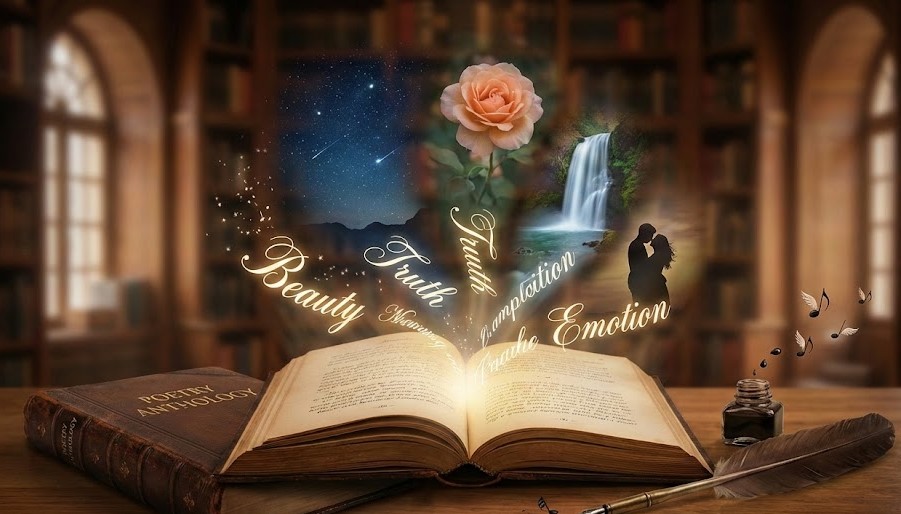
Poetry is not merely a genre of literature; it is the articulation of beauty itself. It is the art that touches the human heart when prose fails. It is found in the celestial sweep of a starry sky and the intimate sweat on a bride’s forehead; in the thunder of a waterfall and the quiet dimple on a child’s face. It is the “peace,” “magic,” and “medicine” that awakens slumbering communities and sheathes the swords of aggressive warriors.
As Franz Kafka famously noted, “Poetry is the axe to break the frozen sea within us.” Yet, despite its power to melt stones and deck withered lips with smiles, the teaching and appreciation of this art form are in crisis. To understand how to save it, we must first understand what we are losing.
A Legacy Older Than Ink
The history of poetry predates the written word. Long before humans developed writing systems in Mesopotamia 5,000 years ago, they were chanting verses to court lovers, march into battle, and lull infants to sleep.
The lineage is formidable. From the Tale of the Shipwrecked Sailor (c. 2500 BCE) and the Epic of Gilgamesh to the Indian epics of the Ramayana and Mahabharata, humanity has always documented its soul in verse. We see this continuity in the Iliad of Homer, the Aeneid of Virgil, and the pre-Islamic “Hanging Odes” (The Mu’allaqat) of Arabia.
In the West, the torch passed from the Greeks to the Romans, eventually igniting the English tradition. While the Old English period gave us the melancholic beauty of Beowulf and Caedmon’s hymns, the true flowering occurred later. A student of literature today walks a hall of giants: Chaucer, Shakespeare, Milton, Wordsworth, Keats, and Eliot.
However, a tragic cultural amnesia plagues the modern era. Long before the likes of Shakespeare or Wordsworth penned a line, the Islamic world was undergoing a poetic golden age. Visionaries like Omar Khayyam, Rumi, and Hafez were taking the world by storm, using verse to explore divine love and unity. Today, there is a disconnect; many have lost touch with this glorious heritage, just as many students of English literature struggle to find the pulse in the works of Shelley or Sylvia Plath.
The Pedagogy of Boredom
The root of this disconnect often lies in the classroom. Teaching is arguably the most challenging of professions, yet it is often treated as a fallback option.
There is a parallel to be drawn with religious instruction. It took the Prophet of Islam twenty-three years to impart his message to his companions, emphasizing patience and gradual understanding. In contrast, some modern religious figures attempt to convey everything in a single, fiery sermon, often with disastrous results. Unfortunately, many modern English teachers have adopted this “single sermon” approach.
Educationists and curriculum designers compound the problem by prescribing dry texts and demanding rote memorization. Students are asked to summarize stanzas and define difficult words, stripping the poem of its music. The goal should not be autopsy, but appreciation. We need students to feel the “spontaneous overflow of powerful feelings” that Wordsworth described, not just analyze the syntax.
A Blueprint for Revival
Having taught English poetry for over a decade, I have developed a methodology designed to move beyond the textbook and into the imagination. It is a three-act play: the Pre-active, the Interactive, and the Post-active.
- The Pre-Active Phase: Setting the Stage Great teaching requires architectural planning. Before entering the classroom, the teacher must define clear goals. The objective is never just “memorizing the poem.” It is about understanding literary devices, grasping the poet’s background, and fostering a genuine love for the art. This phase involves selecting appropriate aids—if a projector isn’t available, a smartphone can suffice to play a recitation or show an image. It involves preparing questions that spark curiosity rather than anxiety.
- The Interactive Phase: The Performance This is where the magic happens. The teacher must enter with a demeanor that invites engagement.
- The Hook: Start with a question about the students’ own lives that relates to the poem’s theme.
- The Sound: Poetry is an oral art. Recite the poem aloud first. Ask the students how it sounded before asking what it means. Encourage them to recite it, focusing on expression over comprehension.
- The Scansion and Denotation: Only after the rhythm is felt should the teacher break down the rhyme scheme and literal meaning.
- The Explanation: This is the deep dive. A teacher well-versed in literary criticism can peel back the layers of the poem, explaining the “connotations” behind the “denotations.”
- The Reflection: Allow silence. Let students read the poem quietly and ponder its beauty.
- The Post-Active Phase: The Mirror The lesson does not end when the bell rings. The teacher must engage in self-assessment. Did the students connect? Was the lesson plan effective? Seeking feedback from students is not a sign of weakness, but of a dedication to the craft.
The Infinite Library
We must remember that poetry takes many shapes. It is the narrative force of the Epic, the emotional intensity of the Lyric, the structure of the Sonnet, and the brevity of the Haiku. It is the wit of the Limerick and the freedom of Free Verse. From the “Visual Poetry” of concrete forms to the musicality of the Ballad and the Ghazal, there is a genre for every human temperament.
If judged by the cold metrics of science or economics, poetry may seem a futile exercise. It builds no bridges and cures no physical diseases. Yet, as Samuel Johnson noted, it is “the art of uniting pleasure with truth.”
Poetry delights, instructs, consoles, and commemorates. It captures the fleeting beauty of a sunset and the enduring pain of a loss. It is the food for the soul that enriches us ethically, intellectually, and spiritually. It is the vessel that has preserved our history, traditions, and values.
As long as a child sings a rhyme, or a teenager hums a song of heartbreak, poetry will not perish. But it is the duty of the teacher to ensure it does not just survive, but thrives—transforming the classroom from a place of rote learning into a sanctuary of “best words in the best order.”
The views expressed in this article are solely those of the author and do not necessarily reflect the opinions or views of this newspaper. The author can be reached at [email protected]
Leave a Reply