They called it the language of ghouls. History calls it the lost voice of Kashmir. Discover the true story of Pishachi, the ancient “ghost tongue” that defied kings, shaped the Bṛhatkathā, and remains the ancestral heartbeat of the Valley. It wasn’t magic—it was the mother tongue.
By Satish Mahaldar
In Indian linguistics, few threads are as mysterious or as misunderstood as Pishachi. Often relegated to the realm of folklore as the “language of goblins,” Pishachi was, in reality, a vibrant Prakrit language that once dominated the northwestern locale of India, specifically the Kashmir region. To truly comprehend the cultural bedrock of Kashmir, one must look beyond the pristine Sanskrit of the priestly class and into the rugged, enigmatic sounds of the mountains. Pishachi is not merely a linguistic footnote; it is a testament to the ancient aboriginal identity of the Kashmiri people and the Dardic ancestors who walked the Himalayas.
From the third century BC to the fourth century AD, the linguistic landscape of India was a study in contrasts. On one side stood Sanskrit, the refined, frozen language of the elite, the courts, and the gods. On the other were the Prakrits—the dynamic, evolving languages of the masses. Pishachi occupied a unique space in this hierarchy. Identified today as a progenitor of the Dardic languages (and a close relative of Pashto), Pishachi possesses a grammar, a vocabulary, and a literary corpus that grant it the undeniable status of a full language. The Indian Constitution of 1950 acknowledges Kashmiri, a descendant of this lineage, but to find the roots, we must look to the ancient “Pisacha Kingdom.”
Mythology often paints the Pishachas as ghouls or demons, but historical texts like the Mahabharata ground them firmly in reality. The Pishachas were mountain dwellers, fierce clansmen of the northwest who allied with Duryodhana in the great Kurukshetra war under the banner of Bhagadatta. They were not supernatural entities but a distinct ethnic group with a martial history, fighting alongside the Huns and Nishadas. It was Sir George Grierson, spearheading the monumental Linguistic Survey of India, who famously demystified the “demonic” label. Grierson argued that the term “Pishacha” was essentially an ancient “othering” strategy—a derogatory nickname given by Aryan authors to the indigenous tribes of the northwest. By stripping away the mythological “ghoul” status, Grierson revealed a human community with a distinct vernacular that served as the mother tongue of ancient Kashmir.
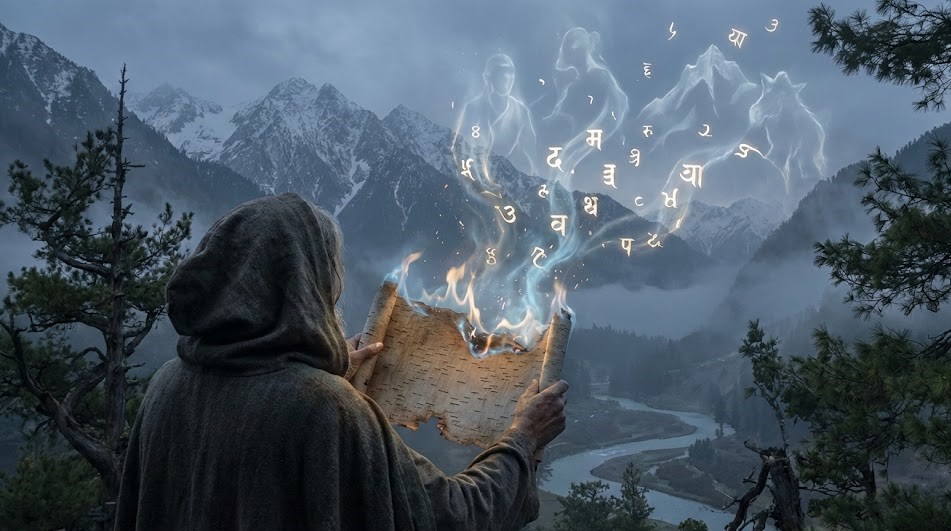
Perhaps the most compelling argument for Pishachi’s literary beauty comes from the tragic legend of the Bṛhatkathā (The Great Story). The tale involves Gunadhya, a minister in the court of King Satavahana. Following a wager with his rival, Sarvavarman, regarding how quickly the King could learn Sanskrit, Gunadhya lost. As penance, he swore to abandon Sanskrit, Prakrit, and Apabhramsa—the three recognized languages of “human culture.” Exiling himself to the Vindhya forests, Gunadhya encountered the Pishachas. He learned their tongue—the “fourth language”—and composed the massive Bṛhatkathā in Pishachi. When he attempted to present this magnum opus to the King, it was rejected due to the “lowly” nature of the language. In grief, Gunadhya burnt the manuscript leaf by leaf, weeping as he read it aloud to the animals of the forest. Only one-seventh of the text was saved, which later became the source material for masterpieces like Somadeva’s Kathāsaritsāgara. This legend transforms Pishachi from a dialect of ghosts into a vessel for one of ancient India’s greatest lost epics.
For centuries, scholars struggled to classify this elusive tongue. Early theorists like Dandin and Bhamaha acknowledged it but often treated it as an “additional” entity, outside the holy trinity of standard literary languages. However, a shift occurred around the 10th century. Rajasekhara, a poet of the cosmopolitan court, reimagined the “Literature Man” (Kavyapurusha) as a composite being where Sanskrit was the head, Prakrit the arms, Apabhramsa the hips, and Pishachi the legs. This metaphor was revolutionary, effectively integrating Pishachi into the body of cosmopolitan literature and arguing that a true poet must master all four. Later, the great grammarian Rudrata expanded the linguistic map to the Sadbhasa (Six Languages), formally inducting Pishachi alongside Sanskrit, Prakrit, Magadhi, Shuraseni, and Apabhramsa.
This acceptance was driven by the theater. As Kashmiri scholars like Udbhata and later Abhinavagupta revolutionized Sanskrit aesthetics, the theater required distinct dialects for different characters. While Shuraseni and Magadhi were standard stage languages, Pishachi found a niche. Hemacandra, the polymath monk (1089–1172), later codified the grammar of Pishachi, proving it was a language that could be learned, taught, and perfected. Thanks to grammarians like him, we have a blueprint of its distinct phonetics. It was a language of hardened sounds, perhaps reflecting the rugged terrain of its speakers. Soft consonants like ‘ga’ and ‘da’ often became the harder ‘ka’ and ‘ta’—for example, Damodara became Tamotara. Unlike other Prakrits, Pishachi retained the ‘l’ sound, and surprisingly, it retained certain Sanskrit letter orders that other Prakrits lost, suggesting it remained closer to the root structure of Sanskrit despite its “wild” reputation.
Hemacandra also identified a variation called Chulika Pishachi. This dialect was likely used in theater by characters speaking from behind the curtain (culika)—bards or announcers unseen by the audience, adding yet another layer of mystique to the language.
The journey of Pishachi—from the battlefield of Kurukshetra to the forests of the Vindhyas, and finally into the grammar books of Hemacandra—is a story of survival. It challenges the notion that literary beauty belongs only to the elite. For the modern Kashmiri, Pishachi is not just an academic curiosity; it is an ancestral echo. It establishes a lineage of storytelling and linguistic resilience that predates modern religious or political divides. The “Language of the Ghosts” is, in fact, the spirit of the valley itself—ancient, enduring, and undeniably beautiful.
The views expressed in this article are solely those of the author and do not necessarily reflect the opinions or views of this newspaper. The author can be reached at [email protected]
Leave a Reply