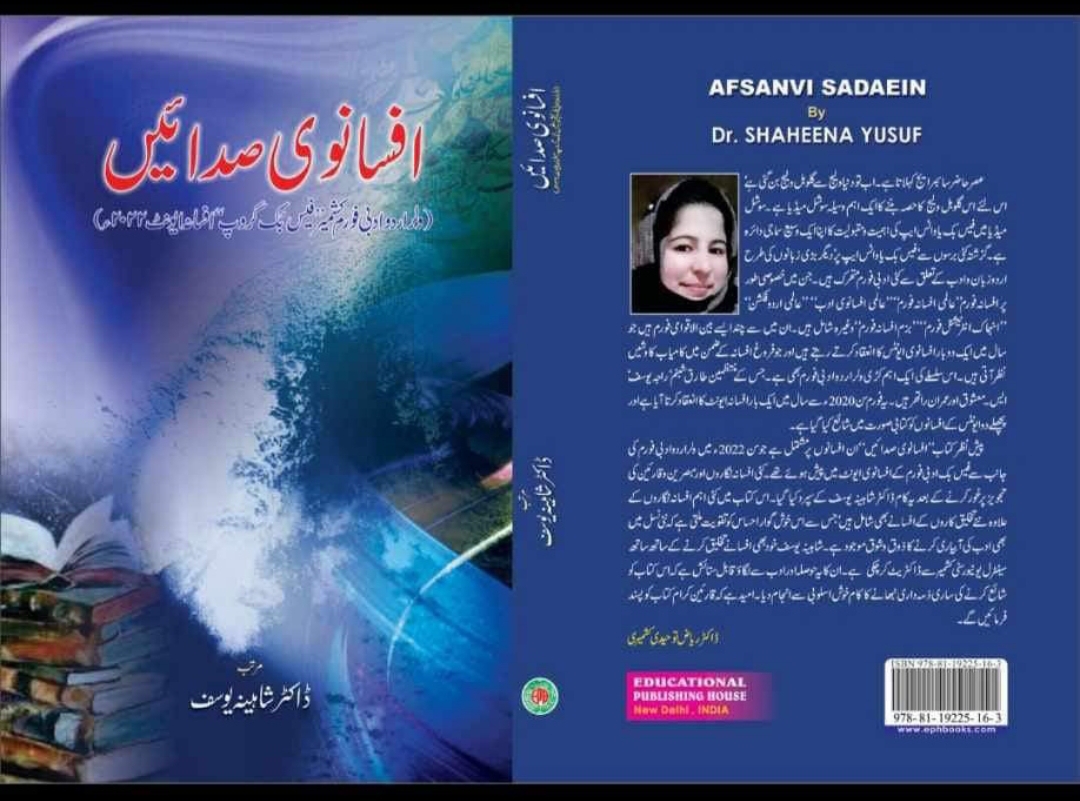
A masterclass in modern storytelling, Afsanvi Sadaein brings together thirty-one of the subcontinent’s most compelling voices. Edited with precision by Dr. Shaheena Yusuf, this anthology is more than a collection of stories—it is a vibrant testament to the enduring power and evolution of the Urdu Afsana in the 21st century.
By Rayees Ahmad Kumar
In the serene yet intellectually vibrant landscape of the Kashmir Valley, where the echoes of classical poetry often meet the pressing concerns of the modern world, the Wullar Urdu Adbi Forum Kashmir has emerged as a formidable custodian of the Urdu language. This organization, a beacon for literary enthusiasts, has cultivated a space where the tradition of the ‘Afsana’—the short story—is not merely preserved but allowed to breathe and evolve through a contemporary lens. Each year, the forum orchestrates a gathering of minds, inviting fiction writers from across the subcontinent to share their narratives, which are subsequently dissected and celebrated by distinguished litterateurs. Founded by the dedicated quartet of Raja Yousuf, Tariq Shabnum, Dr. Riyaz Tawheedi, and S. Mashouq Ahmad, the forum has successfully bridged the gap between traditional literary circles and the digital age. By leveraging social media as a tool for cultural propagation, they have transformed Facebook into a global stage for Urdu fiction, ensuring that the boundaries of the valley do not limit the reach of its stories. It was from one such remarkable 2022 symposium, featuring thirty-one meticulously crafted stories, that the anthology Afsanvi Sadaein was born. Edited by Dr. Shaheena Yusuf, an emerging and vital literary voice from North Kashmir, this 180-page volume, published by the Educational Publishing House of New Delhi, serves as a poignant testament to the enduring power of the short story.
The anthology is dedicated to those creative souls who use their pens as mirrors to reflect the complexities of society, a theme that resonates throughout its pages. The intellectual weight of the collection is established early on through a proem by Professor Khwaja Akramuddin of Jawaharlal Nehru University. His reflections provide a necessary historical context, tracing the evolution of the Urdu short story and its stylistic transformations in an era defined by rapid technological change. This is complemented by an extensive essay from Dr. Mushtaq Ahmad Wani, whose scholarly perspective as the former Head of the Urdu Department at Baba Ghulam Shah Badshah University adds a layer of academic rigor to the book. Dr. Wani offers a compelling observation on the regional dynamics of Urdu literature, noting that while Jammu has its merits, Kashmir has historically nurtured a more prolific density of literary organizations and critics. He rightly credits the Wullar Urdu Adbi Forum with uplifting the genre, particularly through the editorial leadership of Dr. Shaheena Yusuf, whose foreword detail the forum’s resilience during the global pandemic. At a time when physical borders were sealed, the forum utilized virtual spaces to keep the literary pulse of the region beating, a feat that Afsanvi Sadaein eventually solidified in print.
The literary journey begins with “Wapsi,” a narrative by the legendary Noor Shah. Using the iconic Dal Lake as his canvas, Shah explores the subtle yet painful fractures within a community that share a singular faith. He uses the proliferation of separate mosques as a metaphor for the growing divisions in a society once defined by its cohesion, prompting a deep introspection into the nature of communal identity. This exploration of social dynamics transitions into the digital realm with Dr. Mushtaq Ahmad Wani’s “Aaw Ab Nikah Kar Lein.” Here, the author tackles the burgeoning issues of morality and deception fueled by the anonymity of social media. The story of Sadai Saher serves as a cautionary tale of the modern age, where intimacy is fast-tracked through screens, only to be shattered by the harsh reality of betrayal and hidden domestic lives. The narrative flow then shifts toward the ethereal in Dr. Riyaz Tawheedi’s “Phool aur Khushboo.” Tawheedi masterfully handles the themes of mysticism and divine love, guiding the reader through a soul’s journey toward the Creator. It is a reflective piece that balances the earlier social critiques with a sense of spiritual yearning, suggesting that the ultimate “Afsana” is the one written between the seeker and the Divine.
The psychological depth of the anthology is further enriched by Dr. Nazir Mushtaq, a writer who has long occupied a unique niche by blending his medical expertise with literary art. In “Dusra Shouhar,” he portrays the quiet, often invisible agony of a woman enduring long-term mental and emotional distress. His clinical yet empathetic eye brings the struggles of psychiatric patients into sharp focus, challenging the reader to look beyond the surface of domestic life. In a similar vein of human connection, Raja Yusuf’s “Yaar Zinda Suhbat Bari” provides a moving look at the unpredictability of fate. Set against the harrowing backdrop of the 2014 Srinagar floods, the story reunites two childhood friends in the most dire of circumstances. The rescue of a doctor in Rajbagh becomes more than a survival story; it is a meditation on how crisis can strip away the distance of years, proving that the bonds formed in youth are often the most resilient. This theme of hidden human value is mirrored in Tariq Shabnum’s “Shakoor Bangi.” Through the character of a cannabis addict who is widely dismissed by his community, Shabnum explores the concept of the “hidden saint.” The revelation of Shakoor’s quiet humanitarian acts serves as a powerful reminder to the reader that virtue is often found in the most unlikely of places, far removed from the performative religiosity of the masses.
The anthology also provides a platform for strong feminist critiques, as seen in Wajida Tabassum Gurkho’s “Kish koul Ki Qeemat.” Gurkho writes with a sharp, tactical precision, exposing the predatory nature of men who exploit the economic vulnerability of impoverished families. Her voice is essential in a collection that aims to hold a mirror to society, as she refuses to look away from the darker aspects of gender and class exploitation. This social consciousness is echoed in Professor Neelofer Naz Nehvi’s “Khushboo,” which examines the unintended consequences of urban living. By focusing on the risks of renting rooms to strangers without proper vetting, Nehvi unveils a world of domestic secrecy and betrayal, highlighting how the search for convenience can often lead to the erosion of moral boundaries within the home. The geopolitical reality of the region is not ignored either; Mohd Shafi Sagar’s “Sarhad Ke Us Par” offers a heartbreaking glimpse into life on the border. The story captures the stagnant, melancholic existence of families separated by political lines, where mothers live in a perpetual state of waiting for sons who may never return. It is a stark reminder of the human cost of conflict, rendered with deep sensitivity.
Towards the conclusion of the anthology, the editor herself, Dr. Shaheena Yusuf, contributes “Qatil,” a story that delves into the tragedy of neglected youth. By following the downward spiral of a brilliant student who falls into bad company, Yusuf explores the devastating impact of a lack of parental supervision. The boy’s tragic end in a river is a haunting image that serves as a plea for greater community and familial engagement. This is followed by S. Mashooq Ahmad’s “Aur Shah Din Mar Gaya,” a nuanced study of deception and the misuse of faith. The elderly protagonist’s manipulation of a young girl under the guise of mentorship is a chilling portrayal of how social stigmas can be weaponized against the innocent. Finally, the collection touches upon the deeply personal and often stigmatized issue of childlessness in “Taskīn-e-Dil.” This narrative offers a complex perspective on the sorrow of childless couples, juxtaposing their pain with the heartbreak of parents whose children have chosen destructive paths. It suggests a philosophical resignation, questioning whether the void of childlessness is perhaps more bearable than the anguish of a legacy turned sour.
Ultimately, Afsanvi Sadaein is more than just a collection of short stories; it is a cultural document that captures the anxieties, hopes, and spiritual depth of a people. The Wullar Urdu Adbi Forum Kashmir has performed a significant service to the language by curating these voices into a single, cohesive volume. The anthology stands as a testament to the fact that the Urdu short story is not a relic of the past but a living, breathing art form capable of navigating the complexities of the 21st century. Through the editorial eye of Dr. Shaheena Yusuf, these thirty-one voices coalesce into a singular, powerful echo—a “Sada” that resonates far beyond the mountains of Kashmir.
The views expressed in this article are solely those of the author and do not necessarily reflect the opinions or views of this newspaper
Leave a Reply