From “snail mail” to cloud computing and digital addressing infrastructures, the Department of Posts is undergoing a radical reinvention.
By Ajaz Rashid
For generations, the image of the Indian postal system was immutable: the sturdy red letterbox standing sentinel on a street corner, the rhythmic thud of a date stamp, and the uniformed postman on a bicycle, delivering handwritten letters that connected a fragmented nation. It was a system built on physical touchpoints and manual labor, reliable but undeniably analog.
However, a quiet revolution has been brewing behind the counter grilles and inside the mail vans. On December 4, 2025, in a written reply to the Rajya Sabha, Union Minister of State for Communications and Rural Development, Dr. Pemmasani Chandra Sekhar, unveiled the full extent of this transformation. The data presents a startling new reality: India Post is no longer just a mail carrier; it is rapidly evolving into a logistics giant and a fintech powerhouse, underpinned by sophisticated, indigenous cloud technology.
The announcement details the successful rollout of IT Modernization Project 2.0 and a sweeping logistics overhaul, signaling that the Department of Posts (DoP) is not merely catching up to the digital age—it is attempting to define the infrastructure of the future.
The Cloud-Native Postman
The backbone of this transformation is the Advanced Postal Technology (APT) platform. While government IT projects often struggle with legacy issues, the APT appears to be a leapfrog moment. Launched nationwide on August 4, 2025, the platform is entirely indigenous, developed in-house by the Centre for Excellence in Postal Technology (CEPT).
Crucially, APT is hosted on MeghRaj 2.0, the government’s cloud computing environment. This shift to the cloud is not just technical jargon; it represents a massive gain in agility and scalability. In a country as vast as India, where server loads can fluctuate wildly based on regional demands or welfare payouts, a cloud-native architecture ensures stability.
The scale of integration is staggering. Approximately 1.70 lakh offices across 23 Postal Circles are now networked into this single digital ecosystem. But the true innovation lies in how this technology reaches the “last mile”—specifically, the deep rural hinterlands where internet connectivity has historically been spotty.
To bridge this gap, the DoP has deployed the DREAM (Digital Rural Enterprise Application for Mobile) app. Running on Android smartphones issued to Branch Post Offices, DREAM is designed to handle the unique challenges of rural service delivery. It is a specialized tool that allows the Gramin Dak Sevak (GDS)—the rural postal agent—to function as a mobile node of the central network. By equipping the rural workforce with enterprise-grade mobile tools, the DoP effectively turns every village postman into a walking, talking digital kiosk.
Banking at the Doorstep
If the APT platform is the brain of the new postal system, the India Post Payments Bank (IPPB) is its heart, pumping financial liquidity into areas traditional banks fear to tread.
Dr. Chandra Sekhar’s parliamentary reply highlighted a critical statistic: All Post Offices across India now provide IPPB services and are fully connected to the IPPB Core Banking Solution (CBS). Furthermore, 25,022 Departmental Post Offices are networked under the Core Banking Solution.
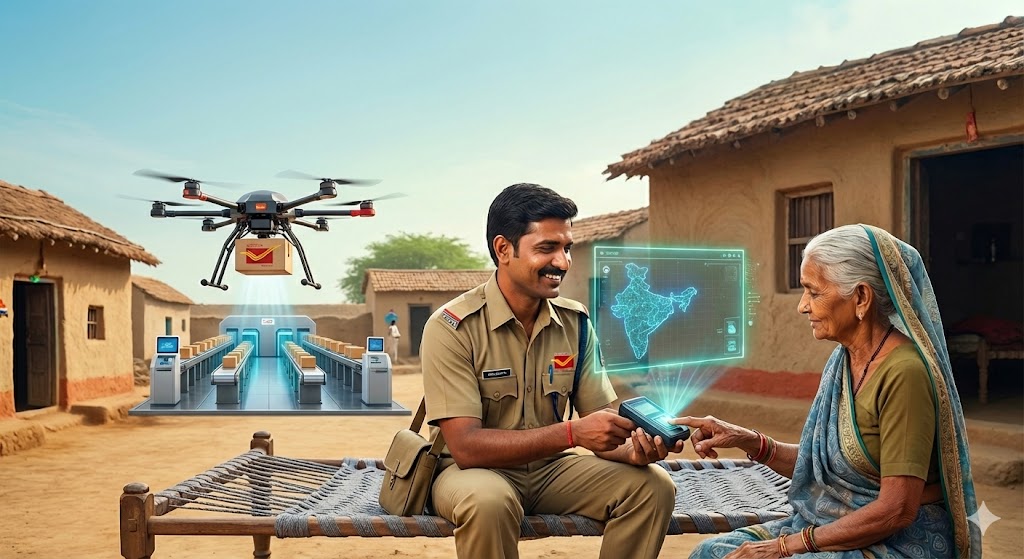
This connectivity has transformed the role of the postman. Once a bearer of news, the postman is now a banker. Every Postman and Gramin Dak Sevak has been equipped with smartphones and biometric devices. This hardware rollout enables Doorstep Banking Services, a concept that is revolutionary for India’s elderly and rural populations.
Consider the implications of the Aadhaar Enabled Payment System (AePS) and the Digital Life Certificate (DLC) services now available at the doorstep. A pensioner in a remote hamlet in Uttarakhand no longer needs to trek kilometers to a bank branch to prove they are alive or to withdraw cash. The bank comes to them.
The service bouquet has expanded significantly. Beyond simple withdrawals, the postal network now handles:
- Account opening and linkage: Seamless integration with Post Office Savings Accounts (POSA).
- Insurance: Third-party insurance services brought to the village level.
- Credit Referrals: Acting as a bridge to formal credit institutions.
- Aadhaar Services: Mobile number updates and Child Aadhaar enrolment for children under 5 years.
By leveraging the trust capital the “Dak” enjoys in rural India, the DoP has created a financial inclusion model that is arguably more effective than the purely brick-and-mortar banking expansion of the past decade.
The Logistics Pivot
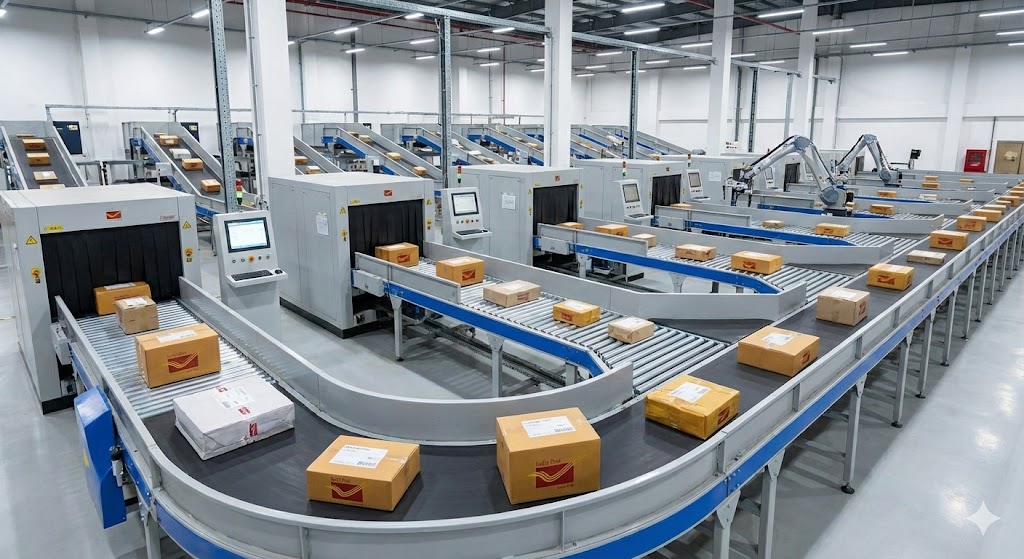
While financial services cater to the rural base, the “Post Offices as Logistics Organisations” initiative is clearly aimed at India’s booming e-commerce sector. For years, private logistics players dominated the lucrative parcel delivery market, with India Post often relegated to documents and speed post. The new strategy aims to reclaim that lost ground.
The government has realized that to compete, it must modernize not just its software, but its physical handling of goods. The Ministry’s statement outlines a shift toward mechanized and dedicated parcel delivery through Nodal Delivery Centres.
Under the aegis of the Mail and Parcel Optimization Project (MPOP), the department is implementing end-to-end process optimization. This includes:
- Automation: Deployment of parcel sorters to reduce manual handling time and errors.
- Standardization: Uniform workflows across the country to ensure predictability in delivery times.
- APT 2.0 Tech: Real-time delivery updates, OTP-based secure delivery, and—crucially—API integration.
The API integration is a game-changer. It allows e-commerce giants (like Amazon or Flipkart) and other logistics companies to plug their systems directly into India Post’s network. This interoperability makes India Post a viable partner for “last-mile” delivery, even for private competitors who may not have the deep rural reach that the DoP possesses.
Already, the department is partnering with major e-commerce players and serving multiple government ministries, including the Ministry of MSME.
The DGNK Network
The logistics modernization also has a strategic economic angle: boosting exports. The establishment of 1,013 Dak Ghar Niryat Kendras (DGNKs) is a direct intervention to support small businesses.
These Kendras serve as dedicated export hubs for MSMEs, artisans, and Self-Help Groups (SHGs). In the past, a weaver in Varanasi or a handicraft maker in the North East faced immense hurdles in shipping products abroad—customs documentation, high shipping costs, and logistical complexity. The DGNKs simplify this, bringing export-grade logistics to rural and semi-urban areas. By lowering the barrier to entry for global trade, India Post is trying to democratize exports.
DHRUVA
Perhaps the most futuristic and under-reported aspect of Dr. Chandra Sekhar’s announcement is the Department’s foray into Digital Public Infrastructure (DPI) for addressing.
In a country where “Third house behind the old banyan tree” is often a valid address, finding a location digitally can be a nightmare for logistics companies and emergency services alike. To solve this, the Department has finalized a Central Sector Scheme named ‘DHRUVA’.
DHRUVA aims to recognize address information management as a foundational public infrastructure. The concept is “Address-as-a-Service” (AaaS). Just as UPI revolutionized payments by creating a unified layer for money transfer, DHRUVA aims to revolutionize location by creating a standardized digital address layer.
The foundational layer of this initiative is the newly launched “Know Your DIGIPIN” application. While details on the specific mechanics of DIGIPIN are still emerging, the intent is clear: to create a geo-coded, standardized addressing system that works for everyone—from the drone delivering medicine to the ambulance finding a patient.
This moves the Department of Posts from being a service provider to being a platform builder. If DHRUVA succeeds, it will become the base layer upon which all future Indian logistics and location-based services are built.
The Road Ahead
The picture painted by these press releases is one of an institution in the midst of a violent, necessary rebirth. The Department of Posts is leveraging its greatest asset—its unparalleled physical reach—and supercharging it with the latest digital tools.
From the MeghRaj cloud hosting the neural network of post offices to the DREAM app empowering the rural GDS; from the mechanized Nodal Centres speeding up parcels to the DHRUVA scheme mapping the nation’s doorstep—the strategy is comprehensive.
Challenges remain, of course. Implementation on such a massive scale inevitably faces hurdles, from network downtime in remote areas to the training required for lakhs of postal employees to adapt to new digital workflows. However, the data provided to the Rajya Sabha suggests that the foundational blocks are firmly in place.
India Post is no longer just delivering letters. It is delivering cash, driving e-commerce, facilitating exports, and mapping the very geography of the nation. The “Dak” has gone digital, and it is open for business.
Leave a Reply