
From the romantic airwaves of Yuvawani to the sharp social critique of his latest book, Majeed Masroor’s journey reflects the changing pulse of Kashmir. An in-depth review of a literary icon’s crusade against social decay
By Rayees Ahmad Kumar
The soundscape of Kashmir in the 1990s was distinct, defined not just by the turbulence of the times but by the solace found in the airwaves of Radio Kashmir. In the early years of my childhood, the crackling warmth of the radio was a constant companion in our household, particularly for my grandfather. I hold a vivid, sepia-toned memory of him leaning in to listen to the Yuvawani service, where popular Kashmiri songs often filled the room. Melodies like “Khash Koruth Meanan Amaran Jaan Gou” and “Keal Watakh Chi Yel Meanis Mazras Peath Waai Pata Feari” were more than just entertainment; they were anthems of a generation, humming with a melancholic beauty that seemed to resonate with the very air of the valley. At that tender age, I was too young to grasp the depth of the lyrics or inquire about their origins, accepting them simply as the background score to our lives. It was only years later, as I began to navigate the literary landscape of our region, that I discovered the soul behind these timeless verses was none other than the renowned poet, writer, and broadcaster, Majeed Masroor.
Hailing from the scenic Khan Sahab area of Budgam district, Masroor is not merely a lyricist but a cultural institution in his own right. He has carved a formidable niche in the annals of Kashmiri literature and music, penning hundreds of poems and ghazals that have been immortalized by the valley’s most celebrated vocalists. However, to view him solely as a poet would be a reduction of his literary footprint. Masroor is a multifaceted intellectual whose contributions extend into prose, journalism, and social commentary. His writings, often appearing in leading local and national newspapers, reveal a mind deeply concerned with the fabric of society—its education, its creeping immoralities, and the preservation of its culture. This transition from the lyrical to the analytical culminated significantly in 2022 with the publication of his first collection of articles, titled Parvaaz-i-Shaoor. Published by Taj Printing Service, New Delhi, this anthology is a substantial addition to vernacular journalism, comprising 31 articles spread across 127 pages.
The book is an intimate offering, dedicated to the youth of the valley and those committed to the spiritual and social tenets of the Prophet (PBUH). One cannot help but notice the personal touch adorning the work; photographs of Masroor with his mother, his grandson, and close friends preface the text, signaling that this is a book written from the heart as much as the intellect. In his own foreword, Masroor strips away any pretense of literary ego, stating unequivocally that his sole motive is to serve society through his pen. This sentiment is echoed by the endorsements the book has received. Maulana Mohd Muzaffar Qadri, the Imam of Khanqah Moula Sopore, notes that Masroor is engaged in a diligent jihad against social evils, using his writing to promote community well-being. Similarly, Ishfaq Gouhar observes that the author possesses a rare sensitivity to the wrongdoings prevalent in society, viewing his work as a compass to guide the youth toward a crime-free existence.
The anthology opens with “Ikhlaq: Ek Azim Niyamat,” an essay that sets the moral tone for the entire collection. Here, Masroor argues that noble virtues and exemplary character are not just personal assets but the bedrock of a functioning society. Drawing upon the sayings of the Prophet (PBUH), he emphasizes that good conduct is the highest form of religious practice. This thematic focus on morality transitions seamlessly into his love for the land itself. in “Ye Kashmir Hai,” Masroor sketches the charm and grandeur of the valley with the finesse of a painter. He describes a land blessed with snow-clad peaks and crystal-clear waters, yet he goes beyond mere geography. He invokes the poetic tributes of Jahangir, Iqbal, and Chakbast to celebrate Kashmir not just as a place of beauty, but as a cradle of hospitality and scholarship.
However, Masroor’s love for his homeland is not blind to its cultural erosion. In the article “Madri Zaban – Mother Tongue,” he presents a passionate defense of the native language. He posits a sociological truth: when a community develops an inferiority complex regarding its mother tongue, it begins a slow march toward extinction. He argues that a nation thrives only as long as it preserves its linguistic heritage. This concern for identity is further sharpened in his piece regarding the great mystic poetess, Lala Ded. Masroor takes umbrage at the modern, casual abbreviation of the “Lal Ded Hospital” to “LD Hospital.” He views this not as a mere administrative shorthand but as a grave injustice and a symptom of cultural amnesia. For Masroor, Lala Ded is a towering figure of Kashmiri identity, a philanthropist and spiritual giant whose “vakhs” are etched in the collective memory. To reduce her name to two letters is to disrespect the history she represents.
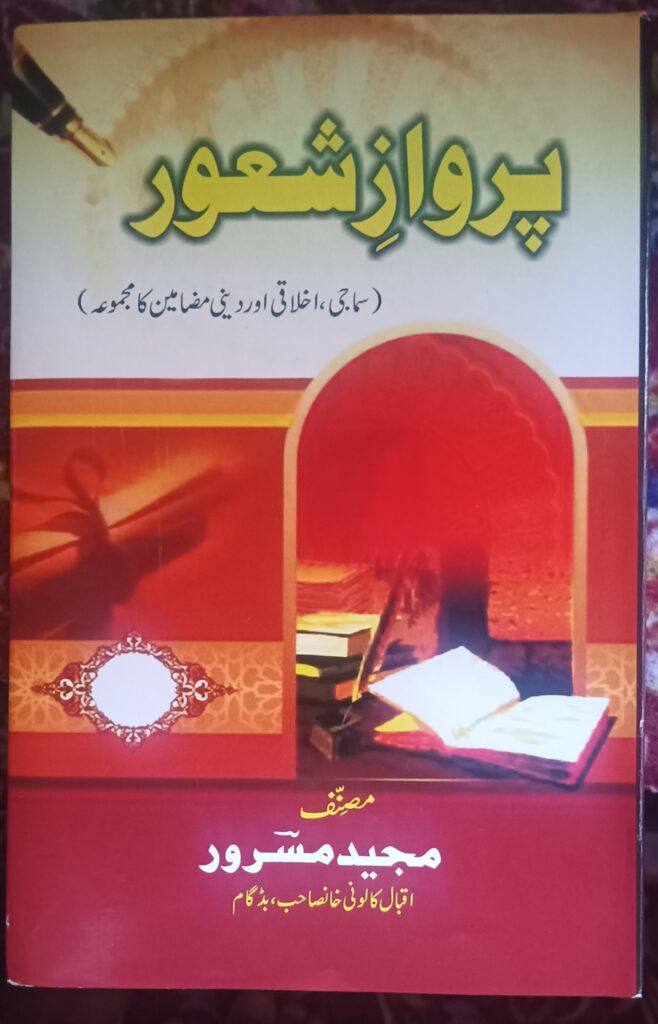
The book oscillates effectively between these broad cultural critiques and intimate human values. In “Khidmati Khalaq hi Insaniyat,” the author utilizes the poetry of Iqbal and Abdul Ahad Azad to highlight that true piety lies in serving humanity, transcending barriers of caste, creed, or tribe. He reinforces the idea that in times of adversity, the only religion that matters is kindness. This thread of respect continues in “Buzurgon ka Ehtram,” where he reminds the younger generation of the cyclical nature of life. By respecting elders today, the youth pave the way for their own dignity in old age. Furthermore, Masroor pays homage to the architects of society in “Ustaad – The Teacher.” He describes teaching as a prophetic profession, arguing that history bears witness that only nations who honor their educators achieve true progress. He cites numerous thinkers to affirm that teachers are the ones who burn the midnight oil to shape the future.
Perhaps the most emotionally resonant chapter in the collection is “Maa – Mother.” Masroor begins with the evocative assertion that the word “mother” is sweeter than honey. It is in this piece that the journalist gives way to the son. The prose becomes tender, almost tearful, enhanced by the inclusion of couplets by Munawar Rana and the author himself. He portrays the mother as the most beautiful creation in the world, whose love is the only truly selfless force in a transactional existence. It is a chapter that lingers with the reader long after the page is turned. Finally, the author grounds his global and social outlook in his local roots with “My Village Khansahab.” He traces the genealogy of his home, narrating the legend of Syed Ismail Khan and his pious son Soleh Khan, illustrating how the village grew around a legacy of saintliness.
In Parvaaz-i-Shaoor, Majeed Masroor has successfully bridged the gap between the lyrical romanticism of his early radio days and the sharp, corrective prose required for today’s social discourse. While the songs I heard on my grandfather’s radio in the 90s provided a soundtrack to our lives, this book provides a roadmap for living them. It is a work that does not just seek to entertain, but to instruct, correct, and preserve. Masroor demonstrates that whether through the melody of a song or the ink of an essay, his commitment remains the same: to elevate the consciousness of his people and to ensure that the heritage of Kashmir—moral, linguistic, and spiritual—survives for the generations to come.
The views expressed in this article are solely those of the author and do not necessarily reflect the opinions or views of this newspaper
Leave a Reply