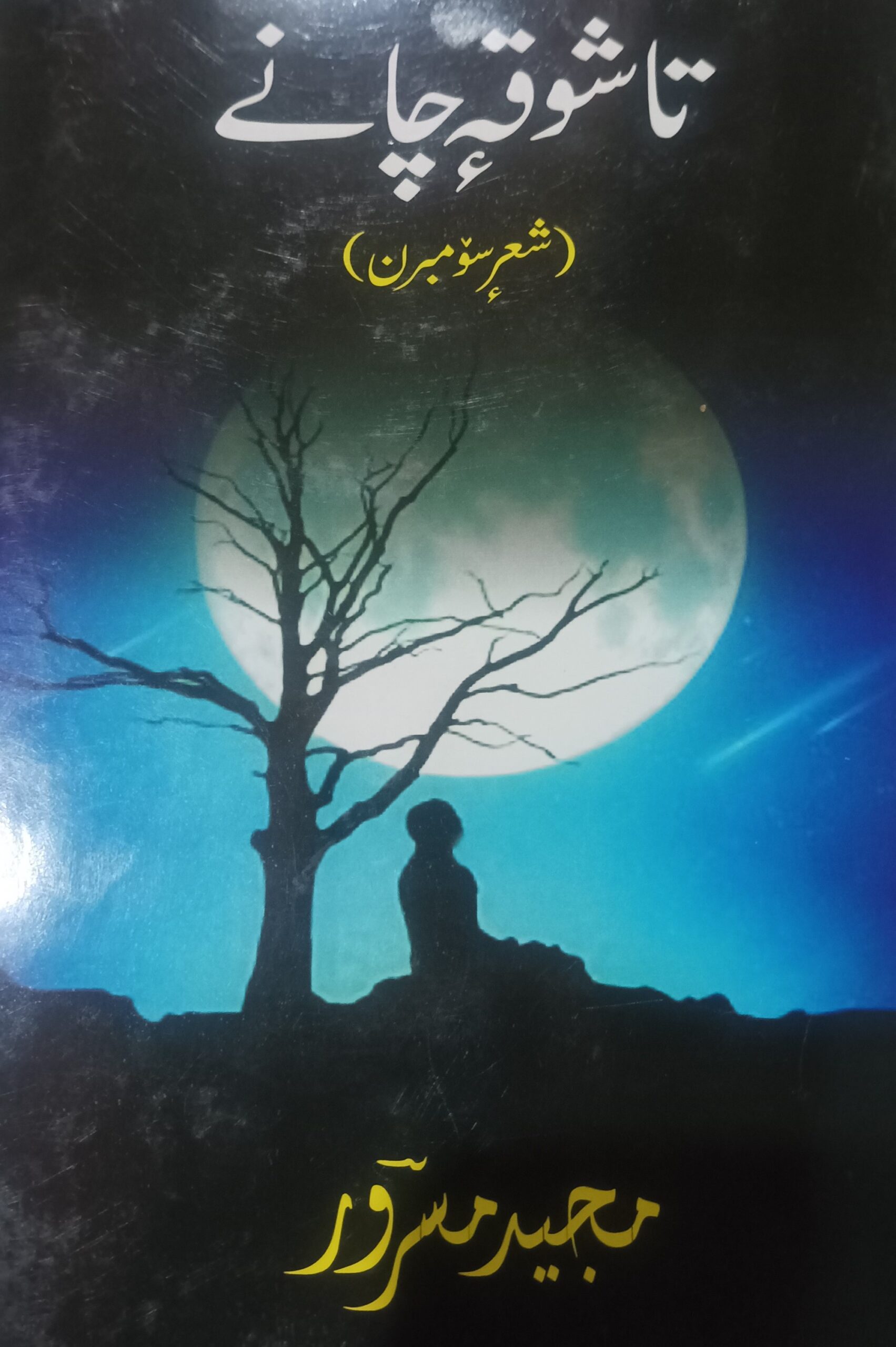
A Review of Majeed Masroor’s ‘Taashouq Chanay’
By Rayees Ahmad Kumar
In the verdant literary landscape of Kashmir, where the written word has long served as a vessel for both spiritual longing and cultural preservation, Majeed Masroor stands as a distinct and resonant figure. To call him merely a poet would be an understatement; in the contemporary cultural milieu of the Valley, Masroor has evolved into an institution of sorts, a broadcaster, an orator, and a custodian of the Kashmiri language. His latest offering, Taashouq Chanay, serves not only as a collection of verses but as a testament to a life lived in service of the mother tongue.
Published by Taj Printing Service, New Delhi, this 201-page anthology represents a significant return to form for the author. In the book’s foreword, Masroor candidly reveals a period of silence, a hiatus where the pen was laid to rest for “certain known reasons.” It was only through the persistent encouragement of friends and literary well-wishers that he gathered his scattered works to compile this volume. This context adds a layer of poignancy to the collection; it reads like a reclamation of voice. Ishfaq Gowher, commenting on the release, aptly describes Masroor as a “true soldier of Kashmiri language and literature.” Gowher’s reflection on their shared history, particularly the days when Masroor organized poetic symposiums on the Gulistan Channel, highlights the author’s dual role. He is not just a writer in isolation; through his work as an honorary literary coordinator and television host, he has brought poetry into the living rooms of Kashmir, bridging the gap between high literature and the common man.
The collection opens with a devout invocation, setting a deeply spiritual tone from the very first page. The opening poem is a heartfelt prayer, a Munajaat, seeking the enduring blessings of the Almighty. Masroor writes:
“Chus bi amut dedtal darith halam az ya Rasool, Akh nazar bas akh nazar nazre karam az ya Rasool. Be kasan baed satha Mohammad aaw, Ashqan hund mudaa Mohammad aaw. Wala waen wasye lol baegrawo, Dargah dil shehlawo az.”
These Naatya verses express the author’s profound love and devotion for the Holy Prophet (peace be upon him), utilizing a choice of words that is both graceful and deeply reverent. The imagery extends to the physical geography of faith in Kashmir, specifically the revered Dargah Hazratbal. Masroor captures the collective devotion of the thousands who gather to catch a glimpse of the sacred relic, translating that moment of spiritual fulfillment into verse. This devotional thread continues as Masroor pays tribute to the towering spiritual figures of the region. He composes Manqabats for revered saints such as Sheikh Abdul Qadir Jeelani, Sheikh Hamza Makhdoom, Sheikh Nooruddin Noorani, and Khan Sahab. In doing so, Masroor positions himself as a humble seeker, adopting these saints as spiritual guides and mentors, grounding his modern work in the centuries-old Sufi tradition of the Valley.
While the devotional aspect provides the book’s foundation, its heart lies in the collection of 68 mesmerizing ghazals. Here, Masroor displays his versatility, moving from the divine to the human, exploring themes of separation, longing, and the transient nature of joy. The poet’s ability to weave depth of thought with linguistic beauty is evident in lines such as:
“Shehlowtha myoni jigar zaanh akh pahar Wuchzihea myoni machar zaanh akh pahar”
Here, the concept of machar—a feverish restlessness or blooming intensity, is juxtaposed with a plea for just a moment (akh pahar) of attention. The structure is elegant, giving the abstract feeling of heartache a tangible, rhythmic form. One of Masroor’s greatest strengths, as evidenced in this collection, is his accessibility. He resists the temptation of overly archaic vocabulary, opting instead for the simple, familiar words of the native tongue. This ensures his message reaches the enthusiastic reader without friction, as seen in the couplet:
“Balyaran ma sa sumblou myoun dil Rayi tehnze az ti tumblou myoun dil”
This accessibility allows him to communicate a universal restlessness in lines like:
“Dorer chouni kotha chalai Yoti soun salai lalo az Ba wai dilki sarie awhalie Yiti soun salai lalo az”
The poet conveys that he can no longer endure the pain of distance; he longs intensely for presence and companionship. It is a raw, unfiltered cry from the heart that any reader who has experienced loss can recognize. The emotional arc of the book swings between the depths of despair and the heights of anticipation. Masroor masterfully captures the excitement of an expected reunion with the lines:
“Az khasni dekas drih tas chu yun Tula narik paith waih tas chu yun”
The joy here is palpable. The confidence that the beloved will arrive creates a scene of frantic, joyful preparation. However, this is balanced by verses that explore the physical toll of emotional pain:
“Dag mei koran chum dilas preath dawa gou be asar Ha tabibu near sa ami daadi nish chukh be khabar”
In these lines, the poet dismisses the physician (tabib). He asserts that no herbal or homemade remedy can heal the agony of a heartache; the ailment is spiritual and emotional, and the physician is ignorant of its nature. Only the beloved’s presence serves as the cure. This theme of existential dependence is further cemented in the couplets:
“Ba wolmut azlai chani maye waesye Chei rous ma zindagi hasi zayi waesye”
Masroor declares that without the beloved, existence—whether in life or death, is devoid of meaning. Life derives its vibrancy solely from that connection; without it, the world is colorless. Taashouq Chanay ultimately serves as a reminder that Majeed Masroor is a multifaceted talent. Beyond the written page, his reputation as a powerful orator and television personality informs his poetry. There is a cadence to his writing that suggests it is meant to be spoken, to be heard in a gathering, echoing the symposiums he so famously hosts. In a time when regional languages often struggle for relevance among the younger generation, Masroor’s work is vital. He bridges the gap between the classical and the contemporary. This book is not just for the literary elite; it is a treasure trove for the youth of Kashmir, inviting them to experience the enchantment of their own language, expressed with eloquence and intellect.
The views expressed in this article are solely those of the author and do not necessarily reflect the opinions or views of this newspaper
Leave a Reply