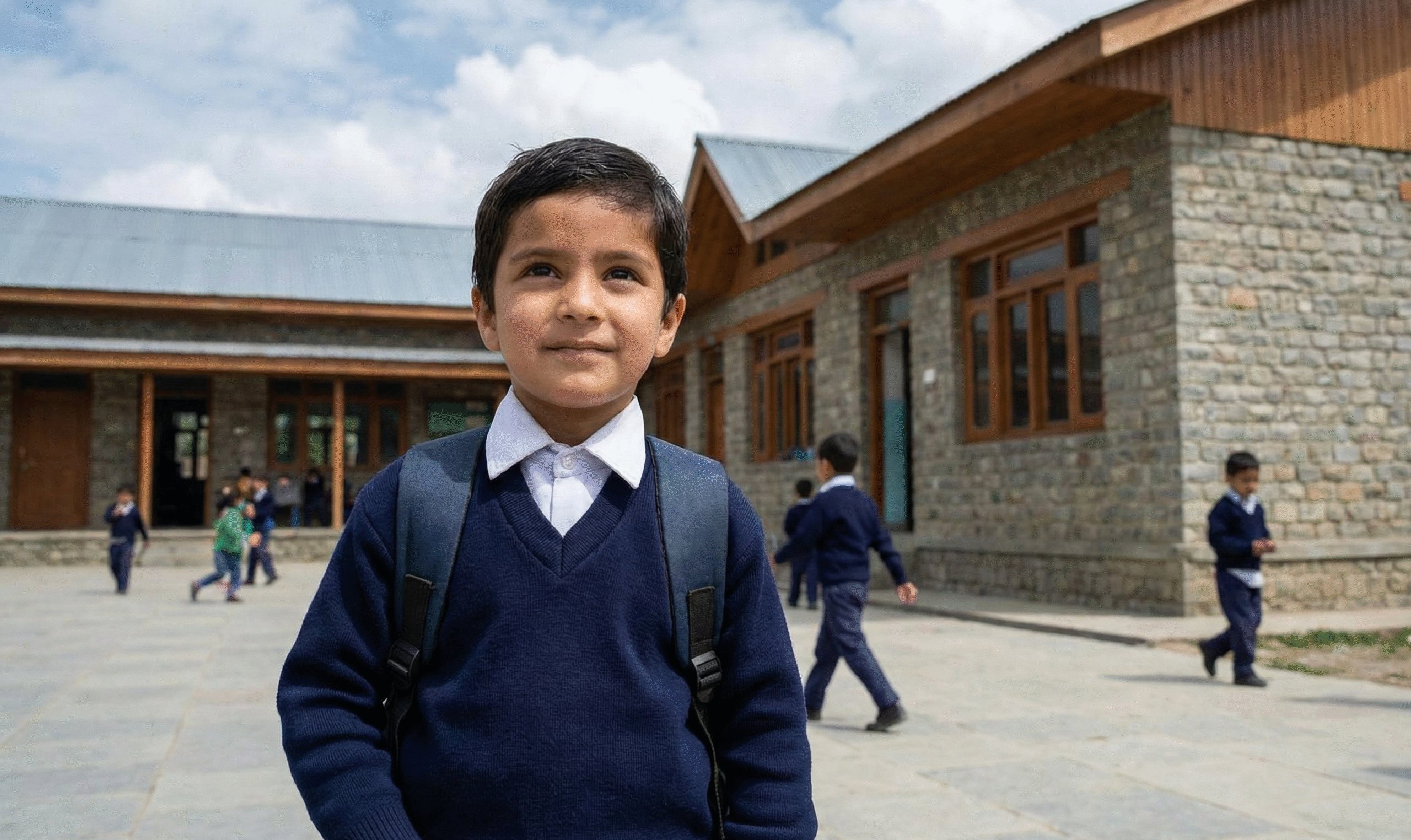
Why J&K’s First Graders Deserve a Compassionate Transition
By Mool Raj
I am not a think tank, nor do I claim to be a policy expert sitting in the ivory towers of academia. I am simply a person—a concerned citizen and a parent—who wishes to express a view that is currently keeping thousands of families in Jammu and Kashmir awake at night. This concerns the future of our children, specifically the innocent toddlers standing at the threshold of their formal education: the entrants to the 1st Standard in the schools of Jammu and Kashmir. While the world discusses geopolitical shifts and macroeconomic policies, a quiet but profound crisis is brewing in our homes regarding the admission criteria for our youngest learners. It is a crisis of confusion, a clash between the noble intent of policy and the harsh reality of its implementation.
To understand the anxiety gripping the parents of the Union Territory, one must first look at the science, for I do not dismiss the rationale behind the age limits. It is widely accepted that age limits are not arbitrary numbers drawn from a hat; they are guardrails for literacy development, social interaction, and independence. After a detailed comparative, analytical, and experimental study of the education systems in India and specifically in Jammu and Kashmir, one cannot ignore the pedagogical consensus. Normally, children are ready for admission into the 1st Standard within the age bracket of 5 to 6 years. However, under the National Education Policy (NEP) 2020, the Government of India recommends that a child be six years old as of March 31st of the admission year. This “6+ rule” is grounded in developmental psychology. Age six is generally considered the threshold where a child is physically and intellectually mature enough to transition from the play-based environment of a nursery to the structured learning of a primary classroom.
At this age, children are better able to develop cognitive learning as well as fine and gross motor skills. These skills are not merely academic jargon; they are the difference between a child who struggles to hold a pencil and one who writes with confidence. Fine motor skills control the small movements of the hands and fingers, essential for writing, while gross motor skills allow a child to sit upright at a desk for extended periods without physical fatigue. Furthermore, the emotional readiness of a six-year-old is vastly different from that of a five-year-old. By age six, children have developed a higher degree of emotional intelligence and social adjustment capabilities. They can navigate the complex social hierarchy of a classroom, handle separation from parents with greater resilience, and develop empathy and cooperation—skills that are foundational for collaborative learning. The curriculum of Class 1 is designed with this maturity in mind. If we enroll children before they are ready, we risk hampering their ability to develop physically and mentally, potentially turning the “joy of learning” envisioned by the NEP into a “fear of school.”
However, pedagogy does not exist in a vacuum. In Jammu and Kashmir, it exists amidst a unique administrative turbulence that sets us apart from the rest of India. We are currently witnessing a discrepancy regarding admission norms between the Central Board of Secondary Education (CBSE) and the J&K Board of School Education (JKBOSE) that is baffling parents. Why are the admission criteria applied so differently across boards within the same region? Why is the same NEP-2020 being interpreted with flexibility in some states and with rigidity in ours? The architects of the NEP-2020 were Indian educationists, not foreign overlords. Their intent was to standardize and uplift, not to exclude. Yet, the current rigid implementation of the age cutoff in J&K feels reminiscent of a darker era. It recalls the actions of Lord Lytton, who infamously reduced the age limit for the Indian Civil Service (ICS) exam from 21 to 19 years to prevent Indian aspirants from entering the decision-making process. While the context is different, the sentiment of exclusion feels eerily similar. We must ask: are we inadvertently creating a system that prunes our children’s potential before it even has a chance to bloom?
The crux of the issue lies in the recent shifting of the academic session. For decades, Kashmir followed a November-December academic cycle, suited to our harsh geography and climate. In 2022, this was shifted to a March session to align with the rest of India. Now, recognizing the logistical nightmares of a March session in a snowbound region, the government—led by the elected representatives—has rightfully restored the November-December session for the winter zones. While this restoration is a welcome relief, it has created a “transition trap” for admissions. We are in a unique situation where the academic calendar is moving backward while the age criteria are moving forward.
The School Education Department recently issued an order announcing a “one-time relaxation” for the 2025-26 academic session, stating that the minimum age of six years will be reckoned as of September 30, 2025, rather than March 31. From the 2026-27 session onwards, the age will be reckoned strictly as of March 31. The government views this as a relief. However, for parents, this feels like a sleight of hand. Thousands of children born between October and December—who would have been eligible under the old norms or a more flexible interpretation—are now left in limbo. They are being told they are “too young” by a matter of weeks or days, forced to repeat a year of Kindergarten despite being developmentally ready. This is not true relaxation; it is a bureaucratic compromise that fails to account for the human cost of the “lost year.”
I urge the Government of Jammu and Kashmir to look at how other states are handling this transition. We are not the only ones grappling with the NEP mandate, but we seem to be the most rigid. Look at Karnataka. When parents there faced a similar crisis for the 2026-27 admission cycle, they did not stay silent, and the government did not turn a deaf ear. Parents petitioned the Department of Public Instruction requesting a 90-day relaxation in the age criteria. They argued that a rigid June 1st cutoff left out thousands of children born between June and August, causing them to lose a year. The parents highlighted that in the previous year, the department had allowed a six-month relaxation. They argued that excluding these children went against the spirit of inclusiveness that education policy should uphold. The result? The state offered flexibility to ensure fairness between consecutive batches. Similarly, in New Delhi, the Directorate of Education has adopted a phased implementation for the minimum age criteria, ensuring that the reform aligns with the NEP without causing immediate disruption to families already in the pre-primary system.
If Karnataka and Delhi can find a middle ground, why can’t the Jammu and Kashmir School Education Department? Why are we applying a “one-size-fits-all” rigor to a region that has just undergone a massive shift in its academic calendar? This rigidity is fueling frustration among the educated youth and parents of the region. The youth of J&K are already at a crossroads, dealing with limited employment opportunities and a volatile history. When they see the government playing games with the future of their toddlers—the innocent and voiceless generation—it only deepens their cynicism. They begin to feel that the system is designed to trip them up rather than lift them up.
It is necessary for parents to admit their kids at the right time to avoid any delay in academic performance, and I agree that age six is generally the benchmark for confidence and holistic development. A child admitted at the right age develops self-esteem, participates actively in learning, and suffers less social anxiety. However, “right age” is not solely defined by a date on a birth certificate; it is also defined by the continuity of the child’s educational journey. If a child has completed Nursery, LKG, and UKG and is deemed ready by their teachers, holding them back because their birthday falls a week after a newly imposed cutoff is counterproductive. It disrupts their momentum and separates them from their peers, which can be just as damaging as starting school too early.
Therefore, I would like to make a humble and fervent request to the empowered authorities of the School Education Department of Jammu and Kashmir, and specifically to the Hon’ble Education Minister, Ms. Sakina Itoo. Madam, you are a daughter of the soil. You are an elected representative who understands the heartbeat of this region. You have already shown immense responsiveness and political will by restoring the November academic session, a decision that resonated deeply with the people. We now ask you to extend that compassion to the admission criteria for Class 1.
Since the exams for students in J&K are being held in October-November for the first time in years, marking the return to the winter session, the admission cycle must reflect this unique transition. We request a one-time, meaningful age relaxation for the current year. This is not a request to dilute the standard of education, but a request for a humanitarian adjustment. Granting a relaxation similar to that of Karnataka or Delhi—perhaps extending the reckoning date to include children born later in the year—would bring relief to lakhs of parents. It would ensure that the restoration of the academic session is a moment of celebration, not a cause for anxiety.
We hope that due consideration will be given to this request. These innocent children are the daughters and sons of the soil of Jammu and Kashmir first, and only then are they the subjects of the officers at the helm of the Education Department. Let us not weigh them down with the heavy chains of bureaucratic technicalities during a year of such significant administrative change. Let their entry into formal schooling be marked by welcome and encouragement, not by rejection based on a date on a calendar. Give them the relaxation. Give them their year.
The views expressed in this article are solely those of the author and do not necessarily reflect the opinions or views of this newspaper
Leave a Reply