Enrolment is up, but employable skills are down. The missing link isn’t the curriculum—it’s the person standing at the front of the room.
By Mool Raj
When we discuss higher education reform in India, the debate invariably gravitates toward the tangible: skyrocketing enrolment figures, the construction of sprawling new campuses, and the modernization of material infrastructure. These are the visible markers of progress. According to the All India Survey on Higher Education (AISHE) 2021-22, student enrolment has swelled to a staggering 4.33 crore, with a Gross Enrolment Ratio (GER) of 28.4. Yet, amidst this statistical boom, a critical element remains dangerously unexamined: the educator in the classroom.
The creation of institutional excellence cannot rely solely on steel structures or printed publications; it depends fundamentally on the faculty. For too long, the professional development of college instructors in India has been treated with a concerning level of desolation. The symptoms of this neglect entrenched, dated instructional practices, dwindling student engagement, and a persistent drop in graduate outcomes, are loud warnings that it is time to pivot our focus from the buildings to the builders of the nation’s intellect.
The Paradox of Qualification
In the current ecosystem, university professors are tasked not merely with transferring knowledge but with cultivating critical minds for a rapidly evolving world. We live in an era defined by technological revolution, global interconnectedness, and interdisciplinary diversity. Education today must do more than pass on information; it must foster innovation and communicative agility. However, a faculty member is only competent if they remain a learner constantly refining pedagogical skills, embracing emergent technologies, and critiquing their own performance.
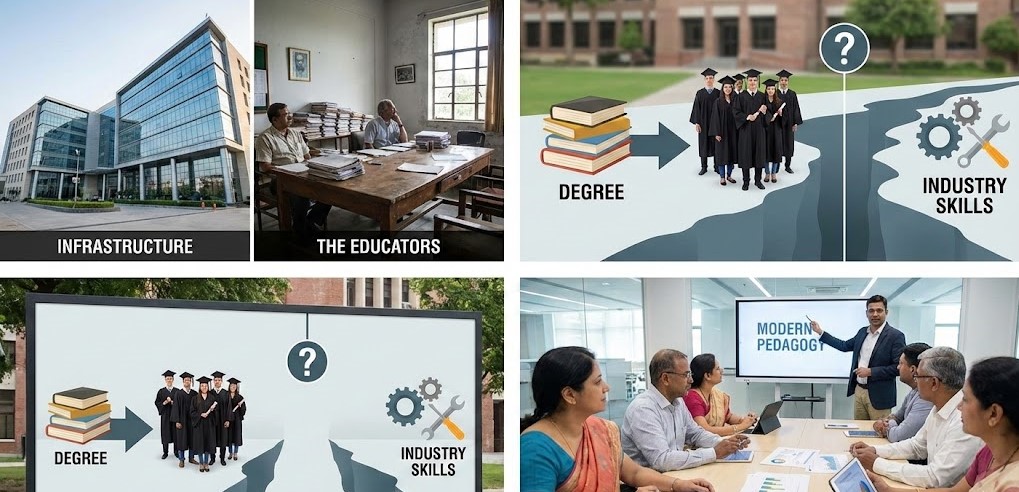
Unfortunately, the hiring mechanisms in Indian universities largely disregard this necessity. Recruitment is almost entirely determined by terminal degrees. Masters or PhDs. Crucial elements such as pedagogical preparation, curriculum design, student psychology, and instructional technology are conspicuously absent from the hiring criteria. We operate on the perilous assumption that subject matter expertise naturally translates into teaching excellence. This belief is not only weakly founded but actively harmful.
The result is the “accidental professor”, a scholar who knows their subject but has never been taught how to teach it. Consequently, classroom practices remain frozen in time. Passive lectures, outdated notes, and rote memorization assessments are still the norm in a significant number of public sector classrooms. Even when curriculum innovations are introduced, they are often delivered through pre-digital methodologies, failing to connect coursework with the vibrant realities of a resurgent India.
The Employability Gap
The disconnect between university output and industry requirements is stark. The India Skills Report 2025 suggests that while employability has improved to roughly 55%, a significant 45% of our graduates still lack the necessary skills to be job-ready. This mismatch is not due to a lack of potential in our youth but is often a direct consequence of inadequate mentoring and instructional design. Skills such as flexibility, critical thinking, collaboration, and leadership are forged in dynamic, interactive classrooms—environments that untrained faculty struggle to create.
In developed education systems like those in Canada, Finland, Singapore, and the UK, Continuing Professional Development (CPD) is not voluntary; it is obligatory. Faculty advancement, tenure, and contract renewals are contingent upon regular training in modern pedagogy, digital aids, and inclusion techniques. While we must be cautious of blindly aping Western models—which often come packaged with their own socio-cultural biases—we cannot ignore their rigorous academic standards. India needs to develop an indigenous plan for grooming its educators, one that respects our unique context while demanding world-class accountability.
The Vacuum of Accountability
India currently lacks a consistent, mandatory faculty development framework. While initiatives like the Malaviya Mission Teacher Training Programme are commendable steps by the government to institutionalize training, the culture of “continuous learning” has not yet permeated the rank and file of academia. Many lecturers complete their entire careers without significant professional development beyond their initial induction.
Teaching is a complex, evolving field, yet we lack an institutionalized system to monitor, evaluate, and reward it. Promotion rules are overwhelmingly skewed toward the number of research publications or mere seniority. Classroom performance and student engagement are relegated to the footnotes of performance appraisals. Even when student feedback surveys are conducted, they are rarely taken seriously or used for constructive improvement.
This vacuum of accountability breeds complacency. The “publish or perish” culture has inadvertently killed the status of teaching. It has created a market for low-impact journals and methodologically weak research, as faculty scramble to meet publication quotas at the expense of their students. While research is vital, we need a balanced ratio where educational efficiency is valued as highly as academic work.
A Roadmap for Reform
Implementing robust CPD requires creative leadership, definite policy, and unwavering commitment. We propose a structural overhaul based on three levels:
- Institutional Core Training: Universities must offer mandatory modules on course planning, student psychology, and instructional technology.
- Specialized Workshops: Regional consortia or professional societies should conduct workshops on inclusion, online teaching, and technology-assisted learning.
- Scholarship of Teaching: Faculty should be encouraged to research their own practice, returning to the classroom with critical questions about how their students learn best.
To make this a reality, we need a Compulsory CPD Policy. All universities must stipulate a minimum number of training hours per academic year, directly aligned with promotions and appraisals.
Furthermore, every public university ought to establish a Centre for Teaching and Learning (CTL). These should not be administrative backwaters but vibrant hubs of pedagogical innovation, offering peer mentoring and instructional design facilities.
New Faculty Induction must be rigorous. A mere orientation is insufficient; new hires should undergo a semester-long induction addressing ethics, technology, inclusive practices, and assessment literacy. This should be paired with Student Teaching Observation and Audits, where peer observation and annual teaching audits by academic leadership ensure reflection and responsibility.
Incentivizing Excellence
We must also change the reward structure. Learning institutions ought to establish pedagogical innovation grants and teaching awards. Public recognition of outstanding classroom teaching can slowly shift the culture away from a research-only focus.
Technology will be our greatest ally in this transformation. The University Grants Commission (UGC) and other bodies can leverage Massive Open Online Courses (MOOCs) to provide quality training to remote faculty. A nationalized CPD platform, offering courses in regional languages alongside English, would maximize reach and impact.
Resistance is inevitable. Faculty may fear increased workloads or scrutiny. Therefore, CPD must not be positioned as punishment but as professional enrichment. Administrative support is crucial here; university leaders must allocate dedicated time and funds for training, ensuring that “educating the educator” is not seen as a burden but as a badge of honor.
Repossessing the Heart of Education
We cannot build the universities of a Viksit Bharat (Developed India) on foundations of stone alone. The most critical infrastructure of any organization is not its buildings, labs, or budgets, but its faculty. If we continue to neglect our teachers, we cheat our students and our society.
It is high time we turn the narrative around. Higher education needs fixing, but higher educators need support to do the fixing. We must elevate teaching to its rightful place as a noble, skilled profession. We must engage minds to educate others. Most importantly, we must take responsibility for every classroom that goes quiet, every student who leaves unmotivated, and every graduate who enters the workforce unprepared.
The transformation of Indian higher education starts not with the students, but with the education of the educators.
Leave a Reply