By Aubaid Ahmad Akhoon
Poetry is more than ornamented language—it is the soul of a civilization, a mirror to its struggles and its triumphs. From the masnavi to the qaseeda, from the gentle romance of classical Urdu to the sharper reflections of modernism, verse has always carried meanings that outlive their creators. Among the constellation of poets who shaped the Indian subcontinent’s literary tradition, Allama Sir Muhammad Iqbal stands alone as a thinker whose words continue to stir hearts, inspire revolutions, and guide spiritual quests.
For many, including this writer, Iqbal is not merely a poet; he is a philosopher, a teacher, and a visionary who redefined the role of poetry in shaping societies. His verse penetrates beyond the surface beauty of rhyme, striking directly at questions of existence, faith, purpose, and nationhood. His message is timeless: know yourself, and through self-realization, rise beyond limitations.
He once wrote:
“Apne mann mein dhoob kar paa ja suragi zindagi,
Tu agar mera na ban saka, na bann apna toh ban.”
(Immerse yourself in your being, discover the secret of life. If you cannot conform to my ideals, at least become your true self.)
A Poet Born in Ghalib’s Shadow
It was Sheikh Abdul Qadir, editor of the Lahore-based magazine Makhzan, who first introduced Iqbal’s work to a larger audience. Reflecting on his genius, Qadir wrote:
“Who could have imagined, after Ghalib, that another luminary would emerge, breathing life into Urdu poetry? Iqbal revived Ghalib’s imagination, giving it a fresh pulse and global recognition. His verses traveled from India to Rome, Iran, and France.”
For admirers and critics alike, the parallels between Mirza Ghalib and Allama Iqbal are striking. Both embodied a restlessness of spirit, a hunger for new idioms, and a refusal to let Urdu remain confined to romantic clichés. If one were inclined toward the mystical idea of reincarnation, as some literary romantics jest, it would not be difficult to see Iqbal as Ghalib reborn in Sialkot—a new voice carrying forward an old fire.
Philosophy and Faith
During his years in Europe, Iqbal immersed himself in philosophy. His doctoral work in Germany earned him the title Doctor of Philosophy, but his intellectual pursuits never estranged him from spirituality. Instead, he wove philosophy into faith, articulating an Islamic humanism that was at once modern and deeply rooted in tradition.
Yet, despite Western accolades, Iqbal remained skeptical of the West’s materialism. He acknowledged its knowledge but warned of its limits. In one couplet, he wrote:
“Khairan na kar saka mujhe jalwah danishi farang,
Surma hain meri aankh ka khaaki Madeena wa Najaf.”
(The brilliance of Western knowledge could not dazzle me; the dust of Medina and Najaf remains the kohl of my eyes.)
This duality—embracing knowledge while resisting spiritual emptiness—defined Iqbal’s worldview. Unlike many contemporaries, he was not intoxicated by Western modernity. His verses often echoed the critique shared by Maulana Muhammad Ali Jauhar: educated in Western halls but loyal to Eastern spirit.
Reverence for Teachers
One of the most telling stories about Iqbal’s character unfolded in 1923, when the British Crown knighted him with the title Sir. Iqbal, ever humble, insisted that his teacher Maulvi Mir Hasan be honored first. “I am a walking embodiment of what my teacher has taught me,” he declared. The British relented, bestowing upon Mir Hasan the title Shams-ul-Ulema. It was a rare moment in colonial India where student loyalty outshone imperial recognition.
Kashmiri Roots
Though born in Punjab, Iqbal’s ancestry traced back to Kashmir. His father, Sheikh Noor Muhammad, came from a family of Brahmins who had embraced Islam generations earlier. Iqbal never shied from acknowledging these roots. In Zaboor-e-Ajam, he wrote:
“Mera bangar ki darr Hindustan deegar name beeni,
Brahman zadah ramz aashnaye Rumi wa Tabrez ast.”
(Look at me in Hindustan, for you will not find another like me. As a Brahmin’s son, I know the mysteries of Rumi and Shams Tabriz.)
This acknowledgment was not a matter of pride in caste but a reminder of the spiritual journey from Brahmanism to Islamic mysticism, linking him with the likes of Rumi and Shams Tabrizi.
Poetry as a Calling
Though Iqbal had dabbled in verse since childhood, his true public recognition began in 1899 at a casual literary gathering. His ghazal was received with applause, and soon his reputation spread. One early couplet went:
“Mauti samajh ke Shaan Karami ne chun liye,
Qatray jo thay mere arq-e-infaal ke.”
(Perceiving the magnificence of divine benevolence, the Almighty handpicked pearls—the crystallized essence of my humble efforts.)
Even in early verse, Iqbal’s themes reached beyond personal emotion to touch the divine. His metaphors transformed tears, sweat, and blood into sacred jewels of human striving.
Admiration and Critique
Iqbal often balanced appreciation of the West with warnings against blind imitation:
“Mashriq se ho bezaar na, maghrib se huzur kar,
Fitrat ka ishara hai ki har subah ko sehar kar.”
(Do not disdain the East, nor dismiss the West; nature teaches us that every night gives birth to a dawn.)
Yet, he cautioned: while the West dazzled with science, its tavern of knowledge offered intoxication without nourishment. In contrast, the East, though weakened, still carried spiritual reservoirs that could revive humanity.
Redefining Love in Poetry
When Iqbal entered the poetic landscape, Urdu verse was dominated by themes of gulo-bulbul (roses and nightingales). Dissatisfied, he declared: “I have changed it.”
For him, love was not romance—it was devotion, sacrifice, and spiritual striving. In one verse, he equated love with the courage of Prophet Ibrahim, the steadfastness of Imam Husain, and the valor at the battles of Badr and Hunain:
“Sadiq-e-Khalil bhi hai ishq, azm-e-Husain bhi hai ishq,
Mardika wajood mein Badr-o-Hunain bhi hai ishq.”
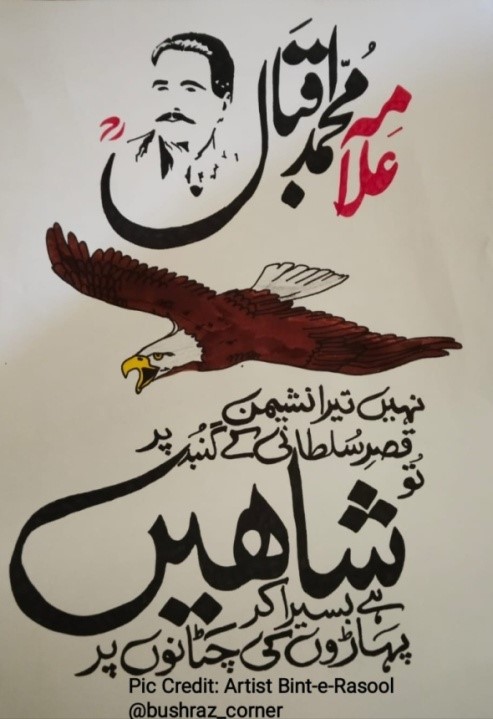
The Shaheen
Among Iqbal’s many metaphors, none is more enduring than the shaheen (falcon). Unlike the nightingale or dove—symbols of romance—the falcon embodied freedom, courage, and vision. It soars high, refuses to build nests, feeds only on its own hunt, and thrives in solitude.
For Iqbal, this bird symbolized the ideal youth: independent, fearless, untempted by comfort, and ever in pursuit of higher goals. He urged:
“Tu Shaheen hai, parwaz hai kaam tera,
Tere aage aasman aur bhi hain.”
(You are a falcon; flight is your vocation. Beyond you lie yet more skies.)
Through this image, Iqbal invited Muslims of the subcontinent to rise above despair and embrace their destiny. The shaheen was not just a bird; it was a call to action, a philosophy of life.
Legacy in Letters and Prose
Beyond poetry, Iqbal’s prose work Ilm-ul-Iqtisad (The Science of Economics) was the first economic treatise in Urdu. His letters, later compiled in Maktubat-e-Iqbal, offer invaluable insights into his philosophy. Renowned scholar Aal-e-Ahmad Suroor noted that Iqbal’s correspondence holds the same literary value as Ghalib’s letters—an archive of an era’s intellectual struggles.
In his English lectures, The Reconstruction of Religious Thought in Islam, Iqbal blended philosophy, theology, and politics, laying foundations for a renewed Islamic intellectualism.
A Poet of the East
Iqbal was not only a poet but a professor, philosopher, lawyer, and politician. He envisioned a world where individuals served both nation and humanity, rooted in spirituality yet open to progress. His verses became a staple in schools, universities, and mosques, inspiring generations.
At the heart of his message was self-realization (khudi), freedom, and the rediscovery of Islam’s glory. His influence shaped revolutionary poets like Josh Malihabadi and Faiz Ahmed Faiz, accelerating Urdu poetry’s modern transformation.
Final Flight
On April 21, 1938, Iqbal passed away in Lahore. His grave, beside the Badshahi Mosque, remains a site of pilgrimage. His epitaph reads:
“Ziyaratgah ahli azm-o-himmat hai lehad meri,
Ki khaaki rah ko maine bataya raazi alwandi.”
(Bold hearts, firm souls, come pilgrim to my tomb; I taught poor dust to rise and touch the sky.)
For Iqbal, poetry was never escapism. It was a mission, a torch in dark times. Whether through the soaring metaphor of the shaheen, his critiques of the West, or his call for selfhood, he left behind a legacy that continues to challenge, inspire, and console.
Reading Iqbal today, one cannot escape the sense that his words transcend time. His verses are not relics of colonial India but living truths—urging us to rise, reminding us that the skies are endless, and teaching us that within the soul lies the power to remake the world.
The views expressed in this article are solely those of the author and do not necessarily reflect the opinions or views of this newspaper. The author can be reached at [email protected]