A 30-day deadline, frozen bank accounts, and revoked passports. Lieutenant Governor Manoj Sinha declares a total war on drug syndicates, shifting the strategy from simple awareness to a ruthless systematic crackdown.
By Ajaz Rashid
On a hot Monday in Kathua, the atmosphere felt charged. The government had signaled a shift in strategy: they were no longer just managing the drug crisis, they were moving to end it.
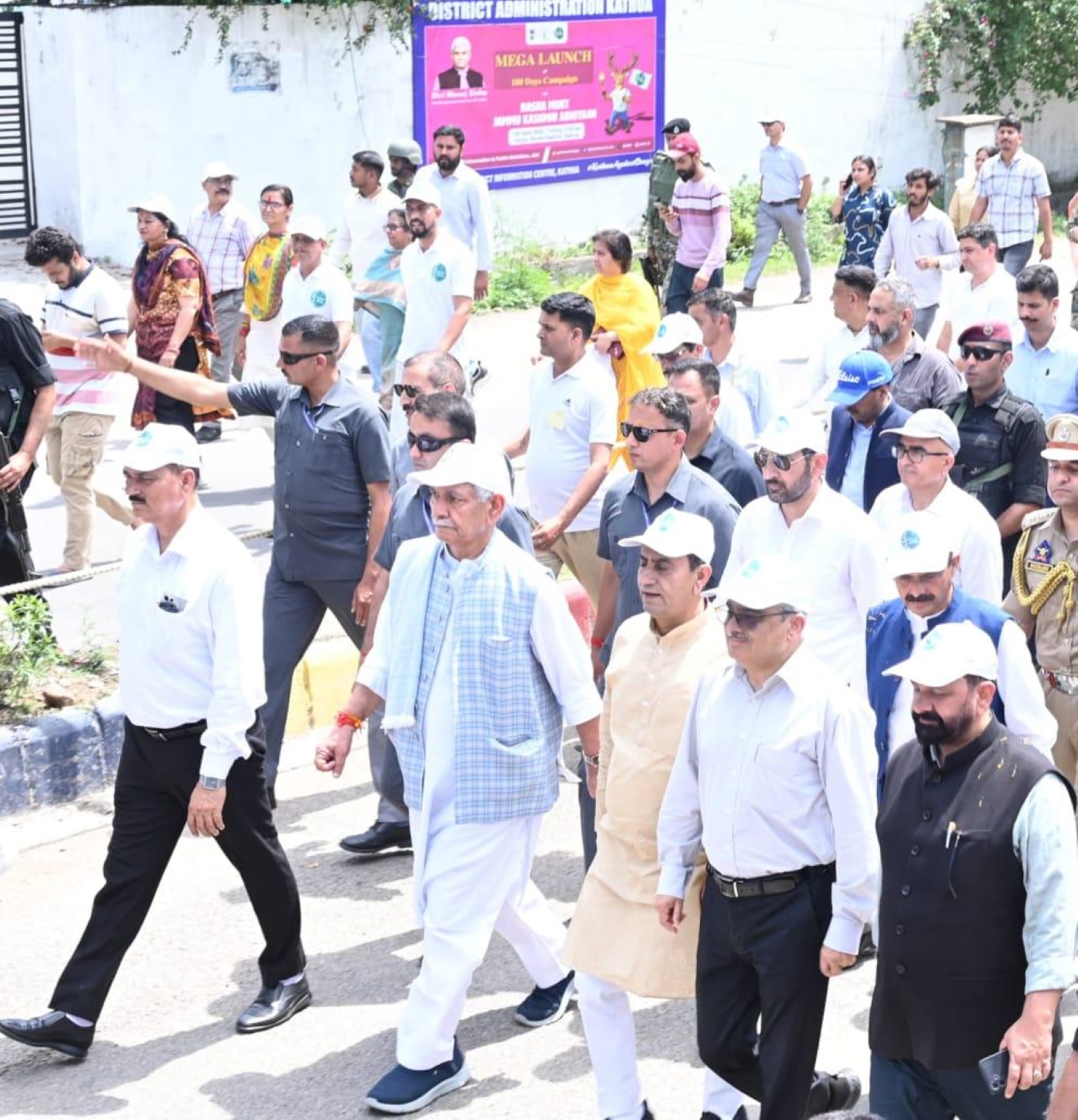
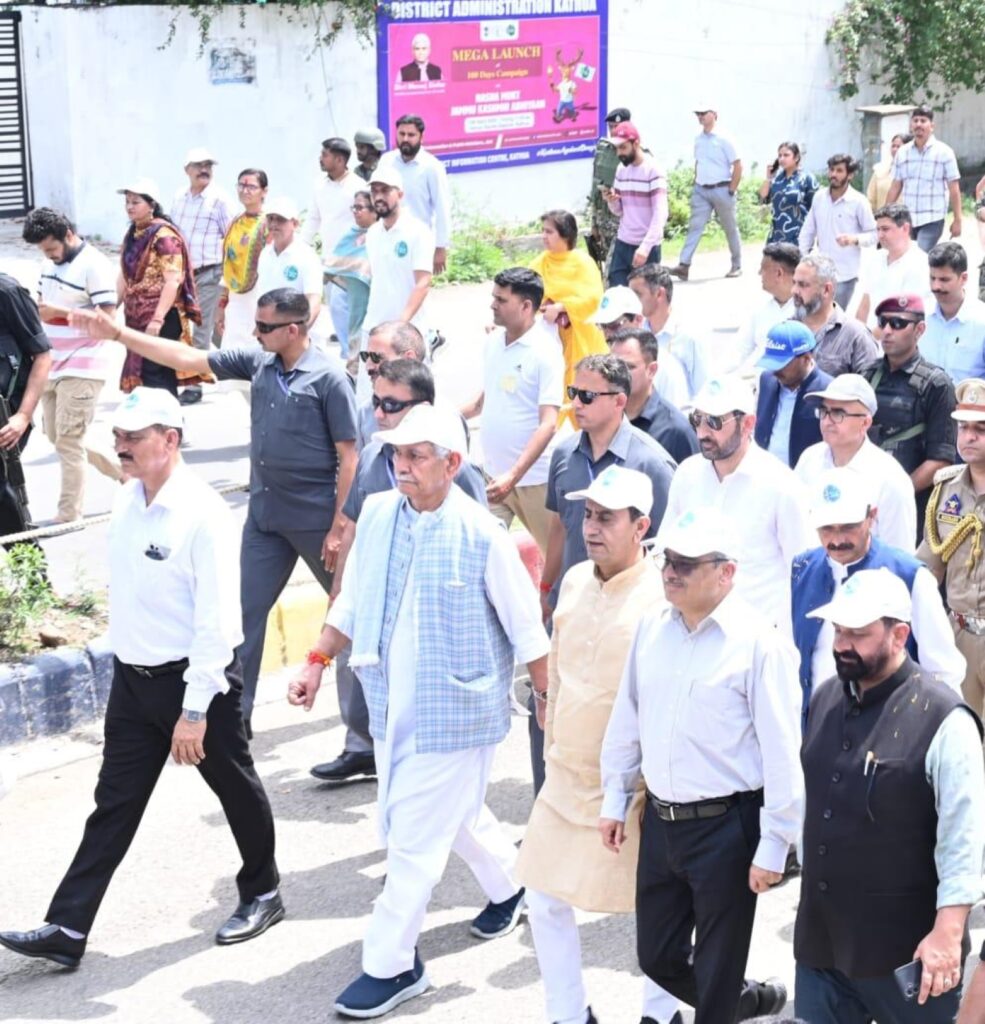
Leading a massive Padyatra from the Sports Stadium to Government Degree College, Lieutenant Governor Manoj Sinha moved through a sea of thousands. Students, civil society members, and saffron-clad activists walked shoulder-to-shoulder with senior officials. But while the march was a show of public unity, the rhetoric following it was a clinical declaration of war.
For decades, the specter of narcotics has haunted the valleys and plains of Jammu and Kashmir, evolving from a local nuisance into a sophisticated, cross-border machinery that threatens to “erode the honor and destiny” of entire villages. On Monday, the administration stopped pleading for change and started setting clocks.
The 30-Day Ultimatum
The centerpiece of the day was a stark directive issued to the police hierarchy: identify the “top drug peddlers” at every single Police Station and dismantle their networks within 30 days.
“Adopt a focused and time-bound approach for complete elimination of drug syndicate,” LG Sinha told officials, his tone leaving little room for the usual bureaucratic lag.
The strategy is no longer just about street-level seizures. The administration is pivoting toward a “scorched earth” legal policy. Under a newly notified Standard Operating Procedure (SOP), the government plans to treat smugglers not as mere criminals, but as existential threats to the state. The proposed crackdown includes the revocation of passports, driving licenses, and arms licenses.
“Under the NDPS Act, we will confiscate all movable and immovable assets, freeze bank accounts, and launch exhaustive financial probes,” Sinha warned. “I want to assure the people of Jammu Kashmir that no perpetrator will escape justice.”
Beyond the Uniform
Perhaps the most striking element of the “Nasha Mukt Jammu Kashmir” campaign is its admission that the police alone cannot win this. The Lieutenant Governor’s speech was peppered with a call for a “people’s revolution,” specifically targeting the “it’s not my problem” apathy that often shields local dealers.
In a move to institutionalize community surveillance, Sinha called upon women’s self-help groups to form “Women Vigilance Squads.” These groups are envisioned as the eyes and ears of the administration, monitoring neighborhoods and feeding real-time information to senior officials.
“People say, this isn’t my problem. This mindset must go,” Sinha remarked to the crowd. “We must remember that true prosperity stems not just from wealth, but vigilant and collective resolve.”
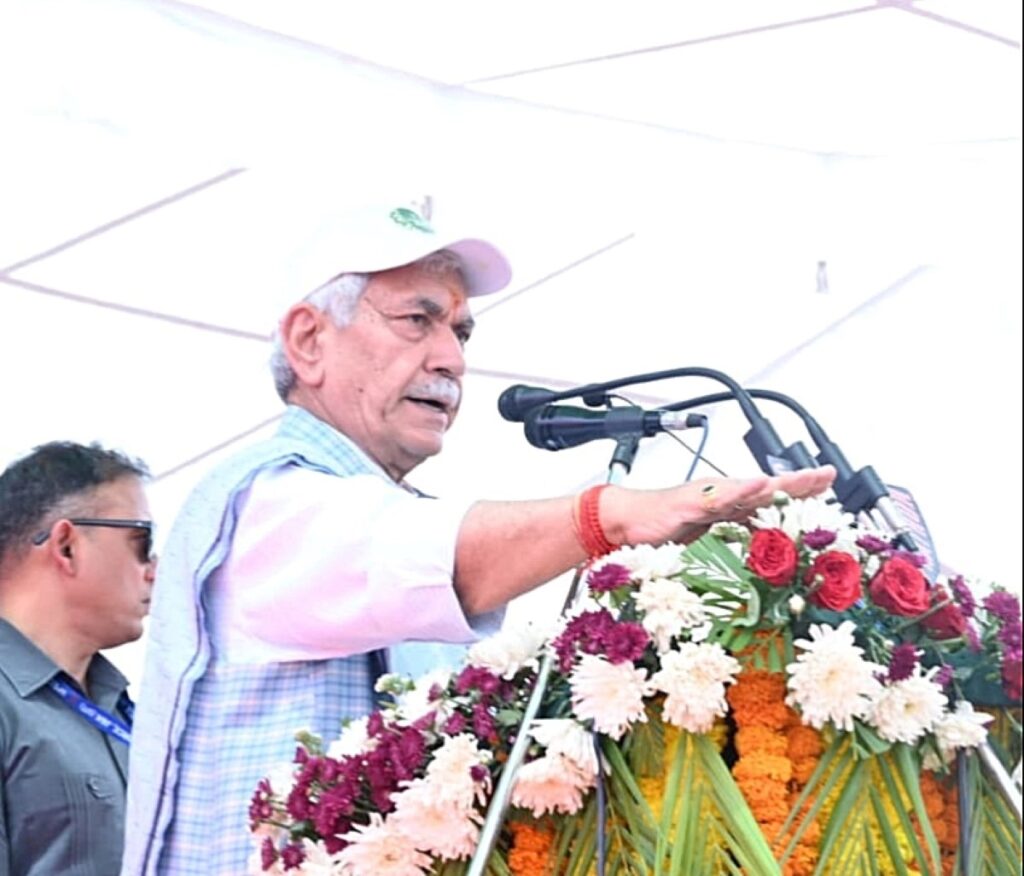
The philosophy here is simple: if the drug syndicate operates within the social fabric, the counter-offensive must be woven from the same cloth. “A youth who grasps life’s purpose becomes our strongest weapon against drugs,” he added, shifting the focus from the dealer to the potential victim.
The 100-Day Roadmap
The campaign is structured around a rigorous 100-day roadmap, divided into three distinct phases intended to move the needle from awareness to permanent systemic change:
| Phase | Timeline | Primary Objective |
| Month 1 | Days 1–30 | Ignition: Massive awareness and public mobilization. |
| Month 2 | Days 31–60 | Penetration: Deepening the reach into families and community units. |
| Month 3 | Days 61–100 | Sustainability: Cementing long-term structures for a drug-free J&K. |
“Next three months won’t just run a campaign but they will sow seeds for lasting change,” Sinha promised. He was careful, however, to draw a sharp line between the predator and the prey. While traffickers face “ruthless” crushing, the administration is preaching a doctrine of “compassionate rehabilitation” for those caught in the cycle of addiction.
“We must shift our mindset: addicts are patients and they need our help and support,” he said, calling for more humane and accessible centers where “lives are reclaimed.”
Zero Tolerance in the Summer Capital
As the drums rolled in Kathua, the echoes were felt in Srinagar. At Amar Singh College, Senior Superintendent of Police Dr. Sandeep Chakravarthy reinforced the timeline, describing the 100-day action program as a “national mission” rather than a routine policing exercise.
Chakravarthy’s focus is on the “ecosystem”, the hidden financial and logistical supports that allow drug dens to thrive in urban centers. “J&K Police have full clarity and a firm resolve. This is not just an awareness drive but a strategic action plan. In the next three months, visible results will be on the ground,” he said.
Crucially, the SSP addressed the primary barrier to public cooperation: fear. He offered a guarantee of “complete protection” for informants, promising that identities would remain strictly confidential. The goal is to turn the capital into a “drug-free district” as a benchmark for the rest of the territory.
Grassroots and Academics
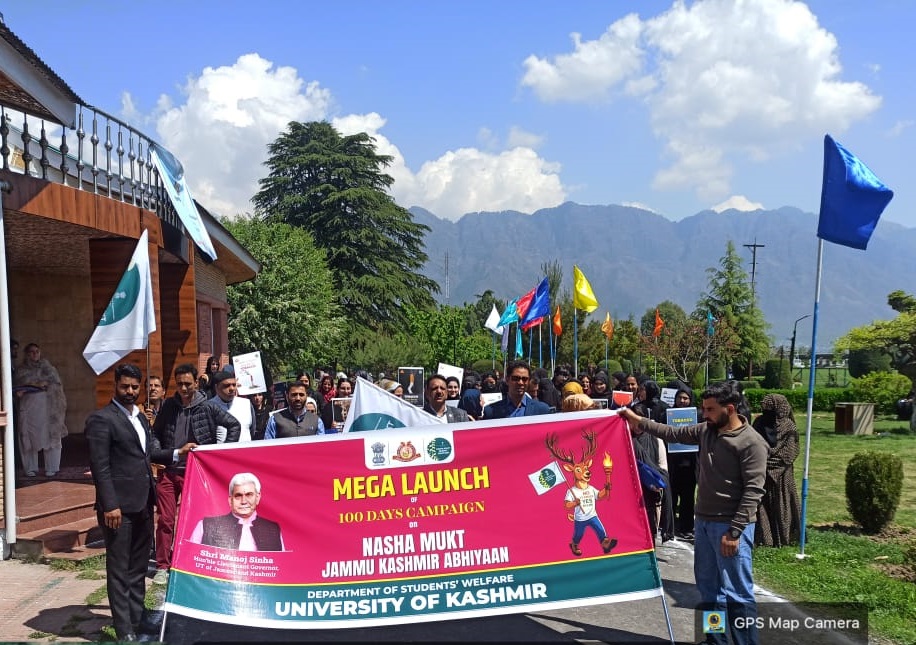
While the high-ranking officials set the policy, the actual work began on Monday in the dusty Panchayat Halqas of Bandipora and the manicured lawns of the University of Kashmir.
In Bandipora, a multi-departmental task force including officials from Health, Education, and Social Welfare descended on villages like Rakhi Sultanpora and Sumlar to conduct “IEC” (Information, Education, and Communication) sessions. The intent was to move beyond posters and talk directly to local residents about the “harmful effects of drug abuse” and “healthy lifestyle choices.”
In Srinagar, the University of Kashmir’s School of Law turned the campus into a staging ground for the movement. Vice-Chancellor Prof. Nilofer Khan emphasized that educational institutions must be proactive. “The Nasha Mukt Abhiyaan is a significant step towards creating awareness and empowering young minds to make informed and responsible life choices,” she stated during the launch.
The School of Law’s involvement highlights the legal dimension of the campaign, encouraging students to engage with the drug crisis as a pressing societal issue that exists “beyond the classrooms.”
“Pledge” vs. Reality
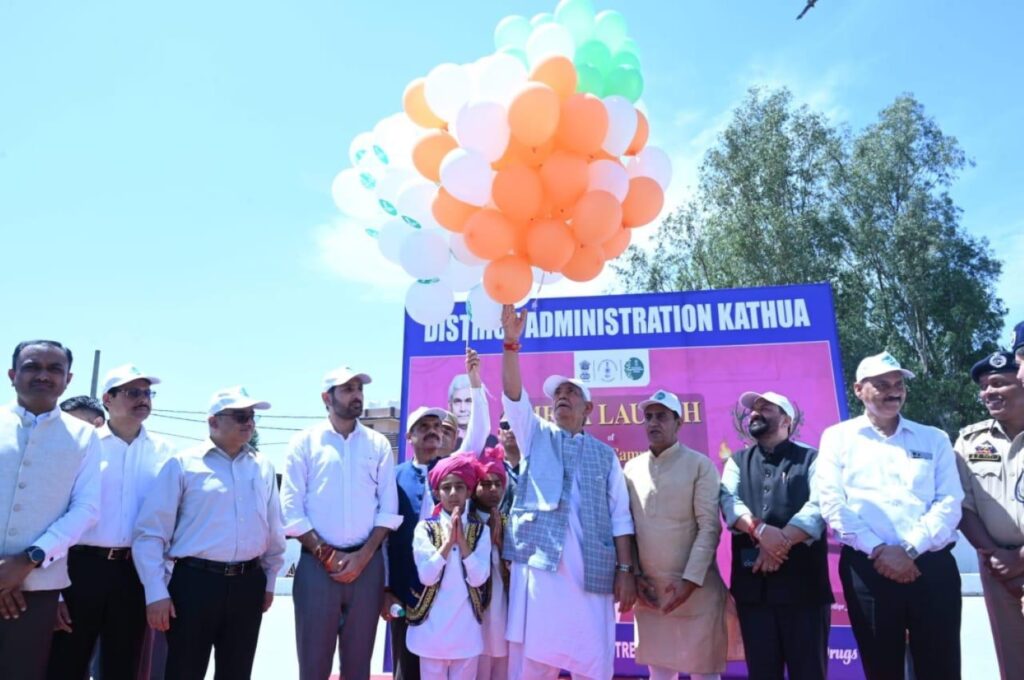
The event in Kathua concluded with the “Anti-Drug Pledge” and the launch of the Nasha Mukt Jammu Kashmir Anthem. Through Nukkad Nataks (street plays) and poetry, local artists attempted to do what policy papers often fail to do: reach the heart.
But for Manoj Sinha, the success of this campaign won’t be measured by the volume of the anthem or the length of the Padyatra. It will be measured in thirty days, when the “top drug peddlers” lists are reviewed, and in one hundred days, when the “seeds for lasting change” are expected to sprout.
“I ignite a people’s revolution to eradicate drugs from every panchayat, every alley, every family,” the LG told the people of Kathua. “This is no dream, it’s my unbreakable pledge.”
As the 100-day clock begins to tick, the people of Jammu and Kashmir are watching. The administration has promised a crackdown that is “ruthless” to the syndicate and “merciful” to the victim. Whether this time-bound approach can truly dismantle a multi-generational crisis remains the region’s most pressing question. One thing is certain: for the drug networks of J&K, the next 30 days will be very, very long.
Leave a Reply