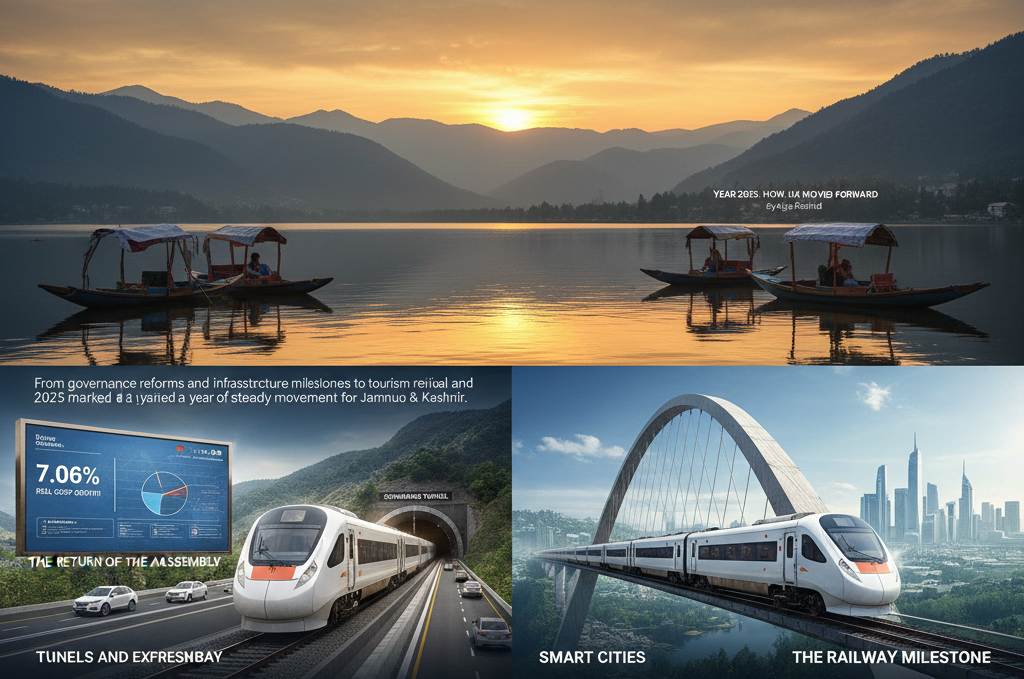
From governance reforms and infrastructure milestones to tourism revival and social welfare, 2025 marked a year of steady movement for Jammu & Kashmir.
As the sun sets over the peaks of the Zabarwan Range this December, the reflection on the waters of the Dal Lake carries more than just the golden hue of winter. For Jammu and Kashmir, 2025 has been a year where the echoes of a turbulent past were increasingly drowned out by the hum of construction, the whistle of new trains, and the vibrant cheers from sports arenas.
In what many are calling the “Year of Aspiration,” the Union Territory has witnessed a structural and psychological shift. From the inauguration of the transformative Sonamarg Tunnel to the successful seating of its first elected Legislative Assembly in a decade, J&K is navigating a new chapter—one defined by connectivity, institutional strength, and a burgeoning economic resilience.
The Return of the Assembly
The defining political image of 2025 remains the floor of the Jammu and Kashmir Legislative Assembly. Following the peaceful elections held in late 2024, the year 2025 marked the first full year of an elected government led by Chief Minister Omar Abdullah.
While the Lieutenant Governor’s office continues to provide a steady hand in administration and security, the revival of the democratic process has brought a renewed sense of agency to the local populace. The Assembly has become a focal point for debating development, with the Chief Minister recently tabling an Economic Survey that projects a 7.06% real GSDP growth for the 2024-25 fiscal year.
“The story of J&K is no longer dominated by the narrative of shutdowns,” says a local political analyst in Srinagar. “It is now a conversation about budget allocations, job creation, and last-mile delivery.”
Social Programmes and Community Impact
Government initiatives this year extended into social empowerment. Central schemes benefited more than 34,700 women from minority communities, advancing inclusion and economic participation.
Beyond economic support, cultural and historical assets came to the fore. A stone sculpture of goddess Durga recovered from the Jhelum River in Baramulla sparked excitement among archaeologists and heritage activists, and was formally handed over for preservation — a testament to the region’s rich cultural tapestry.
Sport and celebration also found their place. Preparations for events such as the Jashn-e-Dal Kashmir Marathon highlighted a blend of athletic spirit and communal harmony, drawing participants and spectators alike.
The Railway Milestone
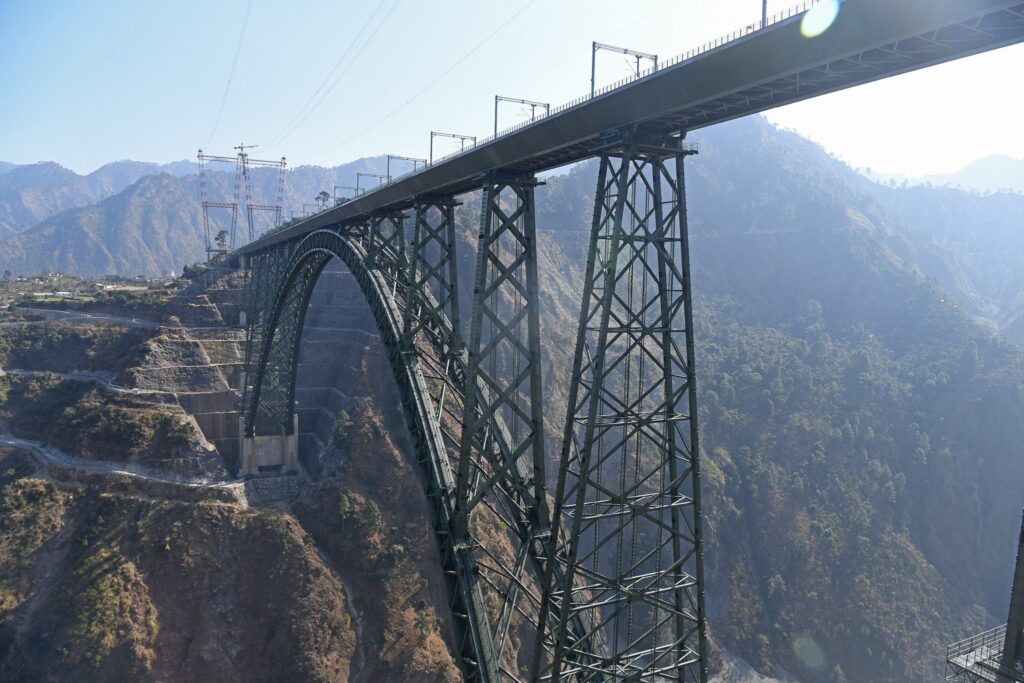
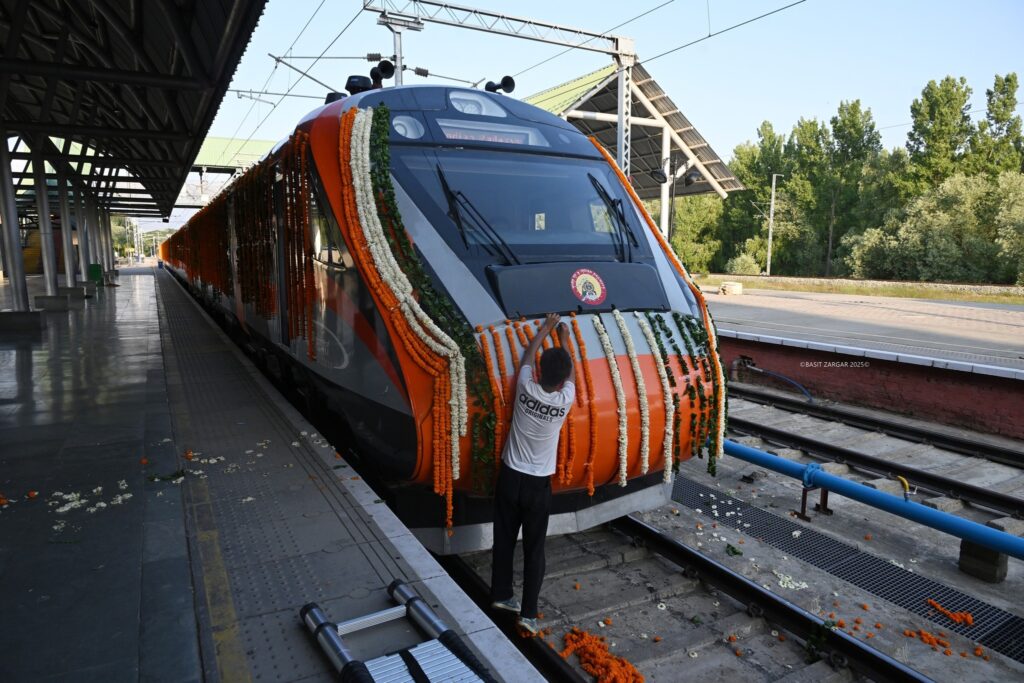
The Udhampur-Srinagar-Baramulla Rail Link (USBRL) reached its crescendo this year. The introduction of Vande Bharat services to Srinagar has not only shortened distances but has also integrated the valley’s economy more deeply with the national market. The world’s highest railway bridge over the Chenab River stands as a global engineering marvel, now facilitating the movement of goods and people year-round, unhindered by the traditional winter closures of the national highway.
Tunnels and Expressways
In January 2025, Prime Minister Narendra Modi inaugurated the Sonamarg Tunnel, ensuring that the “Meadow of Gold” remains accessible even during the heaviest snowfalls. Simultaneously, work on the Delhi-Amritsar-Katra Expressway has reached its final stages, promising to bring the holy city of Katra within a six-hour drive from the national capital.
Growth Beyond Tourism
While tourism remains the soul of the Kashmiri economy, 2025 saw a strategic diversification. The UT’s nominal GSDP is estimated to reach ₹2.65 lakh crore, driven by a massive push in the “Tertiary Sector,” which now contributes nearly 62% of the region’s value added.
- Financial Inclusion: In a startling statistic, J&K saw a ten-fold increase in its investor base on the National Stock Exchange over the last decade, reaching 6.51 lakh investors in 2025.
- Mission YUVA: The government’s flagship employment initiative has gained momentum, aiming to create over 4.25 lakh jobs and 1.37 lakh enterprises over the next five years.
- Smart Cities: As of December 2025, over 279 projects have been completed across Jammu and Srinagar under the Smart Cities Mission, transforming urban landscapes with better lighting, pedestrian zones, and digital governance.
Tourism
The tourism sector faced a significant test this year. Following a tragic incident in Pahalgam earlier in the year, there were concerns about a total slump. However, the numbers tell a story of remarkable recovery.
By mid-2025, J&K had already welcomed over 95 lakh domestic tourists. The government’s “Operation Sindoor” and enhanced security protocols provided the necessary confidence for travelers to return. By the winter season, Gulmarg was back to 100% occupancy, bolstered by the launch of Asia’s longest ski drag lift in December, positioning the region as a premier international winter sports destination.
The New Face of Youth
If the infrastructure is the bones of the new J&K, the youth are its heartbeat. The year 2025 has been a “Golden Year” for sports in the Union Territory.
- Para-Sports: Para-archer Sheetal Devi continued her world-dominating streak, clinching gold at the World Para Archery Championship.
- Cricket: The election of “son of the soil” Mithun Manhas as the BCCI President sent waves of pride across the region.
- IPL Stars: Local talents like Umran Malik and Abdul Samad continue to be mainstays in the IPL, serving as icons for thousands of aspiring cricketers in the valley’s districts.
Educational reforms have complemented this sporting surge. With over 1,000 schools now offering vocational training to 1.4 lakh students, the focus has shifted toward “employability.” The establishment of an AIIMS, IIT, and IIM in Jammu has turned the city into a unique educational hub, the only one in India to host all three premier institutions.
Healthcare
Under the Ayushman Bharat Digital Mission, J&K has achieved a milestone by creating over 1.07 crore ABHA IDs, covering nearly 79% of the target population. The inauguration of AIIMS Jammu (built at a cost of ₹1,660 crore) has drastically reduced the need for patients to travel to Delhi or Chandigarh for advanced medical care, providing a lifeline to residents of J&K and neighboring Ladakh.
As 2025 draws to a close, Jammu and Kashmir is no longer a region merely “waiting for normalcy.” It is a region actively defining its own future. The vanishing of stone-pelting and separatist-called shutdowns has been replaced by a competitive race for development.
Challenges remain—particularly in navigating the delicate balance between rapid infrastructure growth and the region’s fragile ecology—but the momentum is undeniable. For the people of Jammu and Kashmir, the year 2025 was the year they stopped looking back at what was lost and started looking forward to what can be built.
Leave a Reply