Nasira Begum’s journey shows how rural women are transforming livelihoods and creating jobs through SHG-backed entrepreneurship.
By Arsheed Ahmad Bhat
In the remote border village of Chitterkote in Teetwal block of Kupwara district, a quiet yet powerful story of resilience and enterprise is unfolding. Against the backdrop of the Line of Control and the challenges that come with living in a frontier region, Nasira Begum has carved out a path of economic independence through determination, community support, and the opportunities created under the Jammu & Kashmir Rural Livelihoods Mission.
Nasira Begum, wife of Khalid Khan, is a member of the SAIMA Self Help Group in Chitterkote village. Like many women in rural and border areas of Jammu and Kashmir, she once faced limited opportunities for earning a stable income. Household responsibilities and the lack of economic avenues often restrict women’s participation in local economies. However, the emergence of Self Help Groups under the Rural Livelihoods Mission has begun to change that reality by promoting financial inclusion and entrepreneurship among women.
Driven by a desire to improve her family’s financial condition and secure a better future for her children, Nasira Begum joined the SAIMA Self Help Group several years ago. The collective platform provided her not only with financial access but also with training, guidance, and a network of support from other women in the village. Through the structured credit system facilitated by the mission, she gradually began exploring ways to start an income generating activity.
With institutional support, Nasira Begum first availed a loan of ₹15,000 to initiate her enterprise. The loan was carefully utilised and repaid on time, strengthening her creditworthiness within the Self Help Group system. Encouraged by her discipline and commitment, she subsequently accessed a larger bank linked loan of ₹3,00,000 along with an additional Village Organisation loan of ₹30,000.
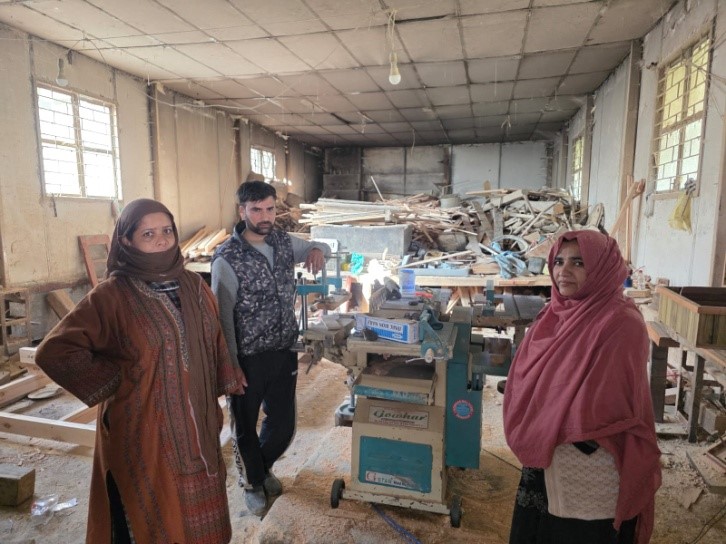
These financial resources became the foundation for a bold entrepreneurial venture in a remote border area where such enterprises are still rare. With the assistance of her husband, Nasira Begum established a joinery mill in their locality. The unit specialises in manufacturing doors, windows, wooden furniture, and other carpentry products that are in constant demand in nearby villages and construction sites across the Teetwal and Karnah regions.
Over time the joinery mill has evolved into a stable livelihood enterprise. According to officials associated with the Rural Livelihoods Mission, the unit is currently generating an annual income of around ₹2.5 lakh for the family. For a household in a remote border village, this steady income has brought significant financial stability and reduced economic uncertainty.
Beyond supporting her own family, the enterprise has also begun to benefit the wider community. The joinery mill has created employment opportunities for local youth who assist in carpentry work, wood cutting, and finishing. In areas where employment options are limited and seasonal migration often becomes the only choice, such small rural enterprises play an important role in sustaining the local economy.
The economic progress achieved through the enterprise has brought visible changes to the family’s quality of life. Improved income has enabled better access to education for children, improved healthcare, and greater financial security. Household expenses that once seemed difficult to manage are now more predictable and manageable.
Equally significant is the transformation in Nasira Begum’s personal journey. From being a homemaker with limited economic agency, she has emerged as a confident entrepreneur and a respected member of her community. Her participation in Self Help Group meetings, financial decision making, and enterprise management has strengthened her leadership skills and self confidence.
Local officials working with the Rural Livelihoods Mission say such stories are increasingly emerging from rural Jammu and Kashmir as the Self Help Group movement expands across villages. Thousands of women have become part of SHG networks that promote savings, credit access, and entrepreneurship through a community based institutional structure.
“Officials of JKRLM stated that such success stories underscore the critical role of Self Help Groups in promoting financial inclusion and sustainable livelihoods, particularly in remote and border areas.”
According to government data, the Rural Livelihoods Mission has mobilised hundreds of thousands of women into Self Help Groups across Jammu and Kashmir in recent years. These groups are connected to village organisations and cluster level federations that provide training, financial linkages, and capacity building support. The mission aims to enable women to establish micro enterprises in sectors such as agriculture, handicrafts, food processing, tailoring, livestock rearing, and rural services.
In border regions like Teetwal, where geographic isolation and limited economic infrastructure often restrict development, such initiatives have a deeper impact. Small enterprises not only enhance household incomes but also strengthen local resilience by creating economic activity within villages.
Nasira Begum’s joinery mill stands today as a symbol of that transformation. What began as a modest aspiration supported by a small loan has grown into a sustainable enterprise serving surrounding communities.
“Nasira Begum’s journey is a testament to how timely institutional support, community participation, and determination under JKRLM can transform lives and foster inclusive rural development.”
The views expressed in this article are solely those of the author and do not necessarily reflect the opinions or views of this newspaper
Leave a Reply