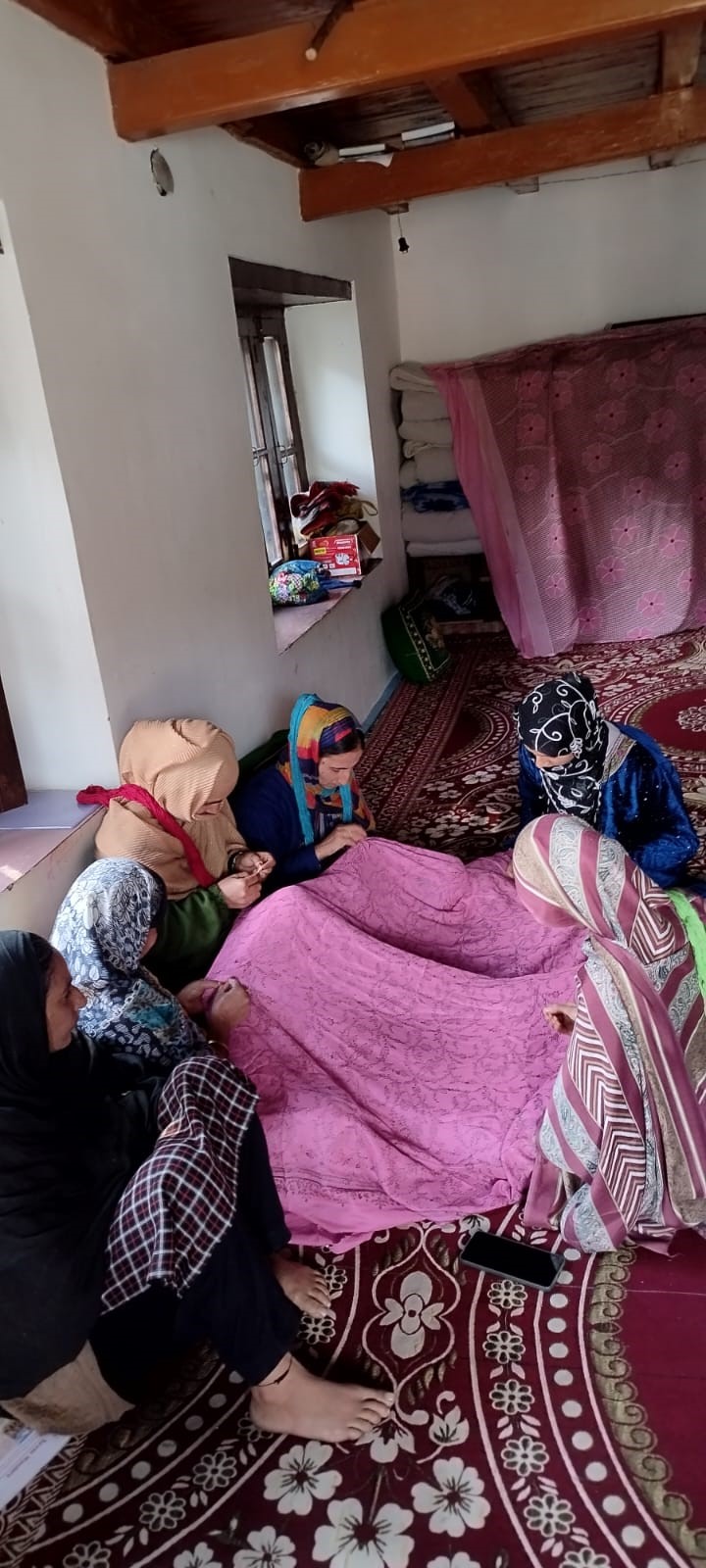
In Simari, the final village on the LoC, 14 women are trading isolation for entrepreneurship. See how the Jammu & Kashmir Rural Livelihoods Mission is turning traditional needlework into a powerful tool for financial independence.
In Simari, the last Indian village perched along the Line of Control (LoC) in North Kashmir, the sound of the needle is replacing the silence of isolation. In a landmark expansion of the Jammu & Kashmir Rural Livelihoods Mission (JKRLM), the mission has successfully bridged the developmental gap in this sensitive border zone, turning traditional embroidery into a tool for economic resistance. What began as a group of 14 motivated women has evolved into a cohesive Self-Help Group (SHG) that is now a cornerstone of the Teetwal block’s rural economy. These women are leveraging generations of ancestral knowledge in needlework and handicrafts—specifically crewel embroidery and Sozni—to create high-value products. By transitioning from domestic chores to collective entrepreneurship, the women of Simari are no longer just residents of a “last mile” village; they are active participants in J&K’s growing rural economy, which now boasts over 94,000 active SHGs as of 2026.
The success in Simari is part of a massive upward trend in the Union Territory’s socio-economic landscape, fueled by the “Lakhpati Didi” initiative. This national movement aims to ensure that every rural woman entrepreneur earns a minimum annual income of ₹1,00,000. Currently, J&K has successfully transformed over 2.0 lakh women into Lakhpati Didis, with a target of reaching 2.33 lakh by the end of this fiscal year. To support this growth, the mission has introduced the Lal Ded Stree Shakti Loan, providing microfinance of up to ₹2 Lakh to help SHG members scale their handicraft units into full-fledged micro-enterprises.
By providing training and direct market linkages through platforms like the “Ashakari” exhibitions and District Rural Haats, the JKRLM is dismantling the barriers of geography that once isolated border communities. For the women of Simari, this is more than an income stream; it is a newfound social authority. Their journey from the edge of the border to the center of the entrepreneurial map stands as a powerful testament to the transformative power of collective action. As Kupwara continues to witness a robust 10.6% increase in rural economic well-being, Simari’s pioneers are leading the charge for an inclusive, self-reliant Jammu & Kashmir. This initiative is expected to inspire more women in nearby villages to form SHGs, further strengthening the vision of “Viksit Bharat” from the ground up.
The views expressed in this article are solely those of the author and do not necessarily reflect the opinions or views of this newspaper
Leave a Reply