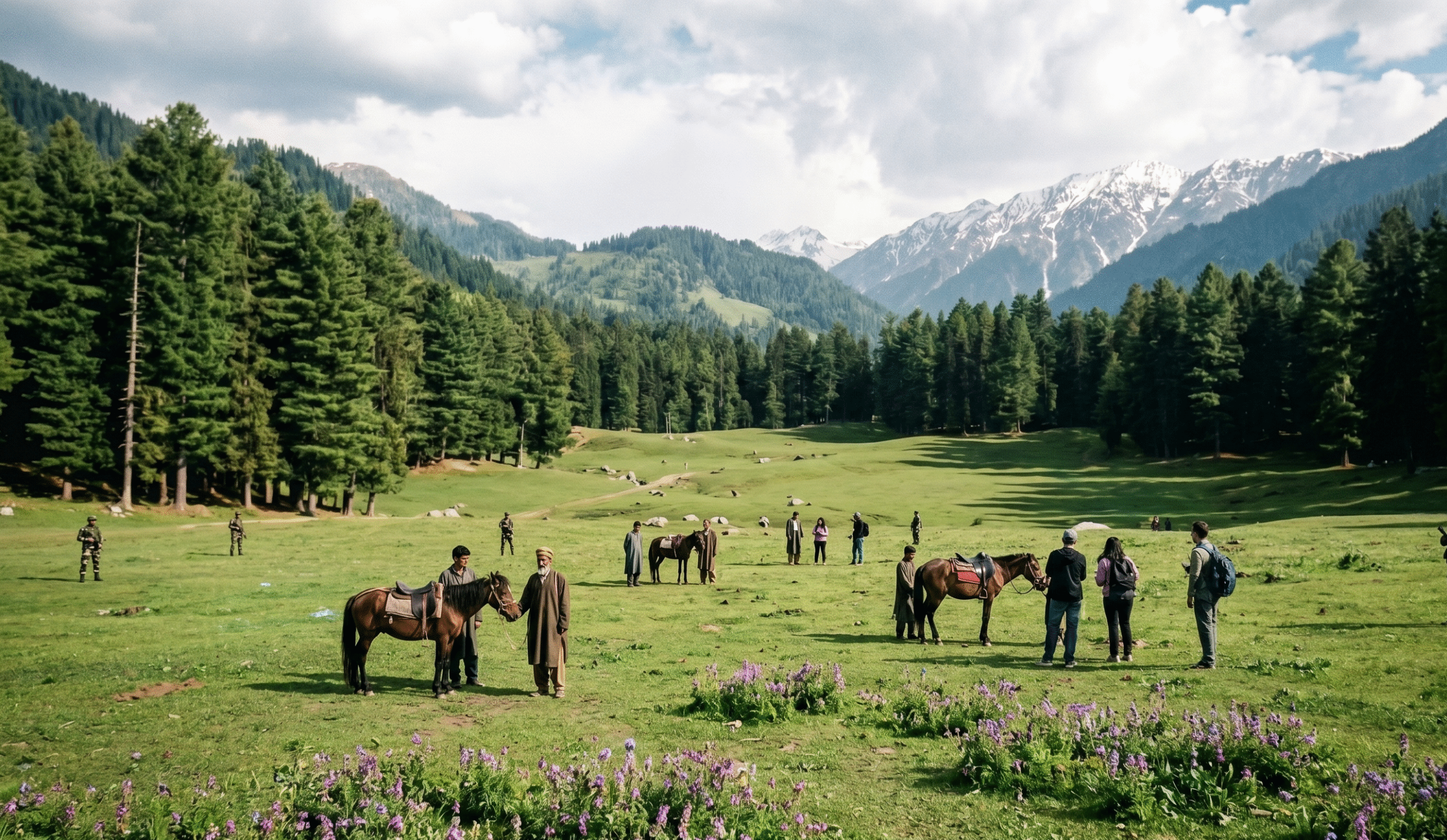
A Year Since the Pahalgam Massacre, the nation honors the 26 lives lost and the local heroes who stood against the darkness. Their sacrifice has fueled a year-long mission to dismantle terror modules and secure a peaceful future for every citizen.
By Ajaz Rashid
A year ago, on April 22, 2025, the crisp mountain air of Baisaran tourist haven was shattered by the staccato of M4 carbines and AK-47s. Today, as Jammu and Kashmir approaches the first anniversary of the Pahalgam terror attack, the landscape is a study in contrasts: the breathtaking beauty of the Himalayas remains, but it is now framed by a “steel carpet” of security that stretches from the pews of religious shrines to the farthest reaches of the International Border.
For India, the wounds of April 22 are still fresh. The attack, which claimed 26 lives, mostly tourists from across the country and a local hero who stood his ground was more than a security breach; it was a calculated assault on the soul of the Union Territory’s economic engine. One year later, the mood is one of solemn remembrance, coupled with a fierce, renewed resolve.
The Day the Meadow Turned Red
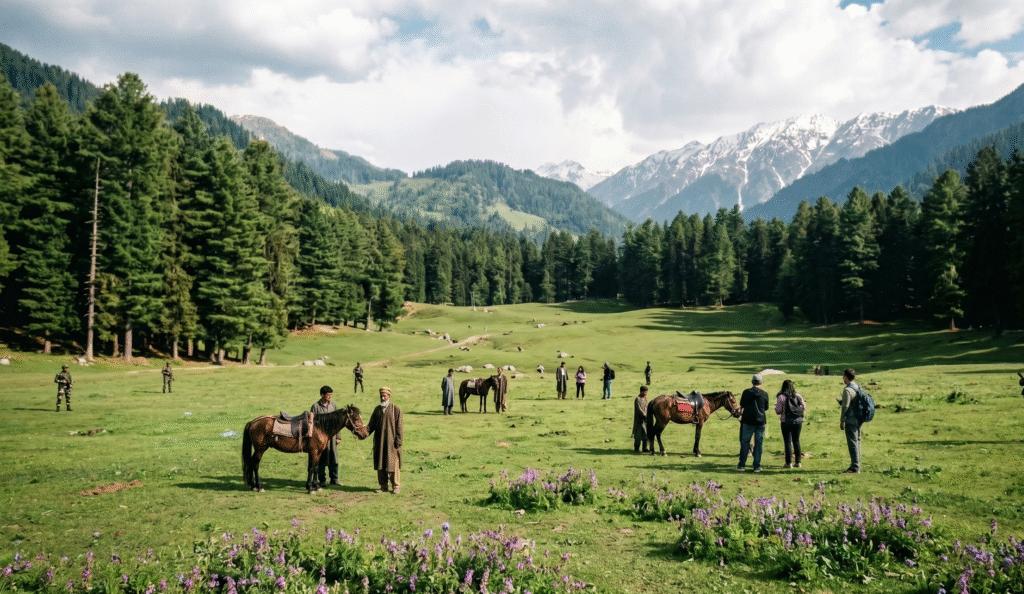
It was approximately 1:00 PM on a Tuesday when the horror began. Witnesses recall a group of terrorists, some clad in military-style fatigues and others in traditional Kashmiri pherans, infiltrating the fenced Baisaran meadow. This 800-meter-long stretch of emerald grass, accessible only by foot or pony, was teeming with families and newlywed couples.
The brutality was cold and sectarian. Survivors recounted how the attackers separated men from women, specifically targeting Hindus. In a display of chilling cruelty, some victims were asked to recite religious verses, while others were subjected to humiliating “checks” before being executed at point-blank range.
Among the 26 who perished was Syed Adil Hussain Shah, a local pony handler. In an act of extraordinary courage that has since become a symbol of Kashmiri resistance against radicalism, Shah attempted to wrestle a weapon from one of the terrorists. He was shot dead, but his sacrifice is credited with providing a momentary distraction that allowed several others to scale the perimeter fence and escape into the dense pine forests.
The Crackdown
The response from New Delhi was swift and uncompromising. Within weeks of the massacre, the Indian government launched Operation Sindoor, a multi-dimensional military campaign aimed at dismantling the infrastructure of terror across the Line of Control.
“The message was clear: there is no place to hide,” says a senior security official involved in the post-attack strategy. Following detailed intelligence, Indian forces neutralized nine key terror camps in PoJK and Pakistan, including major hubs in Bahawalpur and Muridke. The strikes reportedly destroyed nearly 20% of the adversary’s air defense and ammunition infrastructure, forcing a desperate call for a ceasefire by May 10, 2025.
Closer to home, the internal cleanup has been equally relentless. Over the past 12 months, security agencies have significantly strengthened the “Grid.” According to data from the White Knight Corps:
- 46 terrorists have been eliminated since the Pahalgam attack.
- 7 high-value targets were neutralized in the Kishtwar district alone during 2025-26.
- Saifullah, a notorious Jaish-e-Mohammad (JeM) commander, was killed in the Chatroo forests on February 22, 2026.
- Usman alias Abu Maviya, another key operative, was cornered and killed in Kathua’s Billawar area in January.
These operations have not just been about numbers; they have been about reclaiming the high ground. Winter deployments in the upper reaches, which were previously abandoned during heavy snow, are now permanent fixtures, effectively choking the infiltration routes used by groups like The Resistance Front (TRF).
The QR Code Revolution
Perhaps the most visible change for the thousands of tourists returning to Pahalgam is a small, black-and-white square: the QR Code.
In the aftermath of the attack, the National Investigation Agency (NIA) identified gaps in the monitoring of local service providers. To bridge this, the J&K administration has introduced a mandatory QR code-based identification system. From the pony handler who leads you up the trail to the photographer who captures your memories, every stakeholder now wears a badge of digital trust.
“It’s about accountability,” says Anuj Kumar, Senior Superintendent of Police. “With a single scan, a tourist or a security officer can see the Aadhaar-verified details, police clearance, and professional registration of any service provider. It has replaced the easily forged physical IDs of the past.”
So far, over 7,000 QR codes have been issued, with a target of 25,000. For local union leaders like Abdul Wahid Wani, the move is a welcome shield for their livelihoods. “Our bread and butter depends on the safety of our guests. If a scan makes a tourist feel safe, we are 100% behind it,” Wani says.
Security Grid
As the April 22 anniversary nears, Jammu and Kashmir is under a high-alert blanket. Security has been beefed up not just in tourist hubs like Gulmarg and Sonamarg, but at vital religious installations.
The Vaishno Devi shrine in the Trikuta hills has seen a massive surge in surveillance, with additional paramilitary companies deployed along the trekking routes. In the Jammu region, districts along the International Border—Kathua, Samba, and Rajouri—are under 24/7 drone surveillance following reports of “sleeper” movements.
| Area | Security Measure |
| Pahalgam | QR Code IDs, intensified patrols in Baisaran, 18 “vulnerable” hotspots secured. |
| Samba/Kathua | Heightened vigilance at Border Police Posts (Koulpur, Kamore), joint BSF-Police coordination. |
| Kishtwar/Udhampur | Forest-range operations to flush out remnants of JeM and Lashkar modules. |
| Srinagar | Increased CCTV monitoring and “Area Domination” exercises in old city and civil lines. |
The impact of the 2025 attack was felt deeply in the tourism sector, which saw a sharp, immediate decline. Nearly 50 destinations were temporarily shuttered for security audits. However, the recovery has been a testament to India’s resilience.
Today, Pahalgam is bustling again. The Baisaran meadow, once a crime scene, is once again filled with the laughter of children though now, a discreet but armed presence remains at the perimeter. The government’s proactive stance has sent a signal to the world: J&K is open, and it is defended.
As the sun sets over the Lidder River on the eve of the anniversary, the sentiment in the Valley is one of cautious optimism. The “Pahalgam Massacre” was intended to divide and deter; instead, it has led to a more sophisticated, tech-driven, and unified security architecture.
“We remember the 26 lives we lost,” says a local shopkeeper near the Pahalgam market, pointing toward the mountains. “But we also see the change. The terrorists wanted to close these gates forever. Instead, they’ve only made our resolve to keep them open even stronger.”
For the security agencies, the anniversary is not just a day of mourning, but a deadline to ensure that the peace won through blood and “Operation Sindoor” remains unshakable. The grid is strengthened, the hills are watched, and the message to the perpetrators remains as it was a year ago: The cost of targeting the innocent is a price you cannot afford to pay.
Leave a Reply