The traditional family structure is facing unprecedented strain. Rapid social and economic shifts are quietly redefining relationships.
By Syed Mustafa Ahmad
The family, long regarded as the foundational unit of society, is undergoing a profound transformation. For centuries, it has served not merely as a social arrangement but as a nurturing ground for emotional security, moral values and identity formation. From early human settlements to modern civilizations, the idea of living together, sharing responsibilities and building bonds of care shaped what we recognize today as the family system. Yet, in contemporary times, this institution appears increasingly fragile, caught between tradition and the pressures of a rapidly changing world.
Historically, the emergence of the family marked a turning point in human evolution. As communities formed, individuals began to organize themselves into structured relationships parents, siblings and extended kin. This collective living provided stability, protection and emotional anchorage. The joint family system, particularly prevalent in South Asia, became a model of shared responsibility where multiple generations lived under one roof, pooling resources and supporting one another through life’s uncertainties.
However, the last few decades have witnessed a steady shift away from this arrangement. Data from India’s National Family Health Survey (NFHS-5) and various socio-economic studies indicate a consistent rise in nuclear households, especially in urban and semi-urban areas. While nuclear families are not inherently problematic, their rapid expansion often reflects deeper socio-economic changes that are reshaping interpersonal relationships.
One of the most significant drivers of this shift is the growing dominance of material aspirations. Economic liberalization and consumer culture have redefined success in terms of income, assets and individual achievement. In such a climate, relationships are increasingly evaluated through a utilitarian lens. Family members who are not financially contributing such as the elderly or those engaged in unpaid roles often find themselves marginalized. This subtle erosion of respect and emotional reciprocity weakens the very fabric that once held families together.
Equally influential is the cultural shift fueled by media and globalization. Popular cinema, television and digital platforms frequently portray nuclear families as symbols of independence and modernity. While these representations are not without merit, their uncritical imitation has contributed to the gradual decline of joint family systems. The aspiration to emulate perceived “modern lifestyles” often overlooks the social and emotional costs of such transitions.
The changing nature of work has also played a crucial role. With more dual-income households than ever before, family dynamics have been fundamentally altered. According to recent labour force data, women’s participation in the workforce though still evolving has increased significantly in urban India. This shift has empowered individuals but has also reduced the time available for traditional caregiving roles. As both parents juggle professional responsibilities, children are often raised in more structured, institutional environments, and intergenerational interaction diminishes.
Perhaps the most troubling aspect of this transformation is the growing neglect of the elderly. Reports by organizations such as HelpAge India highlight a worrying trend: a significant proportion of senior citizens report experiencing neglect, emotional abandonment or even abuse within their own families. What was once a relationship defined by gratitude and reverence is, in some cases, being replaced by indifference. The emotional testimony of many elderly individuals who feel like burdens despite having devoted their lives to their families underscores a deeper moral crisis.
At the same time, the absence of accessible family counselling mechanisms has exacerbated conflicts. In many cases, disputes that could be resolved through dialogue and mediation escalate into permanent fractures. Professional counselling services, though growing, remain limited in reach, particularly in rural and semi-urban regions. Without these support systems, families often resort to separation as the easiest solution, even for minor disagreements.
Another underlying factor is the increasing sense of isolation in modern life. Despite living in an age of unprecedented connectivity, individuals often feel disconnected from meaningful relationships. The pursuit of personal space and independence, while important, sometimes leads to emotional detachment. The result is a paradox: people surrounded by technology yet deprived of genuine human connection.
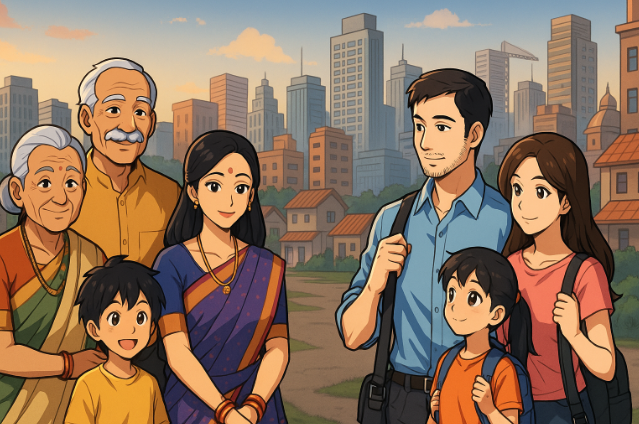
It is important, however, not to romanticize the past uncritically. Joint families were not without their challenges issues of hierarchy, lack of privacy and gender inequality were often embedded within them. The goal, therefore, should not be a wholesale return to older structures but a thoughtful reimagining of family values in a contemporary context.
Strengthening the institution of family requires a balanced approach. Economic progress must be complemented by emotional intelligence. Respect for all members irrespective of their financial contribution needs to be restored. Policies that support work-life balance, community-based elder care and accessible counselling services can play a significant role in this regard. Educational institutions, too, can contribute by fostering values of empathy, cooperation and social responsibility among younger generations.
Ultimately, the survival of the family as a meaningful institution depends on a collective willingness to adapt without losing its core essence. Families must evolve with the times, but not at the cost of compassion and mutual support. The challenge lies in reconciling modern aspirations with timeless values.
The institution of family may be under strain, but it is not beyond repair. Its revival does not lie in nostalgia, but in conscious effort in choosing connection over convenience, empathy over indifference and togetherness over isolation.
The views expressed in this article are solely those of the author and do not necessarily reflect the opinions or views of this newspaper
Leave a Reply