By Agencies
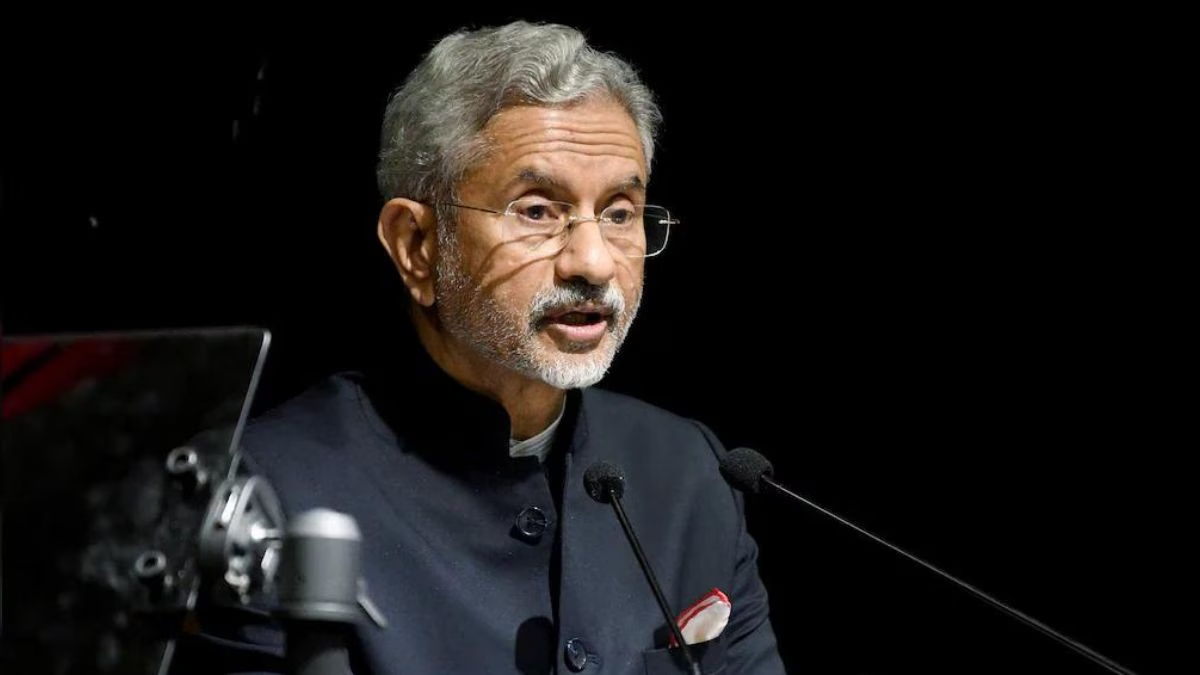
New Delhi, May 4: External Affairs Minister S Jaishankar has rejected recent remarks by US President Joe Biden describing India as “xenophobic” and emphasised that the country has been open and welcoming to people from diverse societies.
Speaking to the Economic Times, Jaishankar also refuted the allegation that the Indian economy was faltering. The Union Minister said that the Citizenship Amendment Act (CAA) introduced by Prime Minister Narendra Modi-led government showcases India’s welcoming approach.
On April 2, Biden had said the “xenophobic” nature of India, China, Japan and Russia is responsible for their economic troubles and argued that America’s economy is growing because it welcomes immigrants to its soil. He made the statement while campaigning for his re-election at Washington fundraising event and argued that Japan, along with Russia and China, would perform better economically if the countries embraced immigration more.
“Why? Because we welcome immigrants. We look to — the reason — look, think about it. Why is China stalling so badly economically? Why is Japan having trouble? Why is Russia? Why is India? Because they’re xenophobic. They don’t want immigrants,” Biden said.
Jaishankar said in the interview published on Saturday said, “First of all, our economy is not faltering.”
“India is always… India has been a very unique country… I would say actually, in the history of the world, that it’s been a society which has been very open… different people from different societies come to India,” he said.
Jaishankar stated that Citizenship Amendment Act (CAA) introduced by Prime Minister Narendra Modi-led government showcases India’s welcoming approach.
He said, “That’s why we have the CAA (Citizenship Amendment Act), which is to open up doors for people who are in trouble… I think we should be open to people who have the need to come to India, who have a claim to come to India.”
Rejecting the criticism of CAA, Jaishankar said, “There are people who publicly said on record that because of CAA, a million Muslims will lose their citizenship in this country.” He further said, “Why are they not being held to account? Because nobody has lost citizenship.”
During the roundtable on The Economic Times, Jaishankar also spoke on the ongoing anti-Israel protests in American university campuses and criticised a section of the Western media for its biased coverage, suggesting that it is “very ideological” and not “objective” reporting. He said that this section of media wants to shape the global narrative and is targeting India.
In response to a question on reports claiming India’s involvement in targeted killings of terrorists in Pakistan, Jaishankar said, “Terrorists are there in large numbers. Statistically, where they will be in large numbers, things will happen to them. Now they have created an industry which is the terrorist’s industry… things could happen there.”
Meanwhile, hours after Biden termed India, Japan and other nations, “xenophobic,” the White House clarified the President’s intentions, emphasising his “respect” for allies and partners.
White House Press Secretary Karine Jean Pierre asserted that the President’s comments were part of a broader message emphasising the strength derived from America’s immigrant heritage. She stressed that Biden’s focus remains on bolstering diplomatic relationships with nations such as India and Japan, evident in his actions over the past three years. “Obviously, we have a strong relationship with, India with Japan, and the President if you just look at the last three years has certainly focused on those diplomatic relationships,” she said.