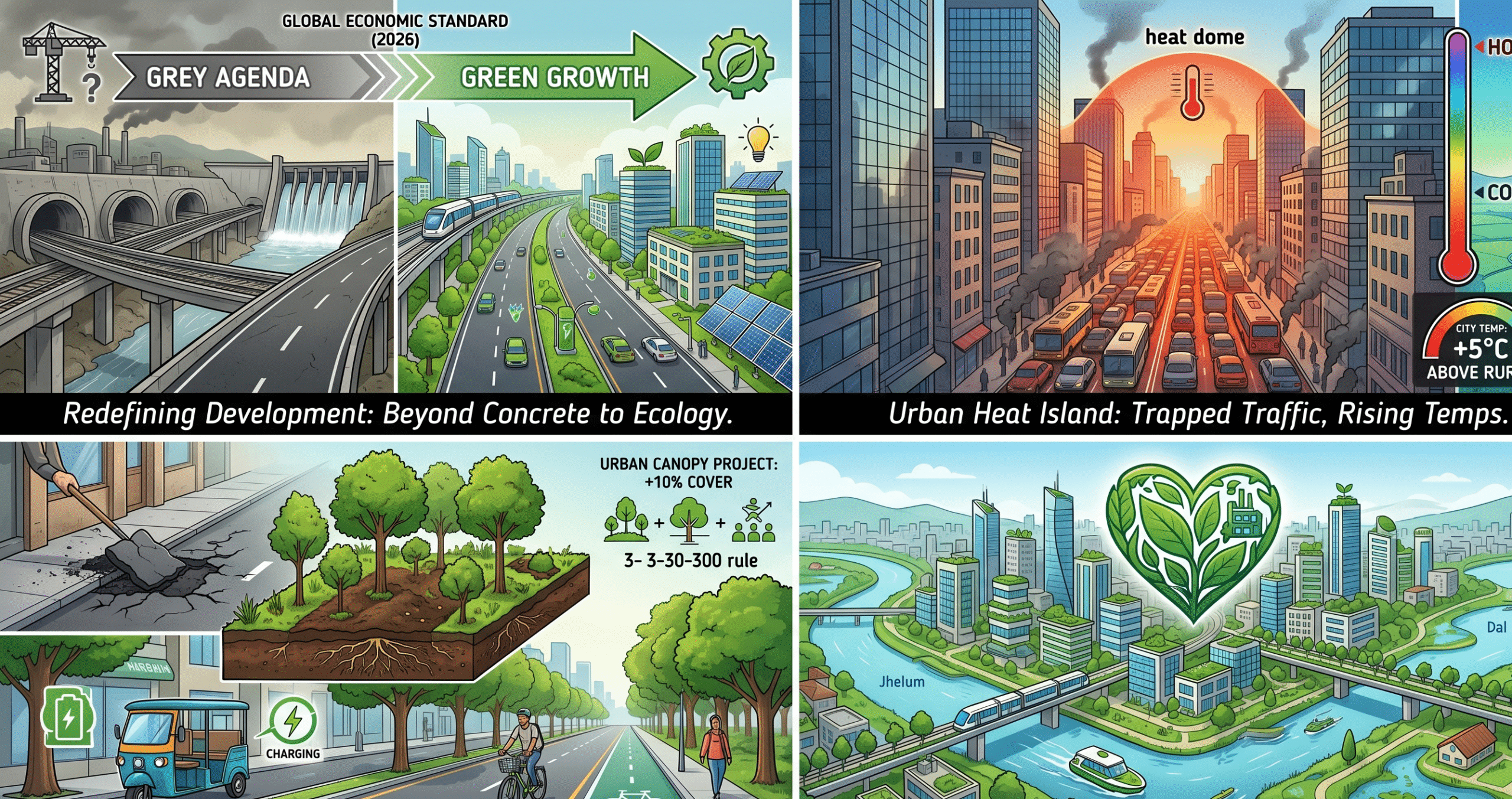
As global economies shift toward a “Green Growth” model in 2026, the definition of a successful city is changing. From Srinagar to the world’s major hubs, we explore why urban development must now prioritize ecological survival over mere concrete expansion.
By Sahil Manzoor Bhatti
In the modern global landscape, development is no longer a luxury, it is an existential imperative. As we move deeper into 2026, the traditional definitions of a “developed” nation are shifting. Economic soundness is no longer measured solely by GDP growth or employment statistics, but by a country’s ability to foster “Green Growth”, a sustainable synergy between industrial advancement and ecological preservation.
For emerging economies and historic hubs like Srinagar, the challenge is clear: how do we build the cities of tomorrow without destroying the natural foundations that make them livable today?
The global economy in 2026 is navigating a complex recovery. According to recent IMF and United Nations reports, global output is projected to grow by roughly 3.1%, with South Asia led by India’s 6.6% expansion remaining a primary engine of growth. However, this growth comes with a heavy footprint.
True development today is defined by the quality of a nation’s sectors. “Economically sound” countries are those providing high-value, sustainable employment for their youth. This is increasingly achieved through:
- Digital Integration: The shift toward virtual trade, where deals are finalized via encrypted video conferencing and AI-driven logistics, reducing the carbon cost of business travel.
- Smart Infrastructure: The transition from mere “construction” to “intelligent management” of roads, transport, and commerce.
For decades, development was synonymous with the “Grey Agenda”, giant tunnels, massive dams, and the widening of asphalt arteries. Today, we recognize that development is a “need of the time” that requires a “Green Agenda.”
In the Kashmir Valley, this shift is critical. Recent infrastructure projects, including the ₹190 crore urban development initiative launched earlier this year, signal a change in priority. These projects focus not just on roads, but on:
- Pollution Abatement: Restoring the Jhelum River and Doodh Ganga through advanced Sewage Treatment Plants (STPs).
- Climate Resilience: Building infrastructure that can withstand the erratic weather patterns of the mid-2020s.
- Historical Restoration: Reviving the “Venice of the East” identity by cleaning the canals and waterways that once defined Srinagar’s transport.
Cities are our economic engines, but they are also becoming “heat islands.” The concentration of concrete and glass, combined with heavy vehicular movement, traps heat. Research in 2025 indicated that even a 5% increase in urban tree cover can prevent thousands of premature deaths globally by reducing the “Urban Heat Island” effect and filtering particulate matter.
In cities like Srinagar, the temperature rise is exacerbated by the loss of wetlands and the removal of old-growth trees for road widening. This leads to:
- Soil Erosion: The loss of fertile topsoil, increasing the risk of landslides and flash floods.
- Air Toxicity: Manufacturing and heavy traffic release greenhouse gases that linger in the valley’s unique topography.
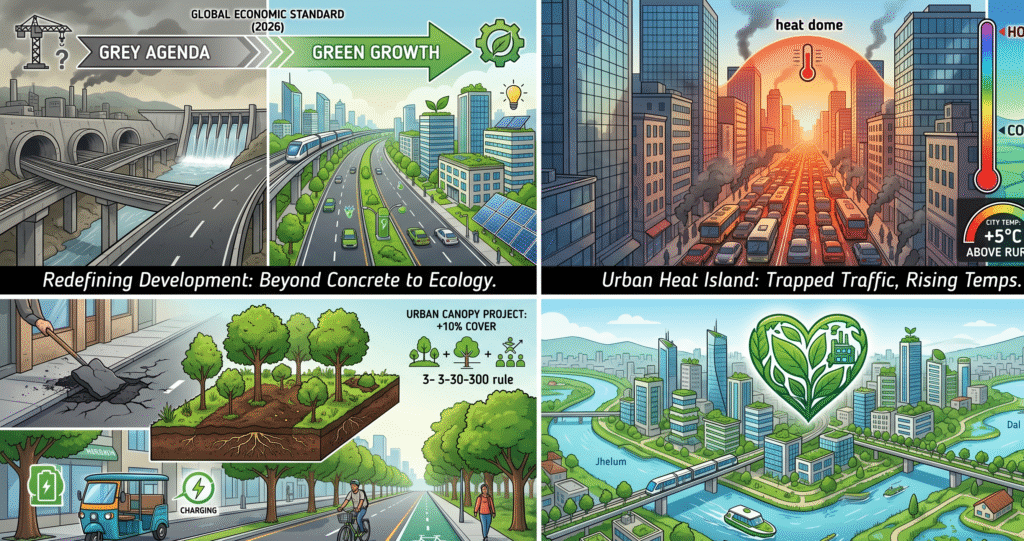
To maintain livable temperatures and air quality, the strategy must be twofold: Afforestation and Electrification.
Trees are the most cost-effective “natural air conditioners” available. They provide shade, emit water vapor through transpiration, and act as carbon sinks. Experts now recommend the “3-30-300 rule”:
- 3 trees visible from every home.
- 30% tree canopy cover in every neighborhood.
- 300 meters maximum distance to the nearest public green space.
While planting trees addresses the symptoms, we must also address the cause: emissions. The transition to eco-friendly transport is underway, but it must accelerate. In Srinagar, the fleet of e-rickshaws has grown significantly from the early 300s recorded in previous years, yet it remains a fraction of what is required for a city of its size.
“A sustainable approach would prioritize reliable public transport, safer walking infrastructure, and better integration of land use… ecology is infrastructure.”, Recent Urban Planning Report, April 2026.
The government has established specialized bodies to issue environmental guidelines, but policy alone is insufficient. The “intellectual class” within the government sector must work in tandem with an informed public.
Development cannot be stopped, nor should it be. However, it can be intelligent. The manufacturing sector cannot be shut down overnight, but its impact can be mitigated by active participation in protection measures.
Planting trees in the heart of our business hubs and along our highways is not just a “beautification” project, it is a survival strategy. As we look toward the remainder of 2026, the success of a city will not be judged by the height of its buildings, but by the health of its air and the shade of its streets. It is our shared responsibility to ensure that the march of progress does not trample the very environment that sustains us.
The views expressed in this article are solely those of the author and do not necessarily reflect the opinions or views of this newspaper. The author can be reached at [email protected]
Leave a Reply