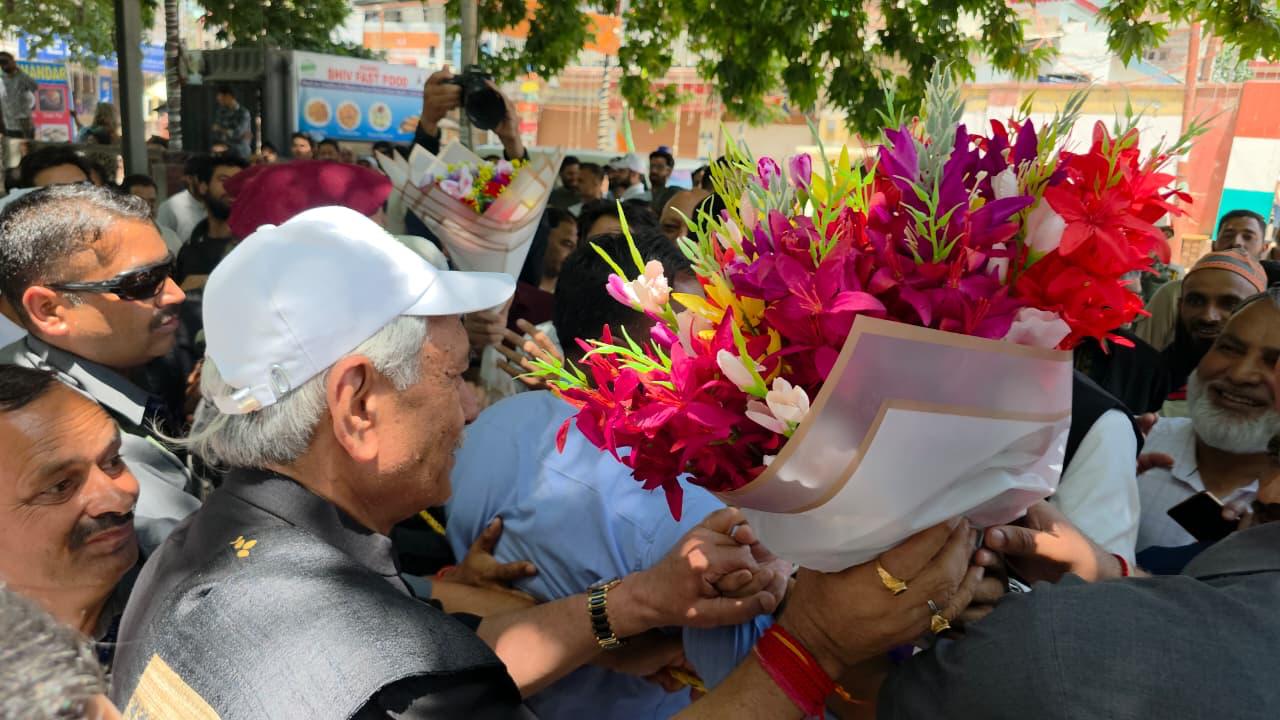
A 55-day operational blitz has resulted in over 1,100 arrests, 1,036 FIRs, and more than 100 property attachments across the region. Authorities emphasize that the aggressive crackdown is aimed at permanently dismantling the financial lifelines of cross-border terrorism.
By Ajaz Rashid
In what is being framed as a high-stakes battle for national security and the social fabric of Jammu and Kashmir, the Union Territory’s administration has launched an aggressive, multi-front offensive against a sophisticated network of narco-terrorists.
Speaking at a series of massive public rallies in Ganderbal and Kishtwar, Lieutenant Governor Manoj Sinha declared an uncompromising “war of years” aimed at permanently dismantling the syndicate that uses narcotics trafficking to finance regional terrorism.
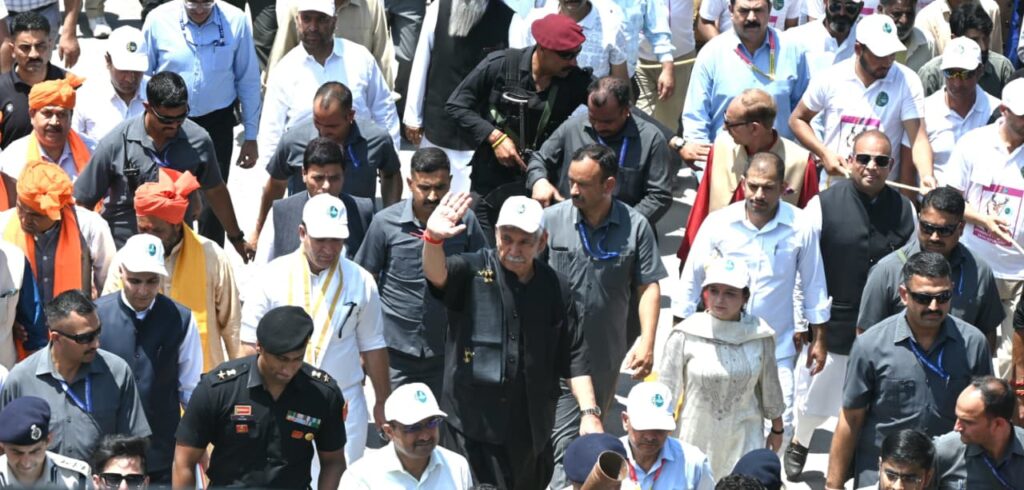
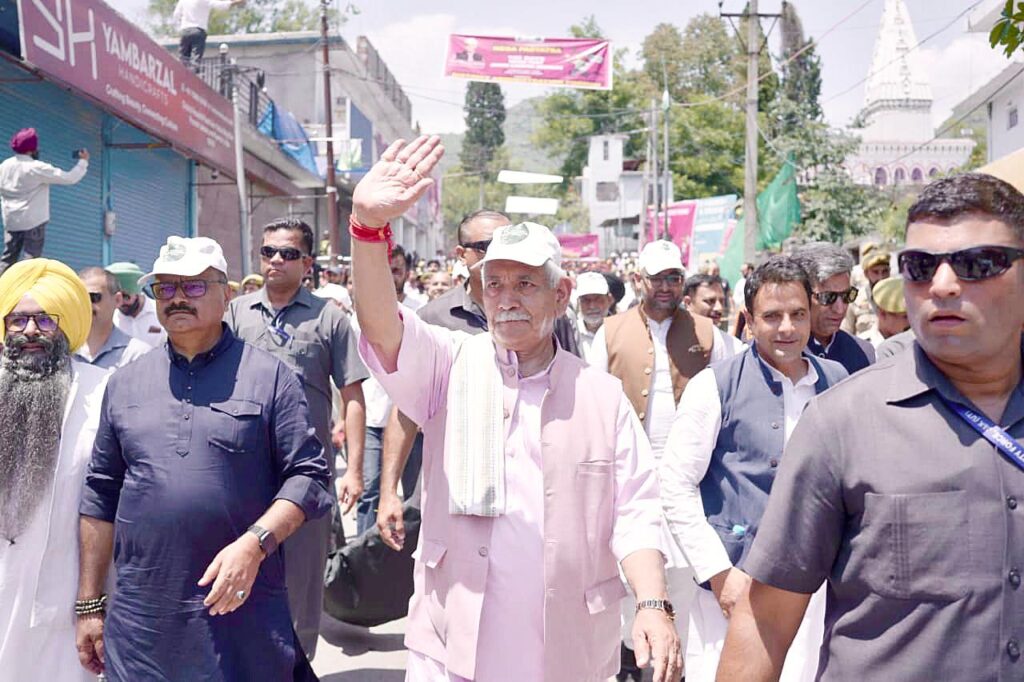
Addressing a packed public rally in Kishtwar following a high-profile Padyatra (public march) this week, Lieutenant Governor Sinha invoked the central leadership’s mandate to underscore the severity of the ongoing operations.
“Asserting that there is no mercy for narco-terrorists under the leadership of Prime Minister Narendra Modi, Lieutenant Governor Manoj Sinha on Saturday said that for 56 days he has pursued a single mission of eliminating every drug smuggler and narco-terrorist from this land.”
The administration’s rhetoric reflects a major shift in how narcotics are categorized in the region. Local authorities no longer treat drug trafficking merely as a domestic law-and-order issue or an ordinary crime; instead, it is officially classified as a direct threat to national security.
The proceeds from cross-border drug smuggling, officials note, are directly funneled into international arms procurement and the maintenance of insurgent networks within Jammu and Kashmir.
“This is not simply a matter of ordinary crime, but it is also a question of national security and a direct threat to the very survival of our society,” Sinha told a gathering in Ganderbal. “The narco-terrorists, whether sitting in neighbouring countries or operating inside Jammu Kashmir, are enemies of our people. They are enemies of our children. They are enemies of our progress. Let me make this clear that narco-terrorists operating in Jammu Kashmir will have to pay a heavy price.”
A 55-Day Enforcement Blitz
The scale of the institutional response is illuminated by enforcement data released by the administration during the Ganderbal leg of the Nasha-Mukt Jammu Kashmir Campaign. Over a intensive 55-day operational window, law enforcement agencies deployed an array of legal, financial, and administrative tools to disrupt trafficking operations.
| Enforcement Metric | Administrative Action Taken |
| Criminal Cases Lodged | 1,036 FIRs Registered |
| Arrests Executed | 1,128 Drug Traffickers Detained |
| Preventive Detentions | 63 Smugglers Booked under the Public Safety Act (PSA) |
| Asset Forfeitures | Over 100 Properties Formally Attached |
| Mobility Restrictions | Nearly 700 Driving Licenses Cancelled |
| International Travel Bars | 130 Passport Cancellations Recommended |
In addition to asset forfeiture, security forces have targeted infrastructure built from the proceeds of illicit trades. Demolition crews have begun dismantling structures raised by traffickers, particularly those erected on encroached government lands, in an effort to systematically erase the financial gains of the trade.
“We are breaking the chain of the drug trade at every single link,” Sinha asserted in Kishtwar. “Whether it’s cross-border smugglers, peddlers or the terror financiers there is no safe haven. Our agencies are hunting down every narco-terrorist and permanently dismantling their networks.”
The Three-Pronged Strategy
The current administrative approach relies on a coordinated three-pronged framework designed to balance aggressive enforcement with societal rehabilitation.
- Supply Chain Interdiction
This phase leverages the full power of the state apparatus. Security agencies, including the Jammu and Kashmir Police, focus on cutting off transit routes, monitoring border vulnerabilities, arresting high-value targets, and seizing the financial assets that keep these criminal enterprises liquid.
- Grassroots Mobilization
Recognizing that enforcement alone cannot solve the crisis, the administration is shifting responsibility to civic institutions. Local governments are embedding anti-drug tracking tools directly into neighbourhoods.
“Our teachers, Panchayat Mahila Samitis, religious leaders, and civil society groups are the torchbearers of this movement, standing united to ensure the shadow of addiction never finds a foothold in Kishtwar and across Jammu Kashmir,” Sinha observed. He called explicitly on civil society to act as defensive eyes and ears: “Mothers, sisters, and daughters have to rise as protectors of our villages, cities and neighbourhoods. Youth of Jammu Kashmir have to become guardians of their schools and colleges.”
- Rehabilitation and Social Reintegration
The strategy draws a sharp distinction between the exploiters and the exploited. While narco-terrorists face aggressive criminal prosecution, individuals suffering from substance abuse are offered a path back to civic life.
The administration has committed to expanding access to medical treatment, psychological counselling, and dedicated employment programs to prevent relapse.
“We are ensuring that drug addicts who seek a path to recovery are provided all possible assistance and brought back to the mainstream with compassion and dignity. But compassion cannot be wasted on narco-terrorists who profit from others’ ruin, who thrive on destruction, who aim to drain the life from Kishtwar’s villages and towns. My objective is very clear that ruthless action will be taken against narco-terrorists while unwavering protection will be ensured for the innocent.”
From Government Campaign to Social Revolution
The current tour has seen the anti-drug message delivered to 19 districts across the Union Territory. During the Ganderbal event, the administration also launched Sindh Samvad, a dedicated podcast series designed to scale up public awareness, while honoring youth winners of regional anti-drug competitions.
Though the formal Nasha-Mukt Jammu Kashmir Campaign was planned as a highly visible 100-day push, officials emphasize that the timeline marks only the introductory stage of a long-term structural effort. The administration contends that long-term success depends on transforming a state-directed program into an independent social movement.
“Fifty-five days ago, from the soil of Jammu, I declared that enough is enough,” Sinha stated, reflecting on the campaign’s momentum. “What began as a war against drugs and narco-terrorism has now ignited into a true people’s movement, a movement born of courage, sustained by spirit, and driven by the collective will of ordinary citizens.”
The campaign concludes its current phase with an open-ended commitment from regional leadership. “It is a war of years, not a battle of weeks. Victory demands a unified, round-the-clock commitment,” Sinha concluded. “During the Padyatra across Jammu Kashmir, I have witnessed the incredible courage of young men and women breaking the shackles of addiction to reclaim their lives. That is why we cannot fail. This campaign is a matter of the soul of Jammu Kashmir.”
Leave a Reply