Kashmir’s world-famous ecosystems are collapsing under the combined strain of rapid climate warming and unchecked human encroachment. As vital water towers recede and freshwater bodies disappear, experts warn that the region’s economic and environmental future hangs in the balance.
By Ajaz Rashid
For centuries, the Kashmir Valley has been immortalized as a terrestrial paradise, a sanctuary framed by snow-draped Himalayan peaks, fed by crystalline glaciers, and woven together by iconic lakes. Yet behind this postcard-perfect exterior, an ecological tragedy is unfolding in real time.
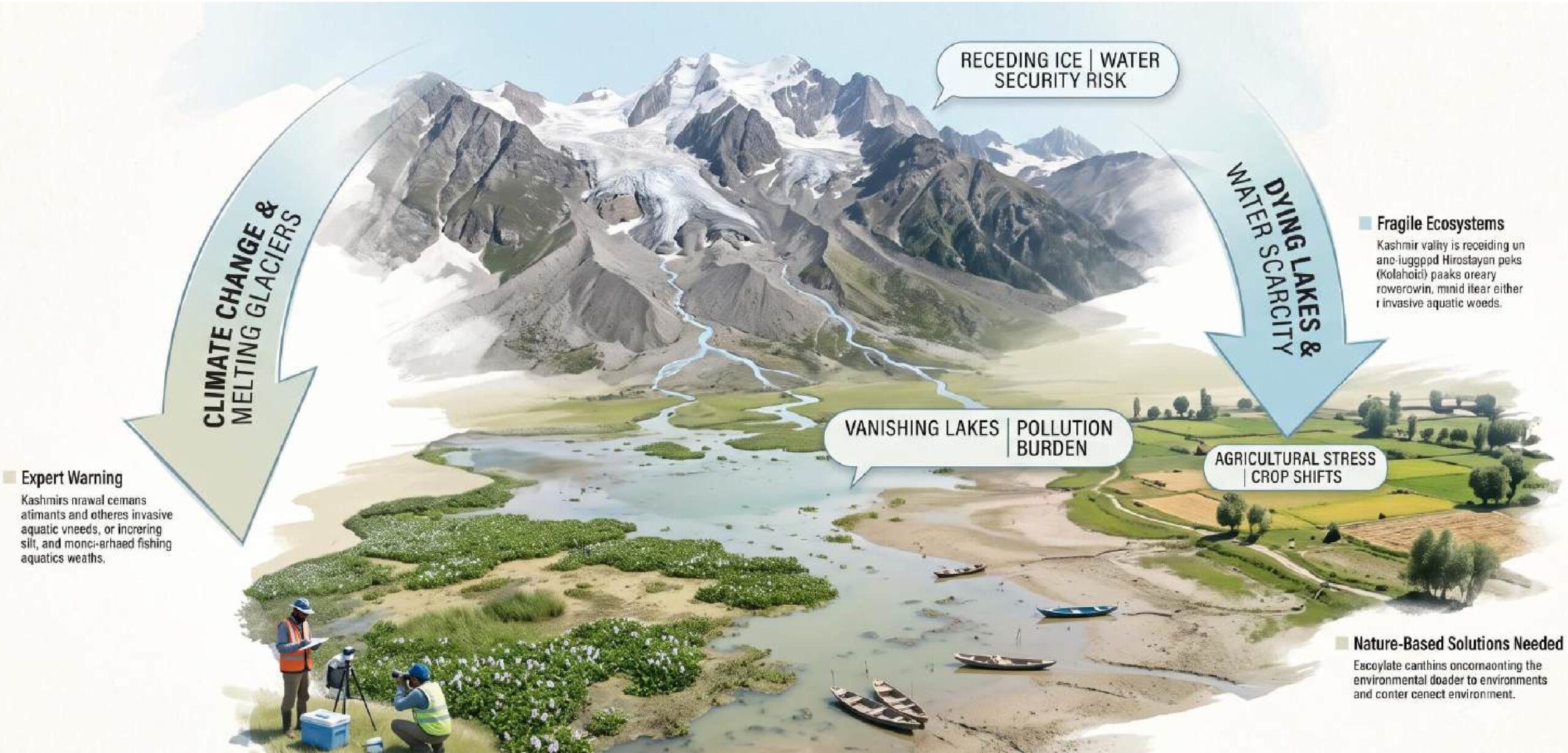
On World Environment Day, prominent climate scientists, glaciologists, and environmental experts delivered a stark warning from Srinagar: Kashmir’s fragile ecosystems are facing an unprecedented double jeopardy of rapid climate warming and unchecked human exploitation. From the receding snouts of high-altitude glaciers to the choked, decaying waters of its famous lakes, the region’s vital natural infrastructure is fraying with profound consequences for water security, biodiversity, and regional economic survival.
At the core of Kashmir’s environmental crisis is the accelerating retreat of its high-altitude glaciers, the primary “water towers” that feed the Jhelum River basin and sustain millions of lives downstream. Professor Shakeel Ahmad Romshoo, a distinguished Earth scientist, glaciologist, and Vice-Chancellor of the Islamic University of Science and Technology (IUST), stressed that the Himalayan environment is undergoing structural shifts that demand immediate, science-backed interventions.
“World Environment Day serves as a reminder of the profound environmental challenges confronting the Indian Himalayan region, including Jammu and Kashmir,” Prof. Romshoo noted. “These challenges glacier retreat, water insecurity, biodiversity loss, and ecosystem degradation are deeply interconnected and require solutions rooted in science and guided by sustainability.”
Scientific studies paint a grim picture. The Hindu Kush-Himalayan region is warming at roughly 0.2°C per decade—nearly twice the global average. Kashmir’s largest mass of ice, the Kolahoi Glacier (traditionally venerated as Gwash Brari or the “Goddess of Light”), has lost over 24% of its total surface area since the 1960s, with its primary snout receding at an alarming rate of over 18 meters annually. Recent modeling by researchers at the University of Kashmir suggests that if current global emissions and regional warming trends persist, nearly 70% of the glaciers across Jammu, Kashmir, and Ladakh could vanish by the turn of the century. The loss of these frozen reserves disrupts natural streamflows, creating erratic seasonal surges in early spring followed by acute water deficits during critical summer agricultural months.
Down in the valley floor, the consequences of upstream climate disruption are compounded by intense urbanization, siltation, and direct environmental neglect. Dr. M.R.D. Kundangar, a veteran academician and environmentalist, warned that Kashmir’s liquid heritage is being depleted before society fully grasps what is being lost.
“Our natural resources, including lakes, wetlands, rivers, and streams, are under immense pressure due to misuse and neglect,” Dr. Kundangar said. “Climate change is increasingly threatening glaciers and other critical ecosystems. These resources are our heritage and must be preserved at all costs for future generations.”
Data highlights the sheer scale of the crisis. An audit by the Comptroller and Auditor General (CAG) revealed that out of 697 lakes catalogued across Jammu and Kashmir, 315 have completely disappeared over recent decades, while another 203 have drastically shrunk. Srinagar’s iconic Dal Lake receives an estimated 70 million liters of untreated sewage every single day from surrounding settlements, commercial properties, and houseboats. This massive influx of nitrogen and phosphorus triggers severe eutrophication, an explosive growth of invasive weeds and algae that starves the water of oxygen, chokes aquatic fauna, and reduces open water surfaces. Meanwhile, Wular Lake, one of Asia’s largest freshwater bodies and a designated Ramsar site has seen its open-water expanse shrink by nearly 25% to 50% over the past century due to heavy siltation and agricultural encroachment. Because wetlands act as natural “sponges” and flood buffers for the Jhelum River, their degradation leaves the entire Kashmir Valley increasingly exposed to flash floods and prolonged droughts.
The cascading effects of ecosystem collapse reach deep into Kashmir’s agrarian and rural economy. Across the valley, nearly 30% of glacier-fed natural springs have dried up or become seasonal, forcing villages to dig deeper wells or truck in potable water. Farmers in the Lidder and Jhelum basins, facing unreliable irrigation channels, have increasingly abandoned traditional, water-intensive paddy cultivation in favor of apple orchards. Fishing communities around Wular and Dal lakes report precipitous drops in fish yields, with many families forced to abandon generations-old vocations.

Addressing these complex challenges requires moving beyond piecemeal conservation toward structural, systemic action. Prof. Romshoo pointed out that while satellite monitoring and scientific modeling have drastically improved our understanding of Himalayan dynamics, science alone cannot save the valley without societal commitment and political willpower.
Dr. Aamir Hussain Bhat, Manager of SECAP (Sustainable Energy and Climate Action Plan), emphasized that environmental stewardship must become a core governing framework rather than a peripheral policy goal.
“Environmental protection is no longer a choice; it is a responsibility,” Dr. Bhat stated. “The true measure of development lies not in what we build today, but in what we preserve for tomorrow.”
Dr. Bhat highlighted that localized actions ranging from restoring degraded forest catchments and upgrading urban sewage treatment infrastructure to adopting circular economy practices are critical to reducing the region’s overall ecological footprint.
The path forward for Kashmir rests on adopting Nature-based Solutions (NbS) that harmonize human development with natural cycles. Experts emphasize that key priorities must include:
- Catchment Restoration: Replanting native forest species along river basins to anchor soil, reduce siltation in lakes, and slow down rapid surface runoff.
- Strict Sewage Interception: Modernizing and enforcing full-capacity sewage treatment plants (STPs) around urban centers, Dal Lake, and Wular Lake to halt nutrient overloading.
- Wetland Rejuvenation: Removing illegal encroachments and dredging silt from natural floodplains to restore water retention capacity.
- Climate-Resilient Agriculture: Transitioning to water-efficient irrigation methods and drought-resistant crop varieties adapted to shifting precipitation patterns.
As climate change continues to rewrite the geography of the Himalayas, Kashmir stands at a critical juncture. Protecting its glaciers, forests, and waters is not merely an act of environmental conservation, it is the baseline requirement for ensuring the future safety, livelihood, and heritage of millions who call the valley home. (With inputs from KNO)
Leave a Reply