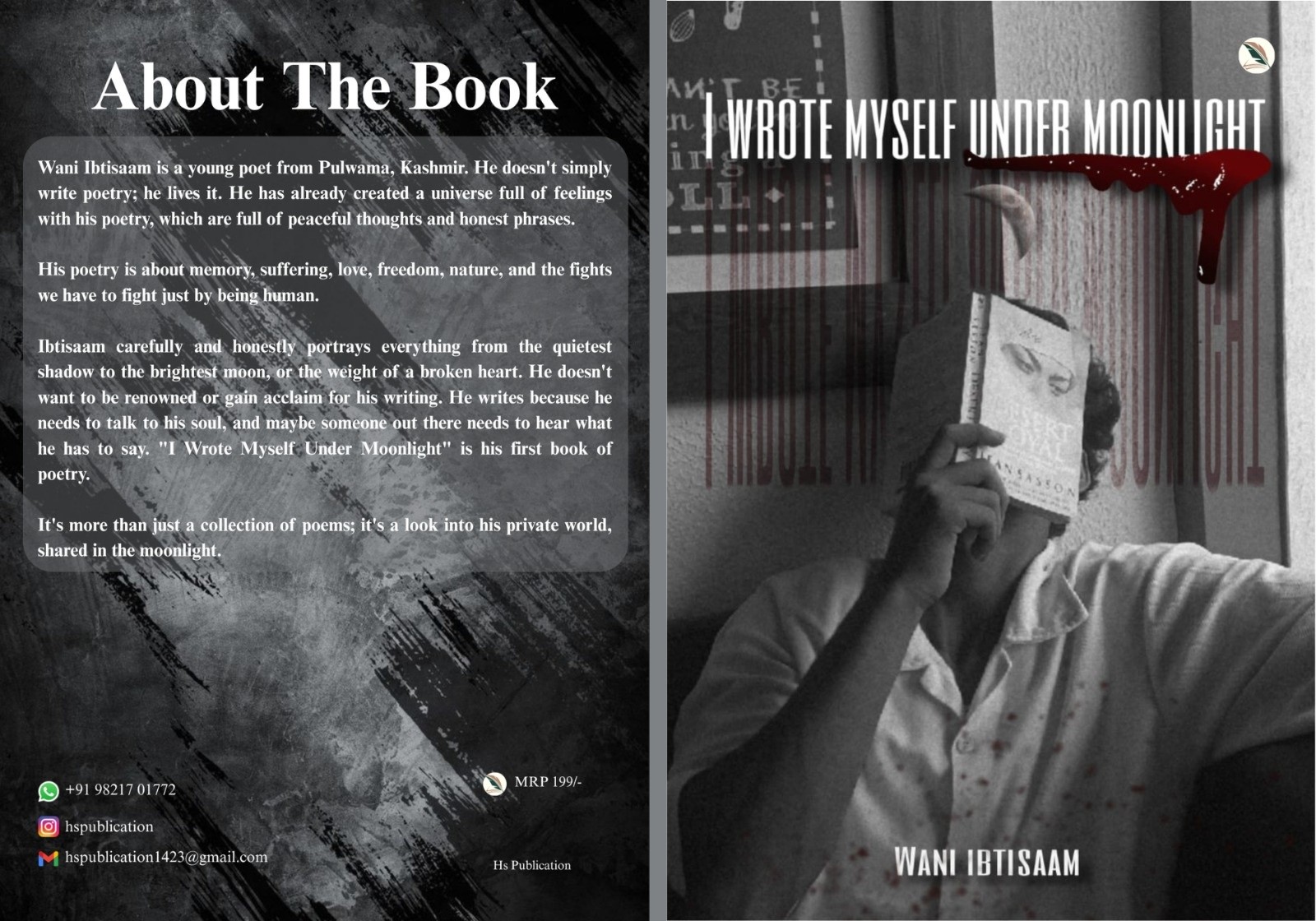
From childhood innocence to moonlit longing, this collection glows with feeling

By Imbisat Tareen
In an age when poetry often bows under the pressure of performance and cleverness, I Wrote Myself Under the Moonlight by Wani Ibtisaam arrives with an unguarded honesty that feels almost disarming. This slim, 22-poem collection doesn’t pretend to be polished or ornamental. Instead, it leans into rawness, dissolving the distance between poet and reader. It is non-fiction in spirit and confessional in tone—part diary, part emotional excavation—anchored in the young writer’s attempt to understand life, loss, memory, and selfhood.
The book opens with acknowledgments that set the emotional register for what follows. Ibtisaam thanks his parents with a simplicity that signals the deep roots of his gratitude. Friends and teachers, especially Syed Ishfaq, appear as gentle architects who shaped his creative curiosity. He also notes the influence of his cousin, author Imbisat Tareen, whose book The Inner Voice gave him not just inspiration but permission—to feel deeply and write from the marrow of experience. Even the publisher gets a heartfelt nod “for taking a risk,” a line that subtly hints at the author’s humility and perhaps a little wonder that his words have made it into a printed form.
Across the collection, recurring themes of self-discovery and emotional unraveling stitch the poems into a cohesive journey. The language is simple—intentionally so—but carries a pulse that comes from sincerity rather than structure. Reviewers have noted that the writing might benefit from refining in places, but it’s precisely this unedited immediacy that gives the poems their visceral quality. The imagery is vivid, the metaphors unfiltered; these are lines written, as the title suggests, under the softer, more forgiving light of night, when truth usually whispers a little louder.
Several poems stand out for how unreservedly they document the author’s inner world. My Ruins captures a young person’s confrontation with emotional collapse. The speaker feels “dead” in their own room, trapped in a liminal space between living and disappearing. The phrase “decomposing alive” strikes with startling force—an image that conveys exhaustion, numbness, and the quiet fear of fading without anyone noticing. It’s a poem of existential fog, and Ibtisaam handles the theme with a maturity that surprises.
I Remember, in contrast, pulls the reader into the tender terrain of childhood. Here, the poet paints himself as a “teddy bear”—small, soft, endlessly curious. Everything was a question then; everything was wonder. The cradle rocks, and life is easy, almost princely. The poem closes with the deceptively light admission, “I still remember!” But beneath that simplicity lies the ache of knowing that time doesn’t return what it takes away. Childhood is both a memory and a wound.
School days find a warm resurrection in The Last Bench, a nostalgic ode to camaraderie. Anyone who has known the stubborn magic of school friendships will find something familiar here—the laughter during breaks, the nonsense conversations, the shared lunches, the small rebellions, the comfort of belonging. The “wooden bench of memories” becomes a symbol of collective growing-up. Ibtisaam suggests that what once felt ordinary has now turned into something almost sacred—proof of who we were before life complicated us.
The theme of friendship deepens beautifully in Backbone. Here, the poet looks back at the people who entered his life as strangers but became emotional anchors. He writes of a bond “dug in our soul” over thirteen years, a phrase that conveys both permanence and tenderness. The idea that the word “backbone” will forever mean his friends is simple, yes, but also powerful—a reminder that some relationships define the architecture of our lives.
Two of the most evocative poems in the collection—The Moon and In the Absence of the Moon—show the poet at his most metaphorically expressive. In the former, the moon is not just celestial but intimate, “dug deep inside my chest,” a source of light, comfort, and direction. The poem breathes with longing and devotion; the moon becomes confidant, companion, compass. The poet imagines himself as its protector, willing to continue this luminous journey “forever, and ever.”
Its companion poem explores what happens when that guiding presence vanishes. Suddenly, the sky is full of stars competing for attention, but their brightness cannot replace what is missing. The speaker still yearns for the moon—for its consistency, beauty, and care. The metaphor is clear: some connections, once formed, remain irreplaceable, even when distance or silence interrupts them.
What sets I Wrote Myself Under the Moonlight apart is not perfect structure or literary sophistication; it is the courage to confess. These are the poems of a young writer who doesn’t hide behind abstraction. Instead, he writes his heart like a diary entry: open, trembling, luminous in its vulnerability.
There is something deeply moving about watching a poet find his voice—not fully formed, but forming; not flawless, but fearless. Ibtisaam offers the reader not finished thoughts but unfolding ones. For many, this will be the book’s greatest charm.
As a reviewer and as someone who knows the author personally, there is pride in seeing a young voice take such a brave step into the world of words. These poems carry his heartbeat on the page, and that in itself is an achievement. I Wrote Myself Under the Moonlight may be a modest collection, but it speaks with an honesty that deserves attention. Ibtisaam’s journey is just beginning, and this book—bleeding, bright, and beautifully unguarded—marks a promising start.
The views expressed in this article are solely those of the author and do not necessarily reflect the opinions or views of this newspaper. The author can be reached at [email protected]
Leave a Reply