Amit Shah Outlines a New Era for Ladakh’s Sovereignty and Soul
Under the shadow of the Himalayas, in a region that has served as the sentinel of India’s borders for millennia, a new narrative is being written. Union Home Minister Amit Shah’s recent visit to the Union Territory of Ladakh was not merely a political tour; it was a comprehensive progress report on a region that has, since 2019, transitioned from a neglected appendage of a larger state to a central pillar of India’s national security and developmental vision.
Speaking to crowds in both Leh and Kargil, Shah framed the rapid transformation of the Union Territory (UT) as a direct realization of Prime Minister Narendra Modi’s vision. From the creation of new administrative districts to the arrival of sacred Buddhist relics and the launch of a “White Revolution” in the cold desert, the visit highlighted a holistic approach to governance that blends hard infrastructure with cultural preservation.
A Revolution in Governance and Connectivity
For decades, the people of Ladakh campaigned for Union Territory status, arguing that their unique geographic and cultural needs were drowned out by the political complexities of the erstwhile state of Jammu and Kashmir. Addressing a gathering in Leh, Shah asserted that those days of stagnation are over.
“Development of the region has remained the priority of Prime Minister Narendra Modi-led government’s development agenda,” the Home Minister stated. He backed this claim with a staggering fiscal shift: Ladakh’s budget has surged from ₹1,000 crore when it was part of J&K to ₹6,000 crore today.
This financial influx has manifested in a dramatic expansion of the region’s physical footprint. Shah noted that the road network has more than doubled, increasing from 1,799 km before 2019 to 4,040 km today. The number of bridges has tripled, rising from 19 to 72. Crucially, the “isolation” of Ladakh is being systematically dismantled. The Home Minister cited the Zojila Pass as a prime example: where it once remained closed for 127 days due to snow, this year it was shut for only 19 days.
The administrative landscape has also been redrawn to empower local communities. Shah confirmed the notification for five new districts—Sham, Nubra, Changthang, Zanskar, and Drass bringing the total to seven. This decentralization is complemented by linguistic recognition. “Earlier only Hindi and English were in use, but now Bhoti, Purgi and Urdu have also been accorded importance,” he said, emphasizing that identity and administration must go hand in hand.
Buddhism as a Global Beacon
The timing of the visit coincided with Buddha Purnima, adding a layer of spiritual gravity to the proceedings. Terming the occasion “truly golden,” Shah oversaw the arrival of the sacred relics of Lord Buddha to Ladakh after 75 years. This was not just a religious event but a symbolic homecoming for a region Shah described as a “living laboratory of Buddhist culture and compassion.”
“Ladakh has been a living land of Dhamma for centuries,” Shah remarked. “Whenever Buddhism faced challenges, this land worked to preserve Lord Buddha’s message. When peaceful times came, it also worked to further propagate that preserved and enriched knowledge.”
The Home Minister paid homage to the four major traditions—Nyingma, Kagyu, Sakya, and Gelug—stating that their teachings on moral discipline and self-reflection are the guiding forces the world needs today. By positioning Ladakh as the historic bridge between India, China, and the Silk Route, Shah linked the region’s spiritual heritage to its modern strategic importance. He urged the administration to ensure that followers of all faiths could have darshan (viewing) of the relics, reinforcing India’s message of peace and coexistence.
The Dairy Initiative in Kargil
If Leh was about infrastructure and spirituality, Kargil was about economic empowerment. Shah laid the foundation stone for a 10,000-litres-per-day (TLPD) dairy plant in Kargil, a move designed to turn the rugged terrain into a hub of the “cooperative model.”
“Women of Kargil can bring prosperity into their lives through this dairy plant, support their families, and become self-reliant,” Shah told a local audience. He drew on his own experience from a region where similar initiatives achieved a turnover of ₹1,25,000 crore, expressing confidence that Ladakh’s women have the same potential.
The strategy is commercially savvy. With approximately 18,000 soldiers from the ITBP and the Army stationed at the borders, there is a massive, built-in demand for milk, curd, and paneer. By meeting these needs locally, the government aims to create a circular economy. To support this, Shah announced:
- The Sindhu Infrastructure Development Corporation: A new body to promote industrial growth.
- National Market Access: An agreement between the Ladakh Milk Federation and Mother Dairy to bring Ladakhi organic products to Delhi.
- Expansion: Plans for a ₹70 crore, 50,000 TLPD plant in Leh and the annual provision of 500 high-yield animal breeds suited to high-altitude climates.
Building a Future-Ready Society
The Home Minister also highlighted the “soft” infrastructure that is preparing Ladakh for the 21st century. He claimed that Ladakh became a fully literate administrative unit in 2024, with no illiterate persons left in the region. This feat is supported by the establishment of the Sindhu Central University, 174 ICT labs, and 130 smart classrooms.
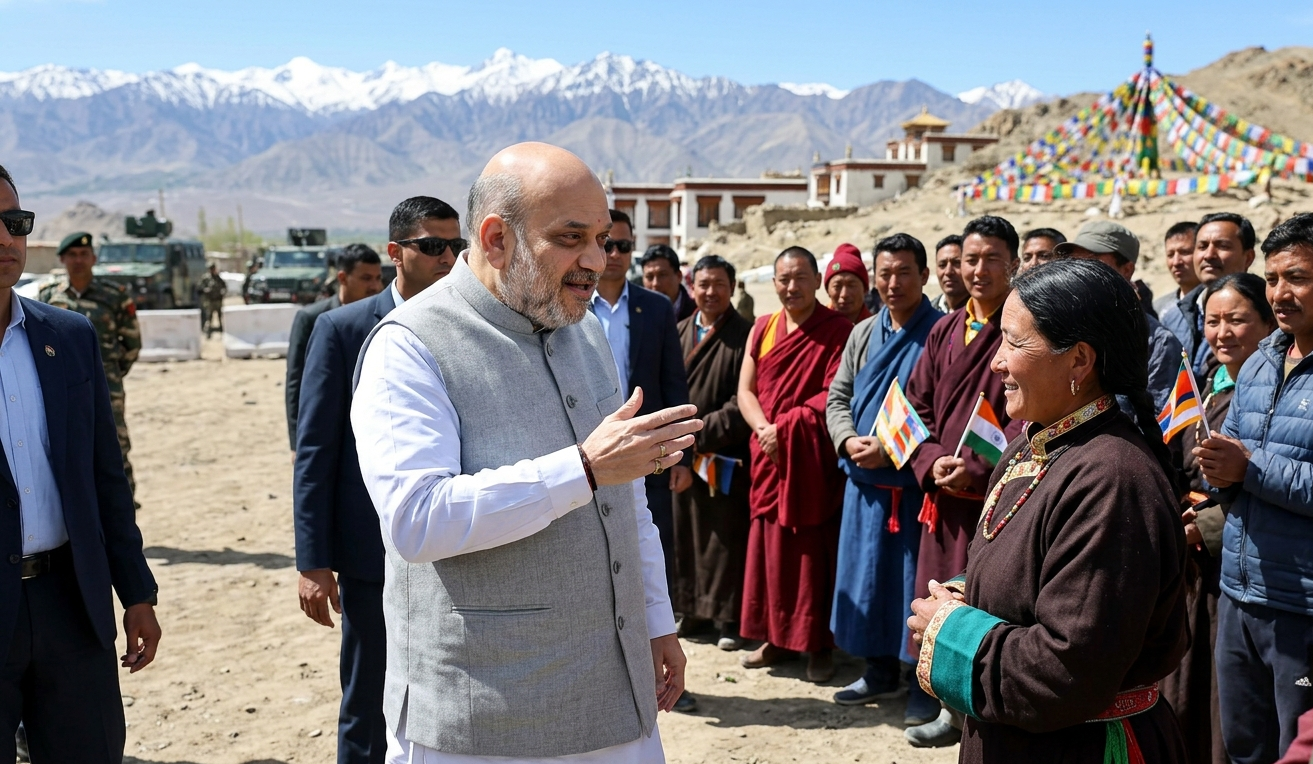
In terms of basic dignity, the Har Ghar Jal scheme has reached 98 per cent of households, providing tap water connections in some of the most difficult terrains on earth. From VSAT connectivity for every panchayat to the tripling of snow-clearing machines (from 60 to 215), the focus has been on making the “unlivable” parts of the region resilient and connected.
A Message to the World
Throughout his addresses, Amit Shah’s message was clear: Ladakh is no longer a peripheral concern. It is a vital, self-reliant border region that embodies India’s civilizational values and its modern industrial ambitions.
“I am giving these figures on this scale because after becoming a Union Territory, it (Ladakh) has remained the focus of the Narendra Modi government,” Shah said. By merging the preservation of ancient Dhamma with the construction of state-of-the-art tunnels and dairy plants, the government is attempting to ensure that Ladakh’s future is as enduring as its mountains.
As the sacred relics of the Buddha begin their stay in the region, they serve as a reminder that for the people of Ladakh, this period is more than a developmental phase—it is a restoration of their place in the heart of the nation.
Leave a Reply