Striking at the financial roots of regional instability, the administration’s targeted offensive has successfully cut off the critical flow of illicit funds to active insurgent groups. By treating the narcotics epidemic as a direct threat to national security, authorities are systematically starving proxy networks of their operational cash flow.
By Ajaz Rashid
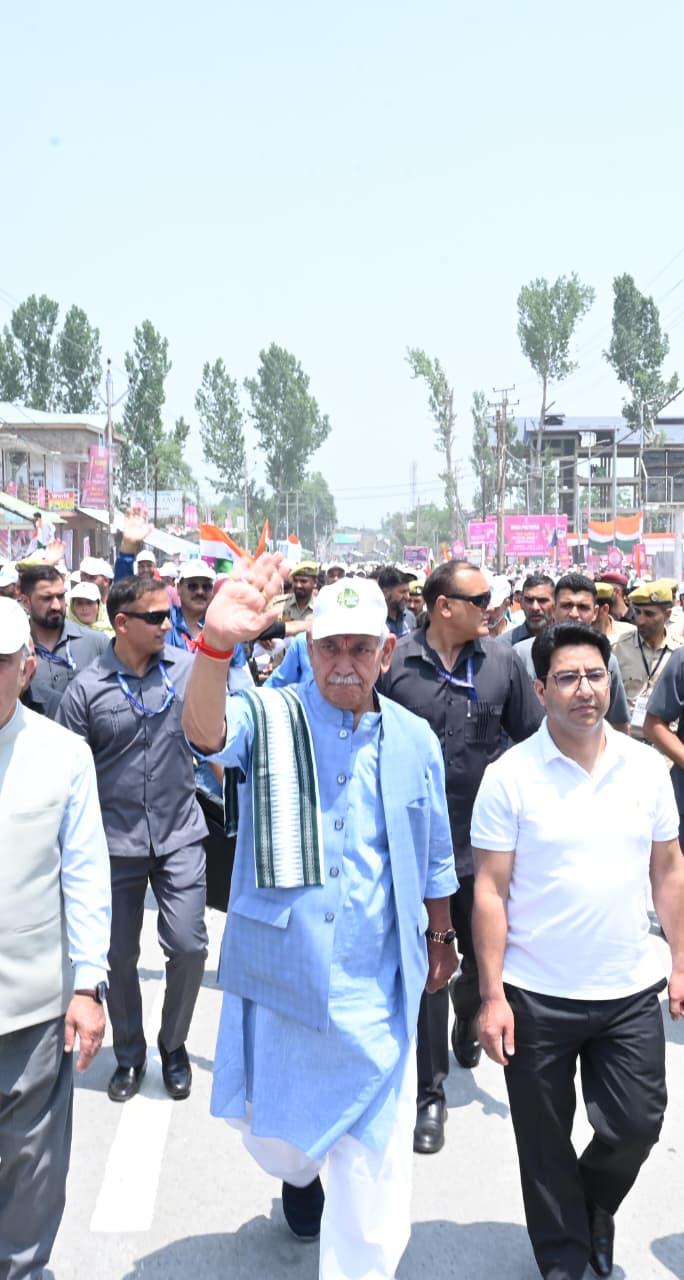
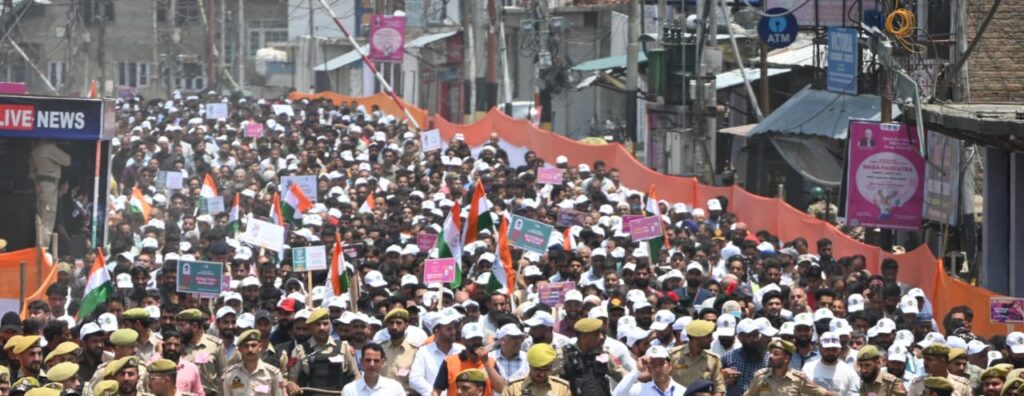
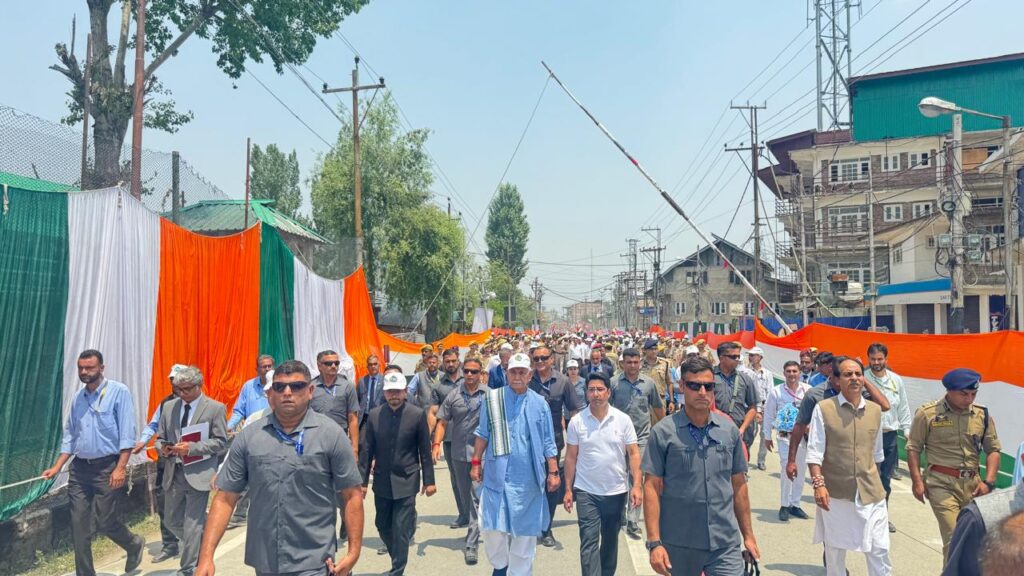
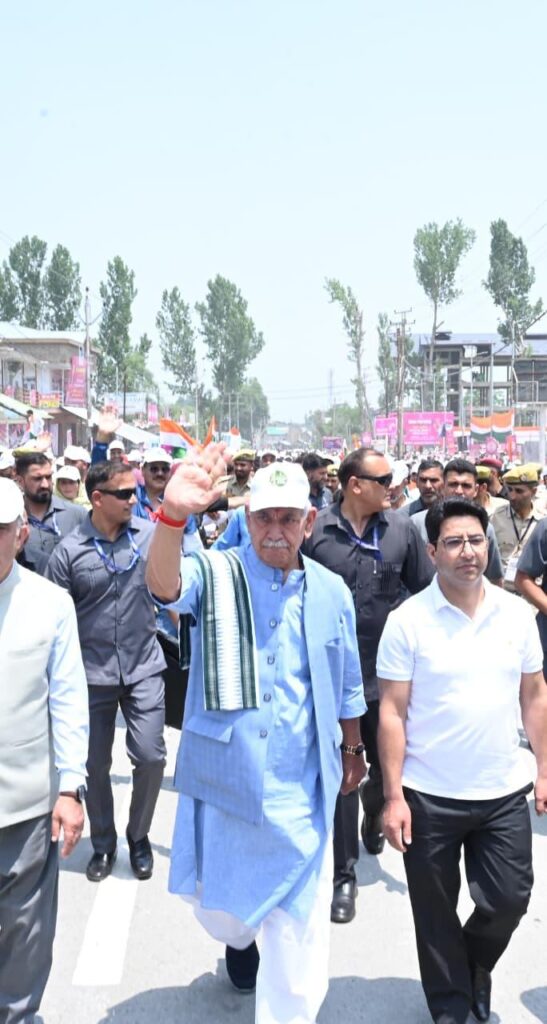
Standing at the Laroo in South Kashmir’s Kulgam district, Lieutenant Governor Manoj Sinha delivered a definitive ultimatum to the underground networks that have long exploited the region. Leading the ‘Drug-Free J&K Padyatra’ (foot march) before addressing a massive public gathering, Sinha explicitly linked illicit substance abuse directly to geopolitical instability, framing the territory’s domestic drug crisis as a critical element of national security.
“This campaign is striking directly at the financial backbone of terrorism,” Sinha said, speaking to an audience composed of local residents, community elders, and administrative officials. “Every rupee spent on drugs fuels extremist violence, and narco-terrorists survive on that blood money. By halting the drug trade, we cut off the lifeline that sustains terror networks.”
The public address and accompanying march mark a critical juncture in the region’s security strategy, synthesizing law enforcement operations with community-driven public health initiatives. For decades, security analysts have documented how cross-border proxy networks utilize narcotics trafficking to finance armed insurrections within Jammu and Kashmir. The current administrative shift treats the demand and supply of narcotics not merely as a domestic law enforcement issue, but as an existential threat to national sovereignty.
51-Day Enforcement Drive
The administration’s intensified efforts have manifested in a highly coordinated, multi-agency offensive. Over a intensive 51-day operational window, local law enforcement and federal intelligence agencies executed a series of targeted raids designed to fragment deeply entrenched distribution networks across both rural villages and urban centers.
The legal and administrative metrics recorded during this 51-day period highlight the scale of the crackdown:
| Operational Metric | Statistical Total | Legal Provision / Action |
| First Information Reports (FIRs) | 923 | Registered against drug traffickers and local peddlers |
| Arrests & Detentions | 1,000+ | Suspected smugglers and street-level dealers detained |
| Preventive Detentions | 55+ | Traffickers booked under PIT-NDPS provisions |
| Mobility Restrictions | 668 | Driving licenses officially cancelled |
| Travel Restrictions | 124 | Passports formally recommended for revocation |
The utilization of the Prevention of Illicit Traffic in Narcotic Drugs and Psychotropic Substances (PIT-NDPS) Act allows authorities to detain habitual offenders preventively for extended periods without bail, effectively neutralizing key coordinators within the supply chain. Furthermore, by stripping identified traffickers of driving privileges and recommending the cancellation of passports, the state is actively leveraging secondary administrative penalties to restrict the physical mobility of syndicates operating across state and international borders.
From 2020 to the Present
This enforcement model traces its structural origins to the national Nasha-Mukt Bharat Abhiyaan (Substance-Free India Campaign), originally conceptualized by the central government.
“Under the leadership of PM Modi and the guidance of Union Home Minister Amit Shah, the Nasha-Mukt Bharat Initiative launched in 2020 marked the turning point,” Sinha observed.
Prior to 2020, anti-narcotics efforts in Jammu and Kashmir operated largely in institutional silos. Security forces focused strictly on large-scale cross-border seizures along the Line of Control (LoC), while local police managed small-scale retail peddling, and health departments dealt independently with the fallout of addiction.
The 2020 policy pivot introduced a “whole-of-government” approach. This methodology integrates the intelligence-gathering capabilities of the Narcotics Control Bureau (NCB) and National Investigation Agency (NIA) with the granular, localized reach of Jammu and Kashmir Police. Simultaneously, it loops in non-traditional stakeholders such as the Departments of Education, Social Welfare, and Health to address the problem systematically from both the supply side and the demand side.
Choking the Financial Lifelines
The primary objective of this institutional integration remains the financial starvation of terror modules. In the hybrid warfare theater of South Asia, narcotics have systematically replaced traditional, easily traceable methods of external funding. High-margin illicit substances smuggled across frontiers are converted into liquid cash within local markets. This cash is subsequently routed through informal hawala channels to pay local operatives, purchase undocumented weaponry, and sustain logistical safe houses.
“I want people of Jammu Kashmir to remember that this is not only a public-health struggle, but also a fight for national security,” the Lieutenant Governor stated. “When we choke off drug smuggling, we weaken those who seek to destabilize our nation, spill the blood of innocent people of J&K, and divert our youth from the path of progress.”
By systematically disrupting retail distribution hubs within districts like Kulgam, Anantnag, and Pulwama, the administration seeks to create a cascading cash crunch for active insurgent groups, effectively rendering them incapable of financing complex operational networks.
While law enforcement forms the tactical frontline, administrative officials acknowledge that state coercion alone cannot permanently eradicate an entrenched drug economy. The Kulgam Padyatra was designed to emphasize the role of civic society in maintaining long-term vigilance.
Reflecting on the psychological shift within the valley, Sinha noted that 51 days prior, a collective civic effort had “kindled a spark of change.” Through sustained public engagement, that initial momentum had transformed into “a fierce flame of hope, courage and resolve.”
The administration is actively transferring ownership of the anti-drug campaign to local communities. “This campaign belongs to the people,” Sinha said. “Parents, teachers, religious leaders and young volunteers have stood shoulder to shoulder with the administration. The road ahead is long. The fight against drugs will take sustained effort, constant alertness and unity. We must remain steadfast. We must encourage our young people, protect our families and strengthen our communities.”
In a socio-political ecosystem historically characterized by deep-seated caution toward state-led initiatives, the open participation of religious leaders (who utilize Friday sermons to preach against substance abuse) and school teachers represents a substantial shift in public alignment.
Structural Rehabilitation
Recognizing that punitive measures must be balanced with compassionate interventions for victims of addiction, the administration is shifting its focus toward institutional healthcare. Rather than treating substance users as criminals, the updated policy framework categorizes them as individuals requiring medical and psychological rehabilitation.
To support this approach, the Lieutenant Governor announced a comprehensive expansion of healthcare infrastructure dedicated to recovery:
- Universal District Coverage: The administration has committed to establishing modern, fully equipped de-addiction and rehabilitation centers across every single district of Jammu and Kashmir.
- Scientific Rehabilitation Policy: Formulated in active consultation with leading national medical experts, a standardized rehabilitation policy has been instituted to streamline clinical treatment protocols.
- Social Reintegration Protocols: The updated guidelines mandate that medical treatment must be paired with structured emotional support systems and vocational training initiatives.
“In order to save the lives of those affected by addiction, both emotional and material support are necessary and every possible effort has to be made,” Sinha emphasized. “We will ensure our youth are freed from the grip of addiction, return to the mainstream of society, and become the strength that will lead Jammu Kashmir toward a brighter tomorrow.”
By building localized clinical infrastructure, the government aims to lower the barrier to entry for families seeking medical intervention, removing the stigma and financial strain traditionally associated with private detoxification care.
The Administrative Pledge
The event concluded with an emotional appeal, with the Lieutenant Governor seeking to position the administration not as an detached bureaucratic entity, but as an empathetic stakeholder in the daily struggles of the population.
“I stand before you not only as your Lieutenant Governor but as a member of your family who shares your pain, your struggles, and your dream of a safe, empowered and drug-free Jammu Kashmir,” Sinha stated. “In 2021, I pledged a fear-free and drug-free Jammu Kashmir so that the shadows of drugs and terror that once loomed over our youth can be banished entirely.”
As the region transitions through this phase of intensive administrative and security interventions, the metrics from the 51-day campaign offer a baseline for future policy assessment. The challenge moving forward will be sustaining this high level of inter-agency pressure while simultaneously scaling up rehabilitation infrastructure to care for those disconnected from the illicit supply chains.
“I can say with confidence today that the chains that once trapped our youth in the dark web of drugs are breaking apart, link by link, day by day,” Sinha concluded.
Leave a Reply