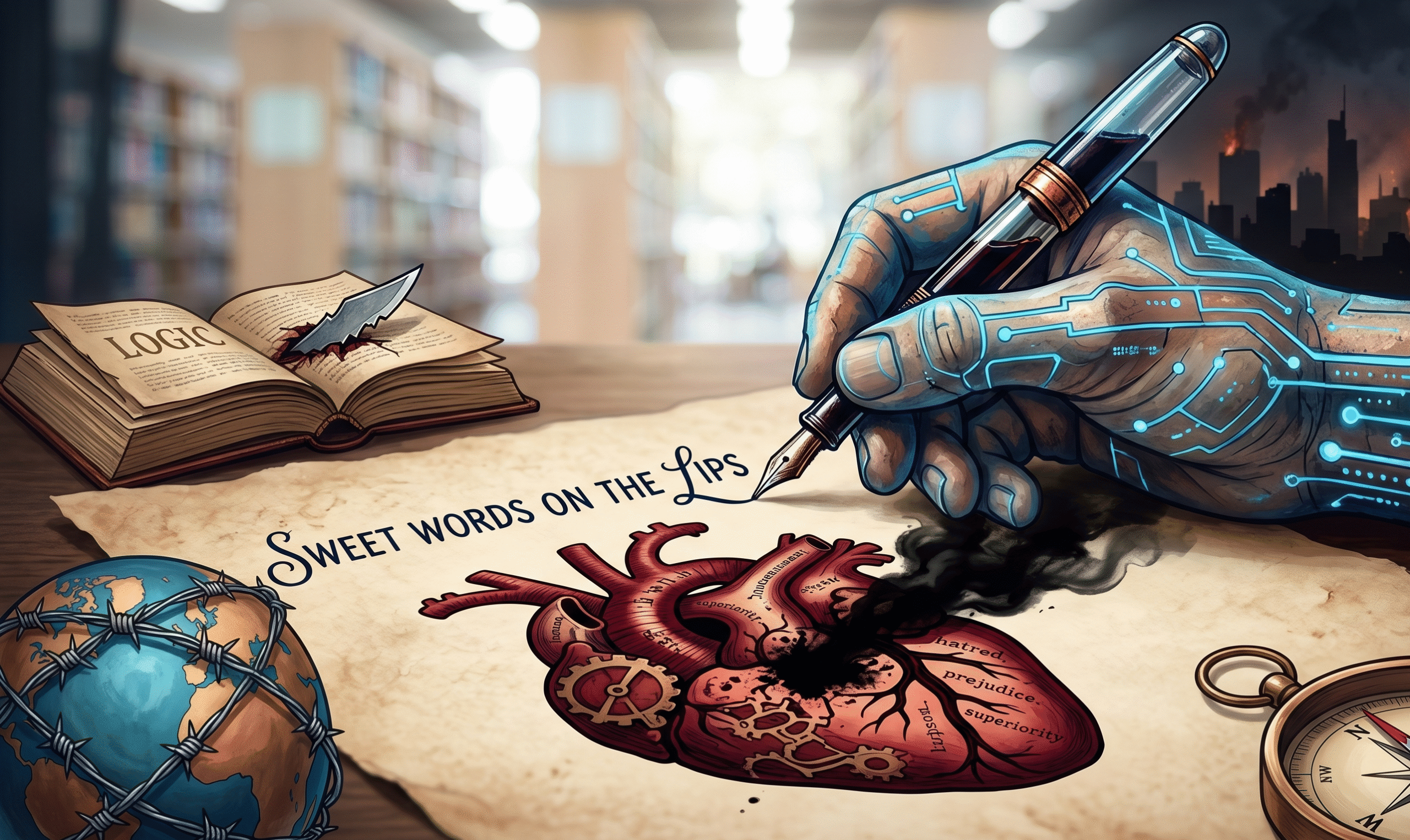
We have successfully trained generations to achieve material success and compete on a global scale. We have forgotten, however, the critical baseline lesson of how not to dehumanize one another.
By Mool Raj
The paradox of modern civilization is written in the gap between our public declarations and our private calculations. We live in an era defined by unparalleled advancement, a golden age of science, technology, communication, and formal education. Humanity has scaled spectacular heights, mapping genomes, standardizing global trade, and connecting the far corners of the earth with instant communication. Classrooms around the world preach coexistence, textbooks laud the virtue of peace, and universities celebrate the triumph of reason, dialogue, and critical thought. Yet, the moment one steps outside these sanctuary walls of learning, the global landscape tells a radically different story. The world continues to burn with old hatreds, deep-seated suspicions, cultural arrogance, and geopolitical conflict. Nations still threaten one another with catastrophic violence, communities fracture along ancestral fault lines of race, religion, and ideology, and powerful societies continue to look down upon the vulnerable. Even highly educated individuals, possessing deep knowledge of history and ethics, regularly choose to become active participants in prejudice rather than bulwarks against it. This unsettling reality forces us to confront a painful journalistic truth: our global systems of learning are failing to cure the most basic flaws of human nature.
This failure raises a fundamental question about the trajectory of our progress. If modern education ostensibly teaches human beings to adjust, cooperate, and resolve systemic friction, why do societies continue to default to conflict? The answer lies in the deep structural paradox of current civilization: formal education is brilliantly designed to sharpen the mind, but it does not automatically soften the heart. We have mistaken intellectual literacy for moral maturity. Education excels at teaching logic, but bigotry and xenophobia are driven by visceral, irrational emotions. It teaches sophisticated communication, but the drive for group superiority is rooted in deep structural insecurity. It explains the cyclical tragedies of history, yet individuals and states consistently choose selective memory to justify current grievances. Our institutions encourage technical discipline, but they rarely cultivate humility. Consequently, while modern schooling shows us precisely how we might live together under ideal conditions, it completely fails to instill the collective will to do so when interests diverge.
This disconnect persists because human beings do not operate on raw reason alone. We are governed by fear, ego, wounded pride, economic greed, and an evolutionary attachment to the tribe. A person can collect advanced degrees and remain entirely trapped inside a narrow, parochial mentality. A nation can possess world-class democratic institutions and still behave with primitive aggression on the global stage. Intellectual development and moral development do not move along the same track. This explains why some of the most destructive catastrophes in human history have not been the work of the uneducated or the primitive. Instead, the darkest chapters of modernity have been systematically planned, legally justified, and efficiently executed by highly educated professionals. Knowledge, when entirely severed from a functioning conscience, is not merely incomplete; it is dangerous. The same academic apparatus that trains a medical healer also refines the skills of a state propagandist. The same scientific breakthrough that cures a pandemic can be weaponized to decimate a population. The very communication technologies designed to democratize understanding are currently leveraged to manufacture and spread state-sponsored lies at breathtaking speed.
The root of this systemic failure can be traced directly to the architecture of modern schooling. The vast majority of national education systems are engineered primarily to maximize economic efficiency, industrial productivity, and state utility. Students are conditioned from childhood to compete, perform, and outpace their peers. They are trained to master complex technical subjects, but they are never taught how to recognize, interrogate, and master their own anger. They are encouraged to speak eloquently, but rarely trained to listen deeply. They learn how to win arguments through rhetorical dominance, but not how to comprehend human pain across cultural divides. We are preparing young people for competitive corporate careers, but we are failing to prepare them for baseline human coexistence. As a direct consequence of this pedagogical imbalance, contemporary societies are producing technically brilliant but emotionally underdeveloped citizens. The mind is rendered powerful and sharp, while the ethical spirit remains fragile and unformed. These individuals eventually inherit the earth; they build corporate systems, manage media empires, lead public institutions, and influence state policy, all while remaining driven by an underlying hunger for superiority, prejudice, and hostility.
This imbalance manifests across the geopolitical and social landscape. We see it clearly when states deploy the elegant language of diplomacy and international law while simultaneously expanding their arsenals for future wars. We see it when political leaders systematically exploit domestic fears to consolidate their grip on institutional power. It is visible when communities fiercely sentimentalize their own historic suffering while actively refusing to acknowledge the current suffering of their neighbors. It appears whenever patriotism degrades into contempt for the outsider, when religious faith hardens into violent fanaticism, and when cultural identity transforms into structural arrogance. At the absolute center of this global crisis sits the poisonous, resilient concept of superiority. Superiority is the oldest and most stubborn illness of human civilization. It is the foundational belief that one’s own group is inherently more deserving, more civilized, more moral, or uniquely chosen compared to the outsider. Whether this claim is framed in the language of nationalism, race, religion, or cultural exceptionalism, the underlying logic never changes: our group matters, and therefore your human dignity is negotiable.
Once this exceptionalist mindset takes root in a society, the justification for cruelty becomes remarkably easy to manufacture. Under its influence, an empire can rebrand territorial domination as regional security. A dominant community can frame systemic prejudice as the preservation of sacred tradition. An aggressive state leader can disguise unprovoked invasion as national honor, and an individual can mask sheer arrogance as professional confidence. This is precisely how hatred survives and flourishes in an hyper-educated, hyper-connected world. It rarely appears in a crude, easily recognizable form. Instead, modern malice wears a tailored suit, sits in parliament, speaks multiple languages, delivers polished press briefings, and conceals its raw instincts behind sanitized terms like strategic interest, civilizational defense, and geopolitical order. But beneath the sophisticated vocabulary, the primitive drive remains untouched: the desire not merely to exist alongside others, but to dominate them.
The current global crisis is therefore not merely political, economic, or environmental; it is a profound moral and educational failure. We have successfully taught generation after generation how to compete globally, but we have failed to teach them how to care globally. We have constructed elaborate institutional frameworks that reward individual and national achievement, but we have built almost no systems that incentivize or reward empathy. We have aggressively strengthened national and tribal identities at the expense of human solidarity. Too often, formal education demands that a student pledge absolute loyalty to a flag long before they are taught their fundamental responsibility to the human race. This does not mean that national history should be erased or that healthy patriotism must be abandoned. A person can possess a deep, abiding love for their homeland while maintaining a profound respect for the rest of humanity. True loyalty to a nation is not demonstrated through blind obedience or chauvinism. Real loyalty means holding one’s country to account, helping it become more just, more humane, and more honorable. A mature citizen does not prove love for their country by generating hatred for another; they prove it by ensuring their own nation does not lose its moral anchor.
The future of global stability depends entirely on creating a new educational balance. We must design a pedagogy that retains technical knowledge but demands wisdom; that preserves distinct cultural identities but prioritizes shared humanity; that pursues professional excellence but actively dismantles social arrogance. Students must certainly continue to learn mathematics, science, economics, and technology to navigate the modern economy. However, they must equally be grounded in emotional intelligence, ethical reasoning, constructive dialogue, historical empathy, and the difficult discipline of seeing themselves in the lives of others. A child should not graduate from an educational institution merely knowing how to succeed in a competitive market. A child must leave school knowing how not to dehumanize another human being.
The contemporary world does not suffer from a scarcity of information. We are drowning in data, facts, and instant news. The world suffers because we lack inner refinement. It suffers because our technological power has vastly outrun our moral compassion. We have trained billions of people to aggressively prove themselves, but we have failed to teach them how to restrain themselves. If education remains strictly confined to technical skill and material success, the future will only grow more perilous. We will simply produce smarter artificial intelligence, sharper digital propaganda, more devastating weapons systems, and colder human hearts. But if our systems of learning begin to form human character with the exact same seriousness and resources currently dedicated to forming intellect, humanity may yet step back from the brink of self-destruction. The true, final test of any educational system is not whether it produces powerful, wealthy, and influential people. The real test is whether it produces human beings who understand how to handle power without defaulting to hatred. Until we achieve that structural shift, civilization will continue to endure this tragic contradiction: highly educated minds governing uneducated egos; technologically advanced nations executing primitive hatreds; and total global connectivity masking profound moral isolation. We continue to fight not because we know too little, but because we have failed to master the most critical lesson of human history: no claim of superiority can ever save a civilization that has forgotten how to see the absolute humanity in others.
Disclaimer: The views and historical interpretations expressed in this feature article are solely those of the author and do not necessarily reflect the official editorial stance or opinions of this publication.
Leave a Reply