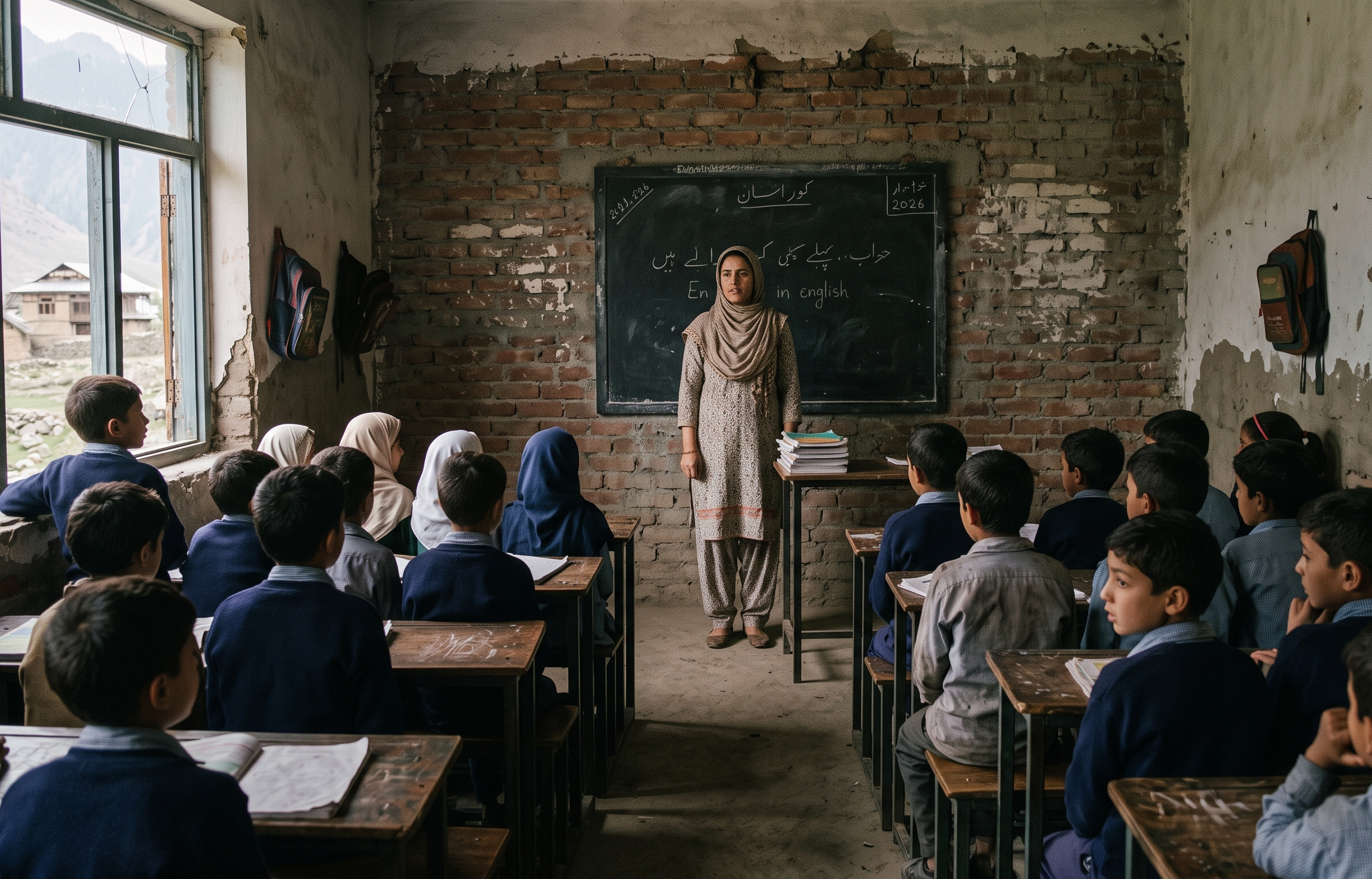
Beneath the impressive fiscal numbers lies a harsh reality of deep learning deficits, unpowered classrooms, and thousands of institutions operating without basic sanitation. As families increasingly squeeze their pockets for private schooling, the state faces an uphill battle to turn access into actual quality.
By Ajaz Rashid
As Jammu and Kashmir transitions into the mid-2026 academic calendar, the School Education Department (SED) finds itself at a historical inflection point. Following the restoration of the Legislative Assembly and the subsequent implementation of a robust ₹1,13,767 crore comprehensive fiscal plan by the Omar Abdullah-led government earlier this year, the systemic rhetoric around public education has sharply shifted from a defeatist “status quo” to an aggressive “surgical repair.”
However, the “sorry state” of the system, a phrase that echoed frequently through the hallowed halls of the Assembly during the spring sessions stubbornly persists. While the latest budgetary layout allocated a significant ₹15,139 crore directly to the education sector (representing a crucial 9% increase from the previous fiscal cycle), the reality on the ground remains a complex, deeply frayed tapestry of crumbling infrastructure, severe foundational learning deficits, and a human resource crisis that Education Minister Sakina Itoo recently described as a “30-year sickness” requiring far more than an instant, resource-driven cure.
The Mid-2026 Academic Deficit and Climate Stress
The preceding academic session will be remembered for its severe administrative disruptions and volatile climatic patterns. Against the legally mandated 220 working days required for comprehensive schooling, many high-altitude regions in Jammu and Kashmir recorded fewer than 150 instructional days, translating to an alarming instructional deficit of over 30%.
Inclement weather patterns ranging from unseasonal, heavy spring snow to volatile flood-like conditions across the Kashmir valley, coupled with intense, record-breaking summer heatwaves in the Jammu division have forced extended, emergency vacations. While the department officially claims to have “covered” the required syllabi through sudden pivots to digital learning modes and heavily compressed classroom schedules, the foundational data from the ASER 2025 report suggests that this institutional “rush-to-finish” culture has severely damaged student retention. The extreme time constraints have deeply burdened students, leaving virtually no room for the specialized foundational literacy and numeracy (FLN) goals explicitly envisioned under the National Education Policy (NEP) 2020.
The Private Preference
Despite the government actively operating 244% more physical academic institutions across the Union Territory than the private sector, the steady shift toward private schooling remains Jammu and Kashmir’s most persistent and painful “hard truth.”
Current Enrollment Landscape (Updated Mid-2026 Data)
| Sector | Number of Schools | Total Enrollment | Total Teachers |
| Government | 18,785 | 14.21 Lakh | 96,380 |
| Private | 5,452 | 12.03 Lakh | 70,234 |
The structural paradox is incredibly stark: with nearly 96,000 civil-service teachers deployed in government schools for approximately 14 lakh enrolled students, the public Pupil-Teacher Ratio (PTR) is technically superior to the national average. Yet, the local public continues to vote against the state system with its wallet.
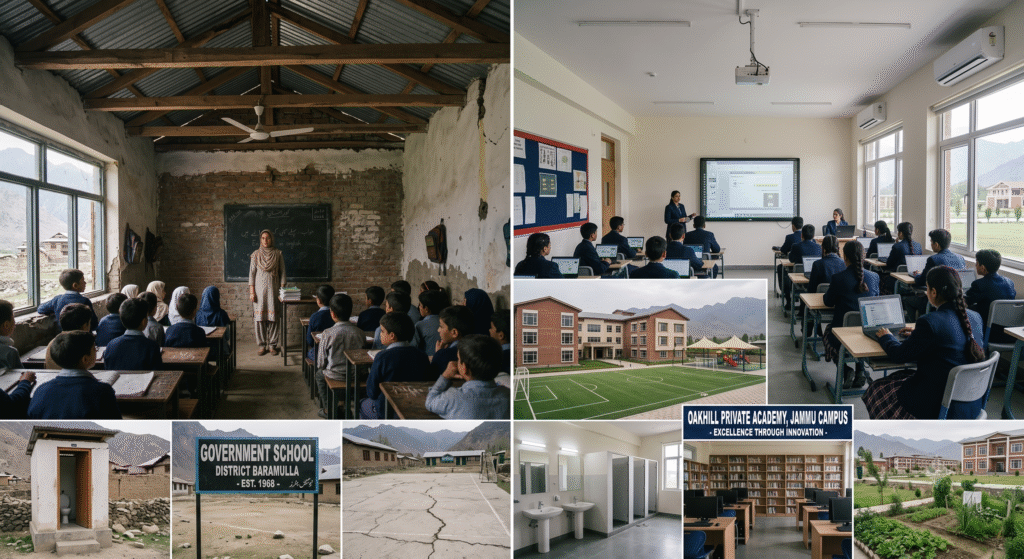
The average annual household expenditure for a private senior secondary student has steadily climbed to over ₹37,000, while the corresponding government expenditure per student sits at roughly ₹14,000. The willingness of low-income, working-class families to bear this heavy financial burden is a direct indictment of the perceived quality, accountability, and instructional execution of government-run institutes.
Learning Poverty and Stagnating Outcomes
The latest Annual Status of Education Report (ASER) highlights a worrisome, multi-year stagnation in real learning outcomes across the region. In rural J&K government schools, only a meager 21.8% of fifth-grade students can successfully read a basic second-grade level text, signaling severe systemic backsliding.
- Mathematics Deficiencies: Only 16.3% of Grade 5 students enrolled in government schools can solve a standard 3-digit by 1-digit division task, a stark contrast to the 37.6% competency level tracked in neighboring private schools.
- The Middle School Slump: There is a highly visible, sharp decline in reading levels as students transition to higher grades, with less than 50% of 8th-grade students able to read 2nd-standard texts fluently.
Minister Sakina Itoo candidly admitted during legislative sessions that historical “access without quality” has been the structural bane of the sector. The administrative focus for the remainder of 2026 is now pivoting toward aggressive outcome-led investing, with the newly operationalized Vidya Samiksha Kendra (VSK) explicitly tasked with tracking real-time learning gains and conceptual clarity rather than just inflating daily classroom attendance metrics.
Infrastructure Gaps
Despite substantial capital injections, the technological landscape of public education in the region remains largely a “digital desert” when analyzed on a school-by-school basis.
- 98% of schools still completely lack comprehensive, functional digital library services or cross-institutional database access.
- Only 373 institutions across the entire Union Territory are currently equipped with fully functional, high-speed digital learning hubs.
- 1,900 government schools continue to operate without separate, functional toilets for female students, severely impacting menstrual hygiene management and attendance.
- 8.5% of schools remain entirely without basic electricity connections, rendering the highly publicized “Smart Classroom” initiative functionally moot in these marginalized pockets.
The budget has earmarked targeted funds for the initial deployment phase of the PM-SHRI Yojana, which aims to aggressively upgrade 396 schools into modern “Green Schools” equipped with cutting-edge laboratories. However, independent policy critics point out that until the 1,900 schools lacking basic toilets are systematically addressed, these localized “high-tech” upgrades feel like an expensive luxury built on a fundamentally fragile structural foundation.
The Staffing Crisis
The most heated debates in the legislative sessions have centered squarely on the crushing human resource deficits: specifically, the 4,200 vacant higher secondary lecturer posts and the alarming ,1,371 schools that are currently run entirely by a single teacher.
“Infrastructure expansion without subject-specific teachers is hollow education. A brand new building cannot teach calculus or language skills without a educator at the blackboard.” Brighter Kashmir Budget Analysis
While Chief Minister Omar Abdullah recently announced an expansive executive resolve to fill over 25,000 vacant positions across various civil departments, only 594 specialized lecturer posts have been formally referred to the Public Service Commission (PSC) so far. This slow bureaucratic pipeline leaves hundreds of schools highly vulnerable to extreme academic understaffing.
The Dropout Dilemma
Jammu and Kashmir currently faces the third-highest student dropout rate in North India at the secondary education level, sitting at a troubling 13.42%. Data reveals that approximately 17% of students actively engage in full-time family labor or informal work after completing Grade 10, rather than continuing their higher secondary studies.
The current fiscal framework introduced a narrow, targeted fee-waiver scheme intended for Antyodaya Anna Yojana (AAY) families spanning from Class 9 up to the undergraduate level. However, education experts argue this policy is excessively exclusionary. By leaving out tens of thousands of “Below Poverty Line” (BPL) families who do not hold specific AAY cards, the state effectively forces many impoverished students to prematurely quit their academic pursuits due to immediate economic hardship and text costs.
Ongoing Structural Reform and Policy Shifts
Despite these monumental hurdles, the current administration has initiated several critical policy shifts aimed at systemic re-calibration:
- De-freezing Essential Posts: The SED is finally de-freezing historical General Line Teacher (GLT) posts to permanently streamline the complex salary matrices and promotion structures of former Rahbar-e-Taleem (ReT) teachers.
- Dual-Level Mathematics Framework: The JKBOSE has officially rolled out a bifurcated “Basic vs. Standard” mathematics tracking option for Class 10, aiming to reduce acute academic stress and lower the mathematics-induced secondary dropout rate.
- Staff Infusion for “Hanging Schools”: Minister Itoo has directed the immediate creation and allocation of dedicated staff for 184 so-called “hanging schools” institutions that were upgraded on paper by previous administrations years ago but were never given authorized personnel.
- Integration of Deregistered Institutions: In a major administrative move, the government has completed the formal takeover of 215 schools formerly affiliated with proscribed organizations, fully integrating them into the mainstream government school system to ensure academic continuity for thousands of affected students.
The current period is one of profound operational re-calibration. The massive injection of ₹15,139 crore is a clear, undeniable signal of political intent, but the institutional “sickness” is deep-seated and generational. As the department pushes the complex Four-Year Undergraduate Programme (FYUG) in higher education colleges while simultaneously trying to fix the vast foundational gaps in primary schools, the core administrative focus must shift from merely creating physical infrastructure to properly staffing it.
The current administration faces a sharp, double-edged sword: they must rapidly meet the sky-high expectations of a newly empowered local electorate while simultaneously navigating a decade’s worth of accumulated vacancies, bureaucratic inertia, and pandemic-era learning loss. If previous years were about reluctantly confronting these hard truths, the remainder of this year must be defined by the “audacity of execution.” Without certified, subject-specific teachers in every single classroom and clean, functional toilets in every school, the historic budget will be remembered merely as a collection of impressive numbers rather than the catalyst for change the region desperately requires.
Disclaimer: Data has been compiled from multiple sources, and figures may vary. Readers are encouraged to verify the data independently.
Leave a Reply