Over 300 tourists were stranded mid-air after the famous Gulmarg cable car experienced a sudden mechanical failure. A massive multi-agency rescue operation successfully evacuated everyone without a single injury.
By Ajaz Rashid
What began as a breathtaking journey over the snow-capped peaks of the Pir Panjal range quickly turned into a harrowing ordeal for hundreds of visitors on Monday afternoon. A massive multi-agency rescue operation spanning six grueling hours, successfully evacuated nearly 320 tourists stranded mid-air after the famous Gulmarg Gondola experienced a sudden, severe technical snag.
The incident, which left dozens of cable cars suspended over the deep ravines of the Kashmir Valley, tested the limits of India’s disaster response networks. Yet, in a testament to seamless coordination and sheer bravery, police, military, and disaster relief personnel ensured that a potential catastrophe ended without a single casualty.
The Incident
The Gulmarg Gondola is one of the highest and longest cable car projects in Asia, drawing millions of visitors eager to witness the unparalleled beauty of Mount Apharwat. Operating in two stages, the system lifts passengers from the Gulmarg base station up to Kongdori Valley, and then further toward the peak.
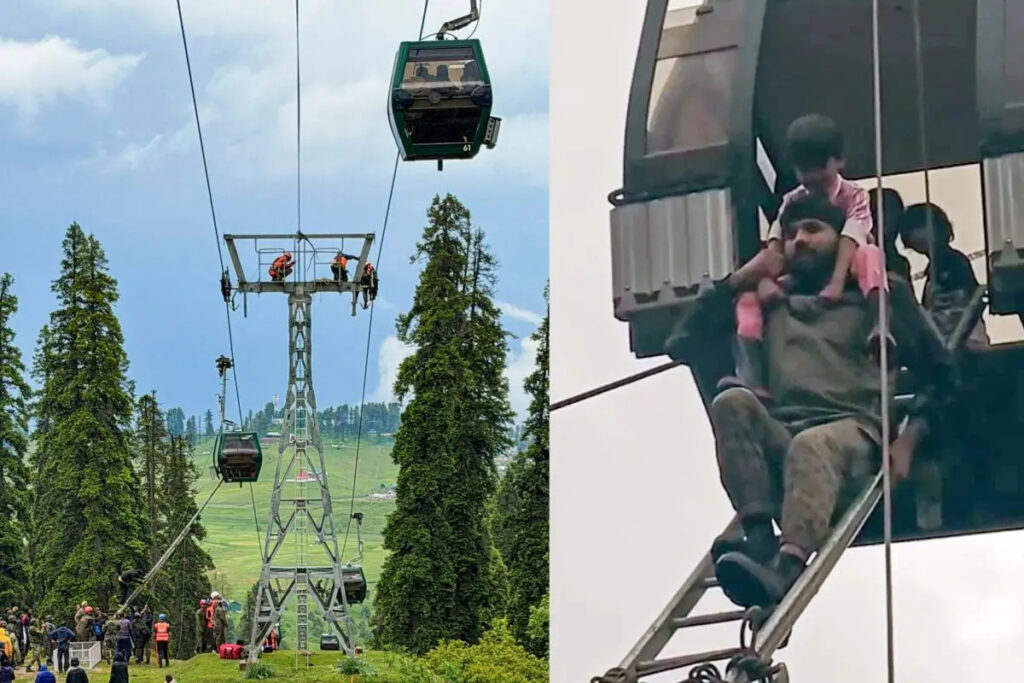
At approximately 1:20 PM on Monday, May 25, the serene mountain silence was broken by the abrupt halt of the cable car system. A technical fault completely paralyzed the primary lift mechanism, leaving 65 cabins dangling motionlessly between the Base Station and Phase-1 (Kongdori). Inside these small, glass-paneled cabins, over 300 tourists, including children and the elderly found themselves trapped hundreds of feet above the rugged, rocky terrain.
Adding to the complexity of the crisis, the weather began to turn. Adverse weather conditions and biting winds, typical of high-altitude Himalayan afternoons, heightened the panic among the stranded passengers.
Director General of Police (DGP) Nalin Prabhat, who closely monitored the situation alongside field commanders, detailed the initial moments of the crisis.
“Police received information in the afternoon that the Gondola had developed a technical fault, causing cabins carrying tourists to get stuck mid-air,” DGP Prabhat told reporters during a press briefing.
The Immediate Response
The urgency of the situation required an immediate and highly specialized response. The first responder on the scene was the Station House Officer (SHO) of Gulmarg. Recognizing the scale of the emergency, the SHO immediately rushed to the spot along with personnel from the local police station and the highly trained Special Operations Group (SOG) to initiate initial rescue efforts and establish a command perimeter.
Within minutes, the scale of the deployment escalated rapidly.
“Soon after, 14 teams of the State Disaster Response Force (SDRF) were mobilised, while another team joined later. Armed Police Mountain rescue teams and Snow Leopard personnel of J&K Police also reached the site, following which a massive rescue operation was launched,” DGP Prabhat explained.
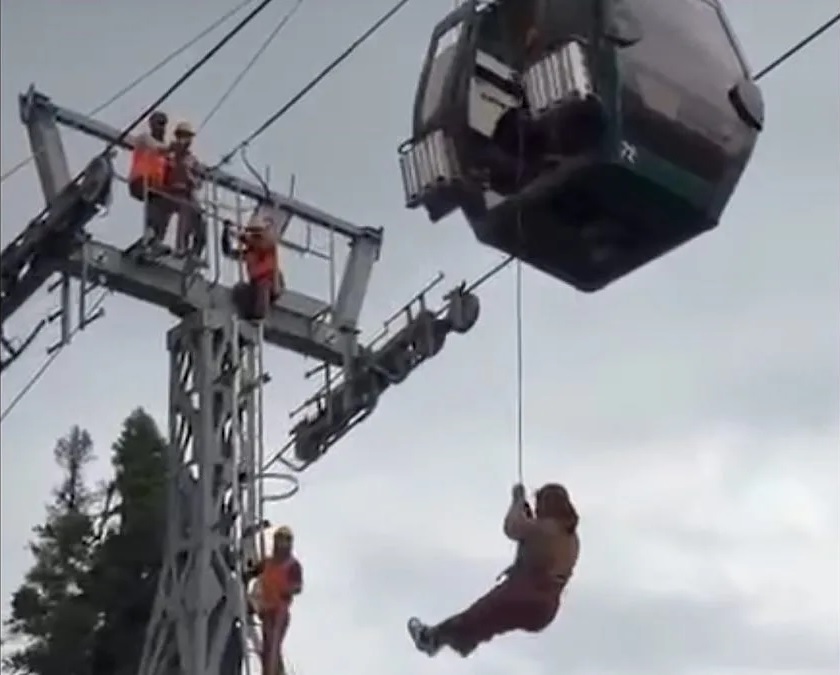
The Snow Leopard personnel, a specialized mountain unit of the Jammu and Kashmir Police, utilized ropes, harnesses, and high-altitude descent gear to reach the stranded cabins. Working alongside a dedicated rescue team from the Gulmarg Gondola Corporation, they began the painstaking process of manually lowering stranded tourists to the ground.
Army and NDRF Join the Fray
As the hours ticked by and the physical toll of the operation mounted, reinforcements arrived. The National Disaster Response Force (NDRF) and the Indian Army deployed heavily equipped units to the mountain.
The military’s involvement proved crucial in managing the sheer volume of evacuees and navigating the treacherous terrain. In a detailed statement recounting the timeline of events, an Army spokesman highlighted the joint nature of the mission.
“The Indian Army and State Disaster Response Force (SDRF) led a coordinated rescue and evacuation operation at Gulmarg Gondola after a technical fault in the Gondola cable car system caused a sudden suspension of services between the Base Station and Phase-1 (Kongdori) on Monday, leaving multiple tourists stranded amid adverse weather conditions.”
The military executed a tactical approach to the rescue, utilizing specialized medical and transport units to ensure that once passengers were lowered to the ground, they could be safely extracted from the wilderness.
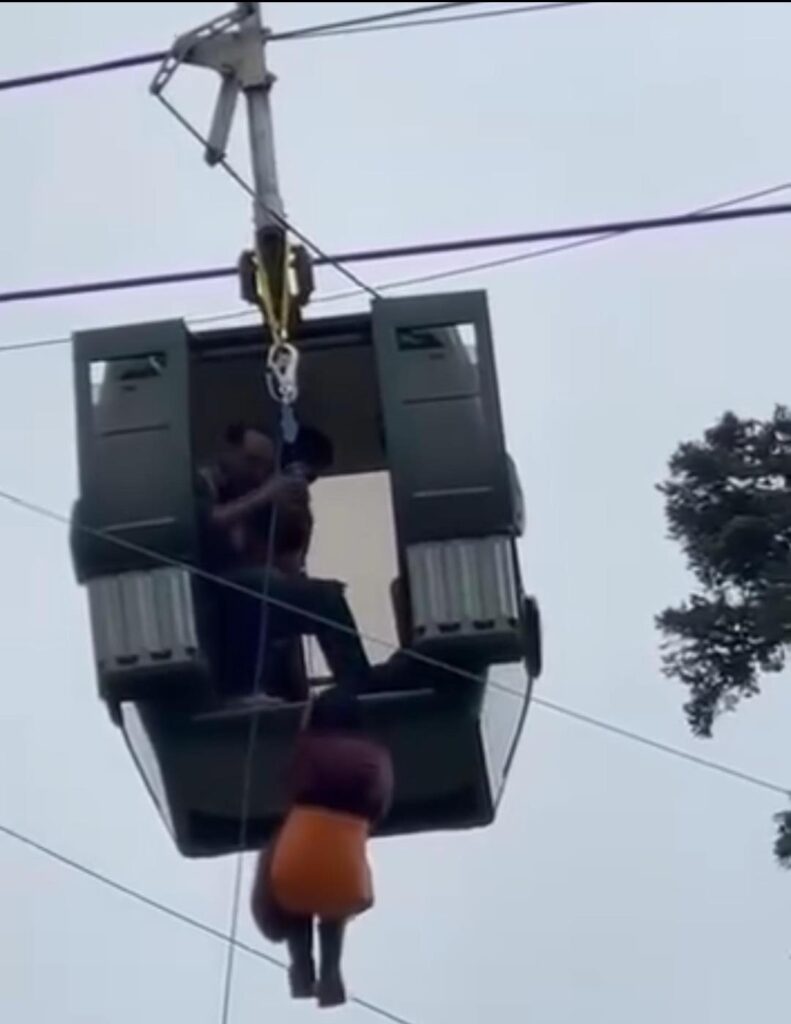
“Following a distress call received from the Jammu and Kashmir Police and the Gondola Management Authority regarding the safety and evacuation of stranded tourists, the Indian Army swiftly swung into action and mobilised rescue teams towards the affected area. Troops from Butapathri Battalion side-stepped three Casualty Assistance Teams (CATs) between the Gondola Base Station and Phase-1, while the Army also staged forward its own All-Terrain Vehicle (ATV) to facilitate evacuation efforts in the challenging terrain and prevailing inclement weather conditions,” the Army spokesman added.
To further bolster the ground transport logistics, civil society and local groups stepped up. “The SDRF, Jammu and Kashmir Police and other civil agencies also pitched in to support the rescue operation, while additional ATVs were coordinated through the Gulmarg ATV Association to augment evacuation efforts, as restoration of the Gondola system was expected to take time.”
Senior police officers, including Additional Director General of Police (ADGP) for Law and Order V. K. Birdi, arrived in Gulmarg to monitor the rescue efforts on the ground. They were joined by senior Army officials—including Punit Doval, Manoj Dattatrey Joshi, M. B. Singh, and S. K. Yadav—as well as civil administration officials who ensured that medical camps were set up at the base station to treat anyone suffering from shock or exposure.
Despite the terrifying circumstances and the punishing environment, the operation yielded a miraculous result.
“No one sustained any injuries during the incident,” DGP Prabhat confirmed, lauding the swift response and seamless coordination among all teams involved in the operation. He emphasized the unwavering commitment of the brave personnel of the security forces, noting that they effectively averted a major crisis.
National Applause and Administrative Action
The successful rescue of hundreds of civilians from a suspended cable car system quickly drew the attention and praise of India’s highest offices.
Union Home Minister Amit Shah released a statement expressing his deep appreciation for the first responders. “Applause to India’s disaster response forces for safely rescuing 300 tourists stranded mid-air in cable cars in Gulmarg, Kashmir. The nation salutes the forces for their valour and skill,” Shah said.
In Srinagar, Lieutenant Governor Manoj Sinha closely tracked the six-hour ordeal and hailed the courage of the agencies involved. Taking to the social media platform X (formerly Twitter), LG Sinha wrote:
“The nation stands united in applauding extraordinary bravery of disaster response teams, who safely rescued 300 tourists stranded mid-air in Gulmarg’s cable cars. Army, JKP, SDRF, NDRF, DC, SSPs moved promptly & after a 6-hour operation, rescued all passengers from 65 cable cars. All tourists are safe.”
He further elaborated on the administrative backing provided during the crisis: “I spoke with senior officials and directed them to ensure every necessary support is provided. The nation salutes the disaster response forces, Army, JKP and district administration for their valor and remarkable skill,” he added.
Meanwhile, the political leadership of Jammu and Kashmir took immediate steps to address the infrastructure failure. On the direct instructions of Chief Minister Omar Abdullah, Deputy Chief Minister Surinder Kumar Choudhary visited Gulmarg to personally oversee the tail end of the rescue operation and assess the disruption in the gondola service. MLA Gulmarg Pirzada Farooq Ahmed Shah, alongside senior administrative and police officers, also remained present at the site to coordinate relief measures for the rescued tourists.
Chief Minister Abdullah commended the professionalism displayed during the rescue operation but made it clear that accountability must follow. He stated that the incident will be thoroughly examined and an enquiry conducted. Responsibility for any lapses will be fixed and appropriate action taken, ensuring that the safety of tourists remains the region’s top priority.
Gondola Closed and Awards Announced
In the wake of the disruption, authorities moved swiftly to secure the cable car system. An official told a local news agency that the Gulmarg Gondola service in North Kashmir’s Baramulla district will remain completely closed on May 26 and 27 for comprehensive technical maintenance.
All tickets booked for May 25, 26, and 27 will be refunded in full to the affected visitors. Authorities expressed deep regret over the inconvenience caused to tourists and visitors, maintaining that the maintenance work has been initiated as a strict precautionary measure to inspect and rectify the technical issue before operations resume. The service will restart only after all safety checks and technical inspections are completed and certified.
While the mechanical failure will be the subject of a rigorous investigation, the human triumph of the day remains the focal point. Addressing the exhausted but victorious rescue teams at the Gulmarg Gondola base late at night, DGP Nalin Prabhat praised the personnel for executing a highly complex operation in harsh weather and rocky, mountainous terrain.
“Today all of you have made J&K Police proud,” the DGP said, his words echoing across the cold mountain air.
He announced that all personnel involved in the operation would be nominated for official commendation awards. Those who have not yet received the DGP Commendation Disc will be awarded the honour, while personnel who have already received it will be considered for other commendation awards.
As the tourists return safely to their hotels and the massive gears of the Gulmarg Gondola undergo inspection, Monday’s incident stands as a powerful reminder of both the vulnerabilities of high-altitude infrastructure and the incredible resilience and skill of India’s disaster response forces. (With inputs from KNO)
Leave a Reply