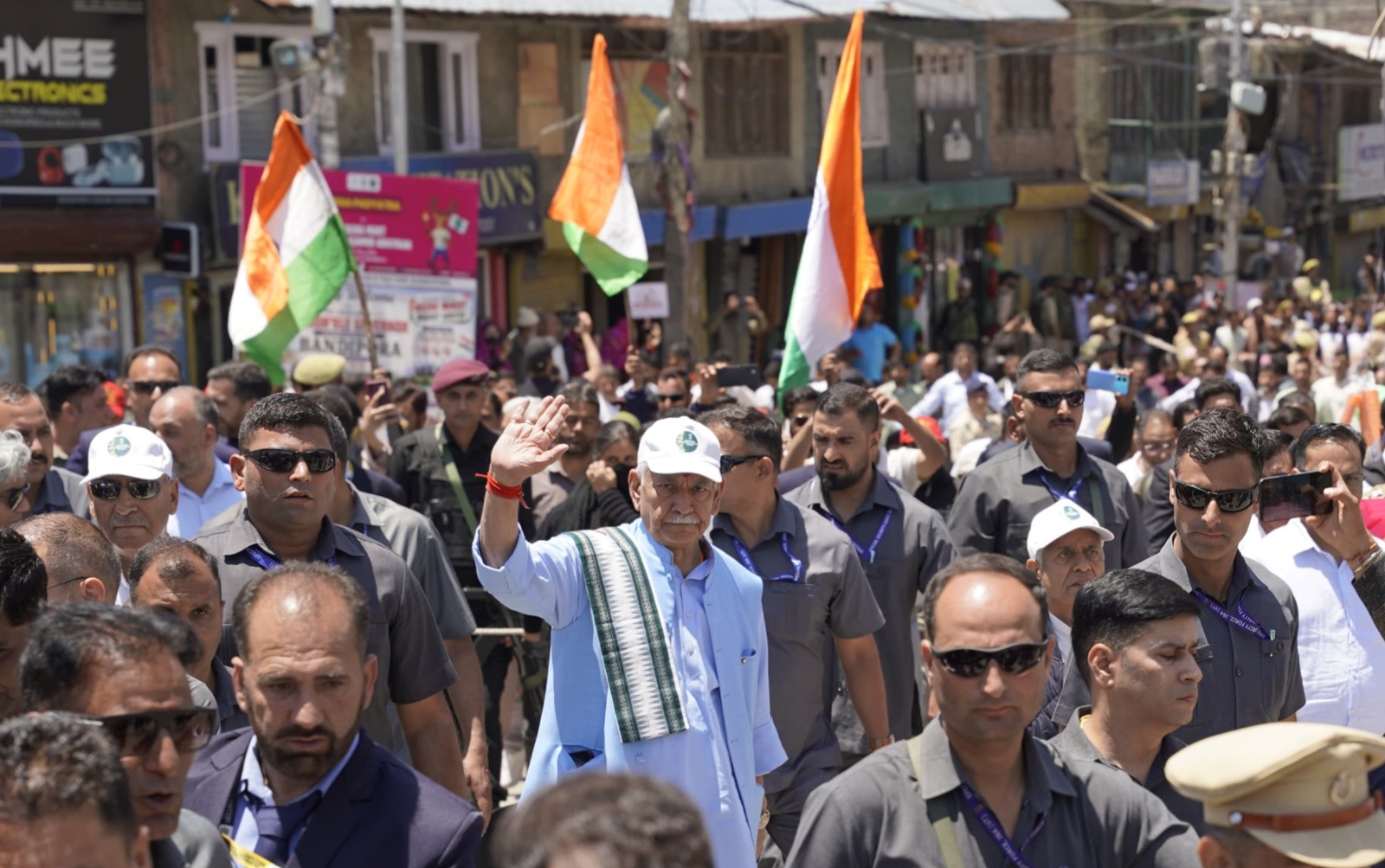
Leading a massive anti-drug march in Bandipora, the Lieutenant Governor vowed to completely dismantle the region’s cross-border narco-terror networks. The administration is pairing this aggressive law enforcement crackdown with a comprehensive new rehabilitation policy designed to reclaim vulnerable youth.
By Ajaz Rashid
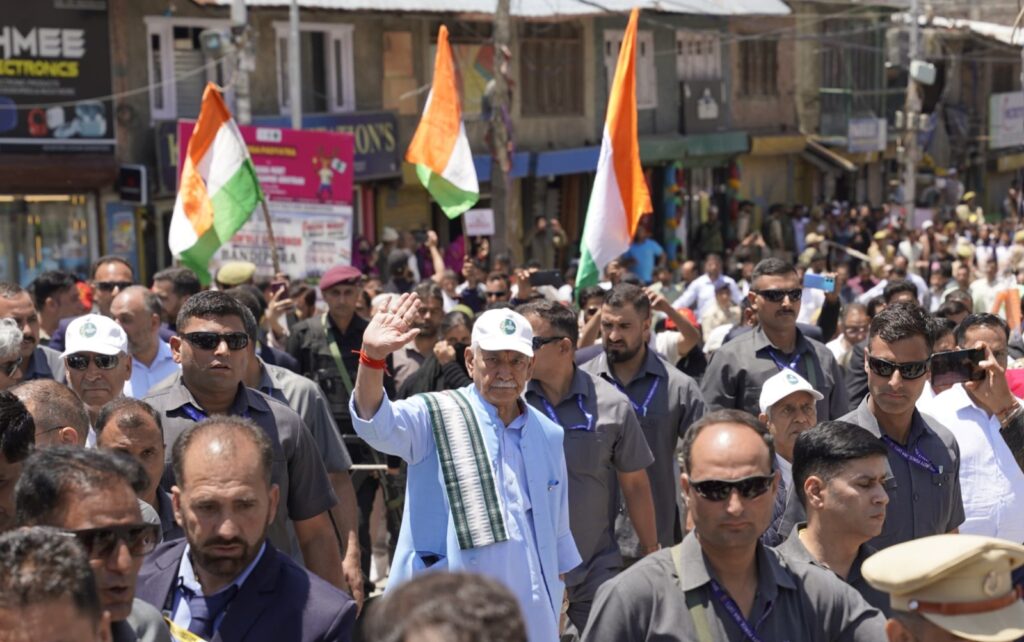
Declaring an all-out war against the intertwined menaces of substance abuse and cross-border terrorism, Lieutenant Governor Manoj Sinha led a massive padyatra (foot march) in North Kashmir’s Bandipora town on Monday. The rally, organized under the nationwide Nasha Mukt Bharat Abhiyan (Drug-Free India Campaign), was designed to galvanize grassroots support against a crisis that has rapidly emerged as one of the most pressing socio-economic and security challenges in the Union Territory.
Against the backdrop of a significant crackdown on narcotics smuggling networks across the Kashmir Valley, the Lieutenant Governor delivered a stern warning to drug cartels, affirming that Jammu and Kashmir is no longer a sanctuary for those who exploit the vulnerable.
Crushing the Narco-Terror Ecosystem
Over the past few years, security agencies in Jammu and Kashmir have identified a disturbing trend: the weaponization of narcotics by cross-border elements to fund terrorist activities and destabilize the region’s youth. Recent data indicates a sharp rise in contraband seizures, including multi-crore hauls of heroin, often transported via complex networks involving drones and traditional infiltration routes.
Addressing a sprawling gathering of locals, youth, civil society members, and administrative officials at the culmination of the padyatra, LG Sinha made the government’s uncompromising stance absolutely clear.
“We have sent a clear message that Jammu Kashmir will not be a safe haven for those who profit from other people’s sufferings. I am determined that we will root out every narco-terrorist and drug smuggler from this soil. Those who tried to destroy our families will have their existence erased from this land. The law is now being applied firmly. Narco-terrorists are being punished, youth are being protected, families are being supported, and renewed hope is returning to the society.”
The administration’s recent operational shifts reflect this firm application of the law. The Jammu and Kashmir Police, alongside the Anti-Narcotics Task Force (ANTF), have moved beyond mere seizures. They are now actively freezing bank accounts and attaching the immovable properties of notorious drug peddlers under the stringent provisions of the Narcotic Drugs and Psychotropic Substances (NDPS) Act and the Prevention of Illicit Traffic in Narcotic Drugs and Psychotropic Substances (PIT-NDPS) Act.
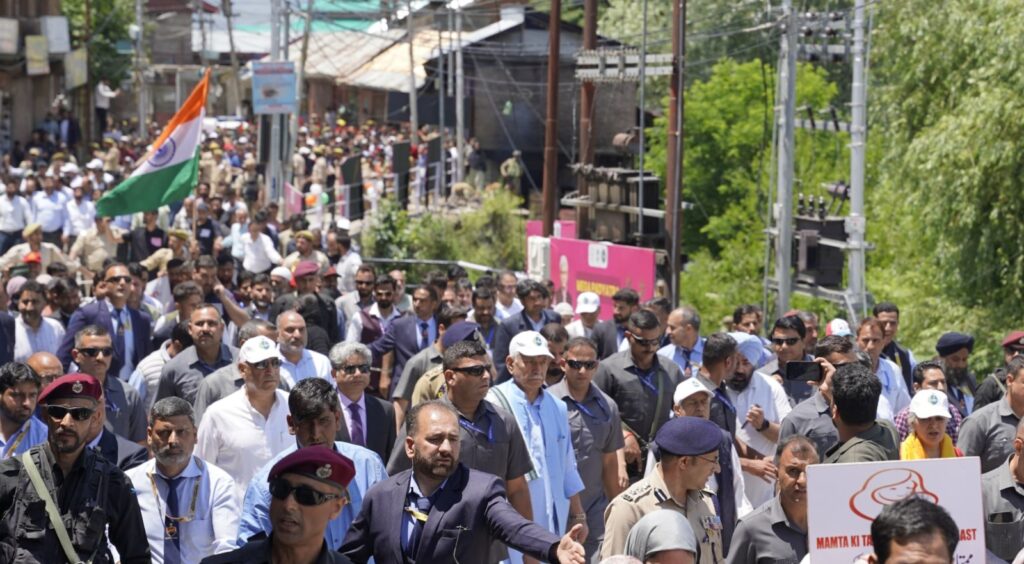
Highlighting a recent administrative milestone, the Lieutenant Governor recalled a promise made weeks prior to escalate this fight.
“45 days ago, I pledged not only to dismantle smugglers and narco-terrorists ecosystem, but also to spark a movement that uplifts youth and restores dignity to families scarred by addiction.”
He emphasized that the government remains united, strong in its resolve, and uncompromisingly committed to purging drugs from society. The ongoing offensive has successfully traced and dismantled several covert supply networks that had operated with impunity for decades.
“The action against narco-terrorists and drug smugglers will continue. It will not stop until every drug smuggler is eliminated from the sacred soil of Jammu Kashmir. Our agencies have launched an unprecedented drive to dismantle narco-terrorists and their hidden network. No drug smuggler, drug peddler, or anyone seeking to poison our society is beyond reach. The entire narco-terror ecosystem is being pursued,” the Lieutenant Governor stated.
While the enforcement approach is iron-fisted against suppliers, the administration is concurrently shifting its perspective on the consumers, treating them as victims requiring urgent medical and social intervention. According to recent surveys by the Ministry of Social Justice and Empowerment, coupled with alarming footfall data from the Institute of Mental Health and Neurosciences (IMHANS) in Srinagar, hundreds of thousands of individuals in J&K are currently grappling with substance abuse, with a deeply concerning spike in intravenous heroin use.
To combat this public health emergency, LG Sinha announced that the administration will soon roll out a comprehensive rehabilitation policy. This framework will be designed to ensure that every youth trapped in the vicious cycle of addiction is given a legitimate pathway back into mainstream society.
“Our aim is that not a single young person is left behind. We will provide jobs, opportunities, and the means for them to live with dignity. I strongly believe the success of a Drug-free Jammu Kashmir will not be measured only by the number of drug smugglers arrested but by the number of lives we can rebuild. It will be measured by the homes that can be restored and the young people who can fulfil their dreams. I promise you that we will not rest until their dreams are realised,” the Lieutenant Governor assured the crowd.
Despite the massive deployment of state machinery, the administration recognizes that law enforcement and clinical rehabilitation alone cannot win this war. The systemic eradication of the drug menace requires an organic, community-led resistance. The Lieutenant Governor issued an impassioned plea to families, educators, religious clerics, and local community leaders to serve as the first line of defense.
“I envision a Jammu Kashmir where every child grows up free from the shadow of addiction. A Jammu Kashmir where families are not torn apart by drugs. A Jammu Kashmir where society moves forward with security, dignity, and trust. This is not merely a dream. It is our mission and together we will fulfill it. We need the vigilance, awareness, and commitment of every resident of Jammu Kashmir. I believe that when people stand united, no narco-terror network or drug cartel can infiltrate them. When the public stands together, no terror can defeat them. I urge, we must unite to bury narco-terror once and for all,” the Lieutenant Governor said.
Inauguration of the Waqar Knowledge Centre
Translating these pledges into immediate on-ground infrastructure, the event in Bandipora also marked a pivotal step in community-level rehabilitation. The Lieutenant Governor officially inaugurated the Waqar Knowledge Centre – Engaging Youth Against Drug Abuse.
Established by the District Administration of Bandipora under the umbrella of the Nasha Mukt Bharat Abhiyan, the Waqar Knowledge Centre (WKC) is designed to close the critical loop in the anti-drug intervention cycle. Often, recovering addicts face social ostracization and a lack of engaging activities, leading to high relapse rates. The WKC tackles this by providing recovering individuals with a safe, constructive platform for social reintegration and personal development.
Key features of the Waqar Knowledge Centre include:
- Recreational Facilities: A dedicated sports corner and an indoor badminton court to promote physical well-being and channel youth energy positively.
- Educational Resources: A well-stocked reading library to foster continuous learning and intellectual engagement.
- Empowerment Hub: An active information desk offering tailored guidance on government welfare schemes, educational scholarships, employment avenues, and modern skill development opportunities.
By offering these resources, the WKC reinforces the administration’s core message: individuals willing to abandon substance abuse will find a robust, government-backed support system waiting for them. Looking ahead, the local administration envisions scaling this successful model by establishing at least one Waqar Knowledge Centre in every block across the district, creating a decentralized network of safe spaces that empower the youth and fortify community resilience against the shadows of addiction.
Leave a Reply