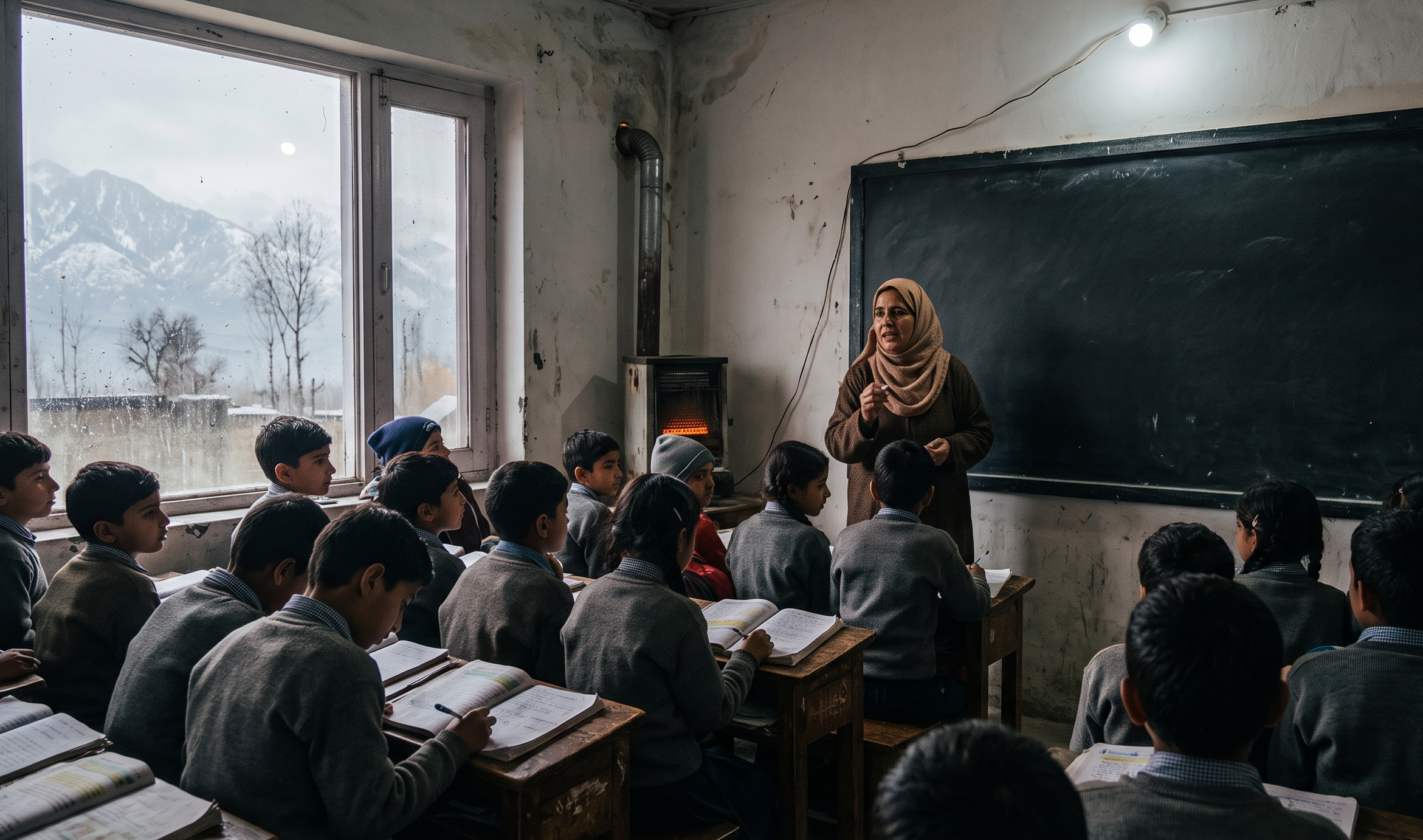
Kashmir’s students already navigate severe weather closures, administrative disruptions, and extensive breaks. Slicing away another school day deprives young minds of the vital continuity they need to compete globally.
By Aubaid Ahmad Akhoon
“In this age, education is the remedy for the ailments of the nation.” These timeless words of wisdom from Allama Muhammad Iqbal continue to resonate with the same urgency and significance today as they did decades ago. Hakeem-ul-Ummat Allama Iqbal was a philosopher of rare foresight who recognized that knowledge, intellect, and spiritual awakening are the bedrock of any society’s survival and prosperity. He was not merely a product of traditional Eastern learning; having studied abroad, he was thoroughly immersed in the modern educational ethos and philosophical crosscurrents of Europe. His philosophy was fundamentally an appeal for self-awakening—an enduring urge directed at youth to cultivate profound knowledge, a rigorous scientific temperament, unyielding character, and moral discipline.
Today, this vision demands urgent contemplation as we deliberate the fragile condition and uncertain trajectory of our school education system. A proposal to declare Saturdays as weekly holidays has gained traction, presented under the guise of student relief and reduced academic stress. While an extra day off sounds undeniably tempting, our education system is gasping for basic resources, instructional consistency, and qualitative depth. We must ask ourselves candidly: can we genuinely afford to surrender more learning time in an increasingly relentless world? A Saturday off may seem innocuous on paper, but progressive educational policy cannot be drafted on the fleeting tides of emotional convenience.
The global environment our children are entering is defined by unprecedented technological acceleration and fierce competition. Breakthroughs in artificial intelligence, robotics, advanced biotechnology, data science, and rapid digitization are reshaping economies and rendering traditional job markets obsolete. Forward-looking nations are actively expanding instructional rigor and recalibrating their curricula to ensure their youth lead this transformation. Unless we furnish our students with superior instructional quality, operational efficiency, and enriched academic exposure, institutionalizing a Saturday holiday will do nothing more than compound our systemic deficits.
Our pupils already forfeit an alarming portion of the academic calendar. Between prolonged winter vacations, summer breaks, gazetted holidays, regional strikes, election duties, and extended examination pauses, meaningful classroom instruction is already compressed into an alarmingly narrow window. Compounding this challenge, experienced schoolteachers are routinely pulled away from their pedagogical duties to serve as enumerators and supervisors in administrative census operations, sparking legitimate public outrage over chronic classroom disruptions and acute staff shortages. When one factors in the unique, unpredictable, and often hostile weather patterns of Kashmir—where severe cold, sudden downpours, or logistical blockades routinely shutter institutions—the cumulative loss of instructional hours becomes devastating. Depriving children of continuity in the name of administrative convenience risks turning schooling into a sporadic exercise. If administrative bodies genuinely sought to ease structural strain, the rational remedy would be to invest aggressively in winterized school infrastructure, functional heating, adequate sanitation, and modern nutritional programs rather than merely padlocking the gates.
Foundational literacy and numeracy, particularly within subjects such as mathematics, physics, and critical language acquisition, are deeply cumulative disciplines. Conceptual understanding demands daily reinforcement, iterative problem-solving, and deliberate teacher-student interaction; a missed instructional day cannot simply be restored by telling a child to skim an extra chapter at home. Education is not a household water tap that administrators can turn on and off at will without wrecking the underlying pipeline. If our academic framework is buckling under strain, slicing away school hours is an evasion of responsibility, not an intervention. We must fix the classroom, not mutilate the calendar. If academic fatigue and emotional burnout plague our children, the solution lies in instituting robust psychological counseling, expanding athletic programs, and cultivating lively co-curricular spaces that transform the school into an engaging sanctuary. If our teaching staff is overwhelmed, let us invest in contemporary pedagogical training, dismantle superfluous bureaucratic paperwork, and deploy remedial bridge programs for students falling behind. The goal is to make children eager to step inside the schoolhouse, not relieved to escape it.
A resilient society requires resilient schools anchored by empowered educators, ambitious institutional standards, and motivated learners. Kashmir’s children have historically endured an extraordinary degree of educational disruption, yet their thirst for learning remains unquenched. They continue to flock to classrooms in droves, driven by parents who see education as the ultimate ladder out of uncertainty. In our socio-economic reality, schooling is not merely a path to paper qualifications; it is the definitive vehicle for human dignity and empowerment.
Policymakers must therefore exercise meticulous caution before dishing out yet another populist holiday. The guiding question before our academic boards must not be, “How many days of absence can we afford to grant?” Rather, it must be, “How can we elevate the classroom experience so that every hour spent in school is transformative?” An educational architecture that aspires to excellence asks qualitative questions, not logistical ones. We cannot mold confident, competitive global leaders out of an ever-dwindling academic year. True competitiveness goes far beyond passing annual tests; it is built on disciplined application, sharp analytical skills, intellectual curiosity, clear communication, and unshakeable resilience in the face of hardship.
We must not confuse institutional indolence with compassion, nor mistake superficial convenience for genuine reform. Our education system does not need an orderly retreat; it requires a bold infusion of energy, higher expectations, and state support. Reducing the school week without clear, empirically validated remedial mechanisms will only accelerate our academic deficit. We cannot clip the wings of our young shaheens under the sentimental pretext of sparing them the effort of flight. Our collective obligation is to strengthen those wings, supply them with superior instruments of inquiry, and challenge them to rise.
Before any final decree is stamped regarding the abolition of Saturday schooling, the administration must submit the proposal to comprehensive public and academic scrutiny. The broader civil society deserves hard data: what will be the exact mathematical cost to total instructional hours, standardized literacy metrics, STEM competencies, teacher workloads, and general academic progress? A policy of this magnitude cannot be manufactured in administrative isolation. It demands transparent dialogue with frontline teachers, parents, curriculum designers, child psychologists, and community leaders. Long-term developmental objectives, not short-term administrative ease, must govern state decisions. We cannot recover the formative academic years already lost to past disruptions. Iqbal continually warned against the paralysis of complacency, urging humanity to cast aside fragile comforts in pursuit of intellectual excellence. The modern world yields no ground to the unprepared. Let Saturdays remain dedicated to vibrant instruction and intellectual growth until definitive, irrefutable evidence proves our children are better served by staying home. We have spent years working to restore their potential; let us not dismantle it now in the mistaken pursuit of an extra holiday.
Disclaimer: The views expressed in this feature article are solely those of the author and do not necessarily reflect the official editorial stance or opinions of this publication. The author can be reached at [email protected]
Leave a Reply