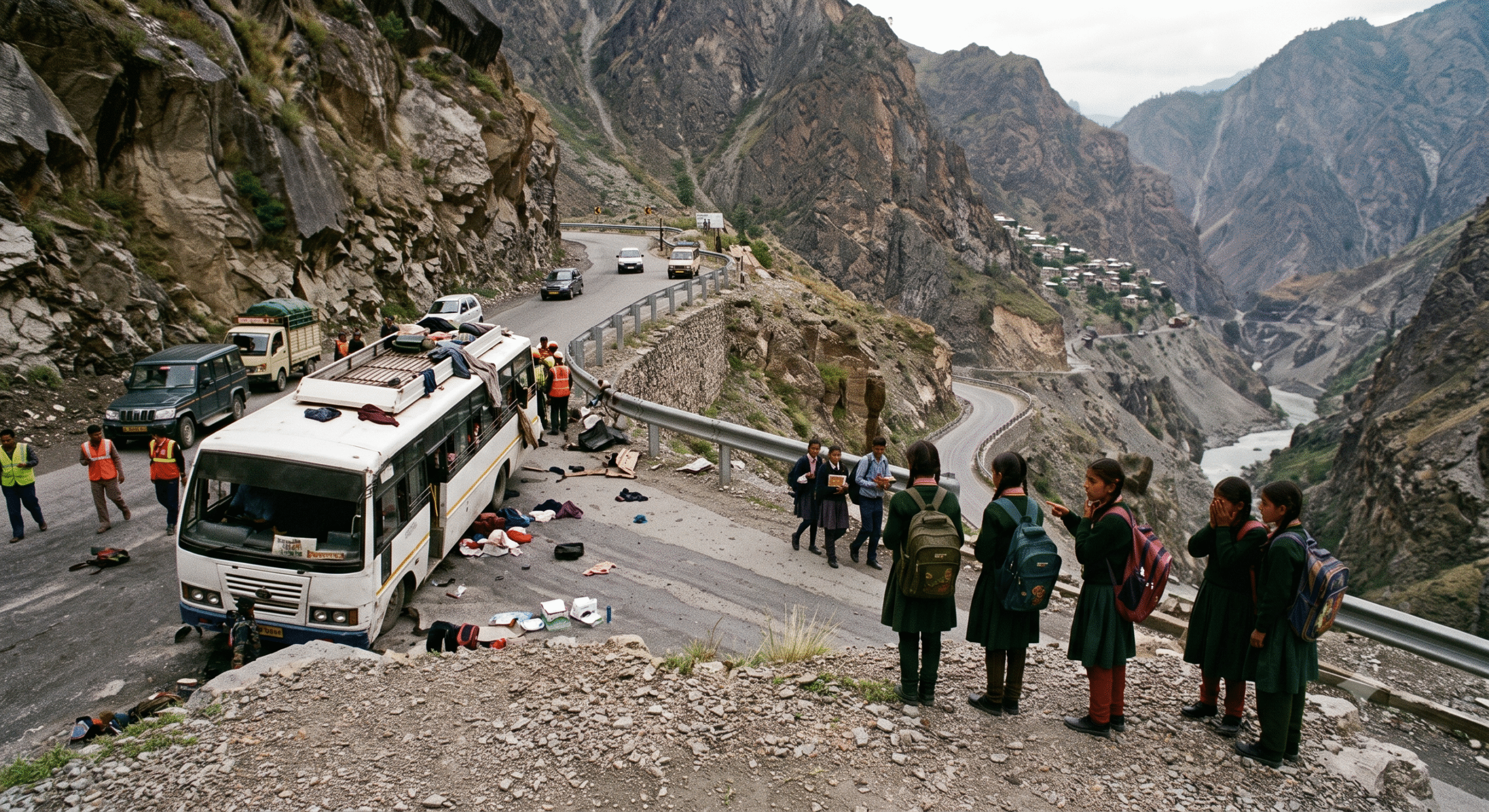
With young lives bearing the brunt of mountain road carnage, pedestrian and passenger fatalities continue to climb across Jammu and Kashmir. Despite a drop in total highway collisions, the lethality of crashes on northern corridors remains dangerously volatile.
By Ajaz Rashid
The Himalayan asphalt winds through treacherous gorges, hugging steep cliffs where one wrong turn means a plunge into eternity. Along the strategic expressways and national arteries connecting the valleys of Jammu and Kashmir and the high-altitude desert of Ladakh to the rest of the nation, a silent crisis plays out every day. New parliamentary disclosures furnish a stark, data-driven window into the tragic reality unfolding across northern India’s mountain corridors.
According to official statistics tabled in the Lok Sabha by Union Minister for Road Transport and Highways Nitin Jairam Gadkari, Jammu and Kashmir recorded 1,109 road accidents on National Highways in 2026. These crashes claimed 206 lives and left 1,658 people injured. Sourced through the Electronic Detailed Accident Report (e-DAR) portal, a real-time centralized database deployed across police jurisdictions, the government noted these figures are subject to ongoing updating.
At first glance, the macro trajectory on expressways and National Highways shows a encouraging downward trend in crash frequency over a five-year horizon. In 2022, Jammu and Kashmir registered 2,378 highway accidents. That number gradually tapered off to 2,342 in 2023, dropped further to 2,120 in 2024, and fell to 1,867 in 2025 before hitting the current figure of 1,109. Yet, this numerical decline in incidents hides a far more unsettling volatile reality: the lethality of these crashes fluctuates wildly. Highway fatalities stood at 259 in 2022, escalated to 294 in 2023, dipped marginally to 271 in 2024, surged dramatically to 431 in 2025, and currently sit at 206 for 2026.
When examining the entire road network spanning rural links, district thoroughfares, state routes, and national highways combined, the picture becomes even grimmer. In response to parliamentary questions raised by Lok Sabha member Shyamkumar Daulat Barve, comprehensive government disclosures reveal that total road deaths across Jammu and Kashmir have climbed relentlessly over the years. The region recorded 5,452 total accidents and 774 fatalities in 2021. By 2022, those figures rose to 6,092 accidents and 805 deaths, accompanied by 8,372 injuries. The trajectory continued upward in 2023 with 6,298 accidents and 893 lives lost. Even as total incidents moderated to 5,808 in 2024 and 5,318 in 2025, the body count reached a devastating peak of 984 fatalities in 2025. Up to July 27, 2026, the Union Territory has already logged 3,269 accidents, 603 deaths, and 4,775 injuries.
The human toll falls heavily on young lives. Demographically, youth and working-age individuals bear the brunt of mountain road carnage. Of the 206 National Highway fatalities recorded this year, 17 victims were minors under the age of 18. Another 25 victims were young adults aged 18 to 25, while 40 deaths occurred in the 25–35 age bracket. The 35–45 age group saw 29 deaths, 28 fatalities were recorded among those aged 45 to 60, and 12 victims were older than 60. For 55 victims, ages could not be ascertained at the time of reporting.
Equally alarming is the exponential rise in pedestrian casualties—a stark indicator of inadequate foot traffic infrastructure and reckless driving behavior along mountain urban stretches. In 2021, pedestrian deaths in Jammu and Kashmir stood at 101 alongside 754 injuries. That figure crept up to 131 fatalities in 2022 and 158 in 2023, before holding at 144 in 2024. Then came a alarming surge in 2025, when pedestrian deaths skyrocketed to 477, with 1,715 injuries reported. Up to July 27, 2026, pedestrian fatalities have already reached 226, with 1,005 injured.
Across the high-altitude cold desert of neighboring Ladakh, highway safety paints its own precarious story. On its National Highways in 2026, Ladakh registered 119 road accidents resulting in 17 fatalities and 177 injuries. Across all road types, Ladakh recorded 236 accidents and 56 deaths in 2021, 374 accidents and 62 deaths in 2022, 289 accidents and 59 deaths in 2023, 264 accidents and 61 deaths in 2024, and 287 accidents with 71 deaths in 2025. Up to July 27, 2026, the region saw 235 accidents, 39 deaths, and 368 injuries. Pedestrian deaths in Ladakh, which historically hovered at 1 to 4 cases annually also witnessed an abnormal spike to 305 in 2025 before standing at 174 in the current reporting period.
Nationally, the highway crisis remains vast. The Ministry revealed that 77,234 road accidents occurred on National Highways across India in 2026, claiming 34,610 lives and injuring 60,224 people.
Addressing the root causes, the Ministry underscored that road crashes are a complex, multi-causal phenomenon. Primary drivers include human error, environmental and road conditions, and mechanical failures. Speeding, drunk driving, driving on the wrong side, jumping traffic lights, and mobile phone usage while navigating challenging terrain remain major contributors to severe collisions.
To counter this, central authorities have turned to data science and structural interventions. Utilizing AI-driven analysis tools developed in collaboration with IIT Kanpur, the ministry identified 6,358 black corridors chronic accident hotspots on National Highways nationwide based on 2023–2025 crash mapping. Corrective protocols are split between short-term engineering fixes, such as high-visibility road markings, clearer signage, crash barriers, delineators, and traffic-calming measures, and long-term re-engineering. The latter includes correcting flawed road geometry, redesigning complex junctions, and constructing underpasses or overpasses.
Beyond infrastructure, enforcement and post-crash rescue systems are being overhaul through a comprehensive framework structured around Education, Engineering, Enforcement, and Emergency Care. Key components include mandatory third-party road safety audits for all high-speed corridors, automated enforcement technologies, and seamless digital logging through e-DAR.
A critical pillar of this strategy is the PM-RAHAT (Road Accident Victims’ Hospitalization and Assured Treatment) scheme, launched by Prime Minister Narendra Modi on February 13 this year under the provisions of the Motor Vehicles Act to guarantee cashless treatment for road accident victims during the crucial ‘golden hour’. However, implementation data presented to Parliament highlights a significant operational lag between policy intent and ground-level execution in the Union Territory.
In Jammu and Kashmir, hospitals had initiated 472 claims under PM-RAHAT till July 28. Out of these, only 51 claims were approved by the State Health Authority, and 43 were officially settled. Crucially, parliamentary annexures revealed that the actual disbursement amount against these settled claims in Jammu and Kashmir stood at zero. In Ladakh, all 12 claims initiated by hospitals were approved and settled, yet the disbursed amount was similarly listed as nil. Nationally, the scheme initiated 12,727 claims, approving 9,601 and settling 7,871 with over ₹10.1 crore disbursed.
To bridge these procedural gaps, the ministry noted that states and Union Territories have been strongly advised to empanel more medical facilities, particularly along known blackspots, ensuring that immediate life-saving care is never delayed by paperwork. As mountain transit expands and highway infrastructure expands across the northwest Himalayas, the challenge remains clear: engineering safer roads and enforcing discipline must keep pace with the asphalt, ensuring that modern connectivity does not come at the cost of human lives. (with inputs from KNO)
Leave a Reply