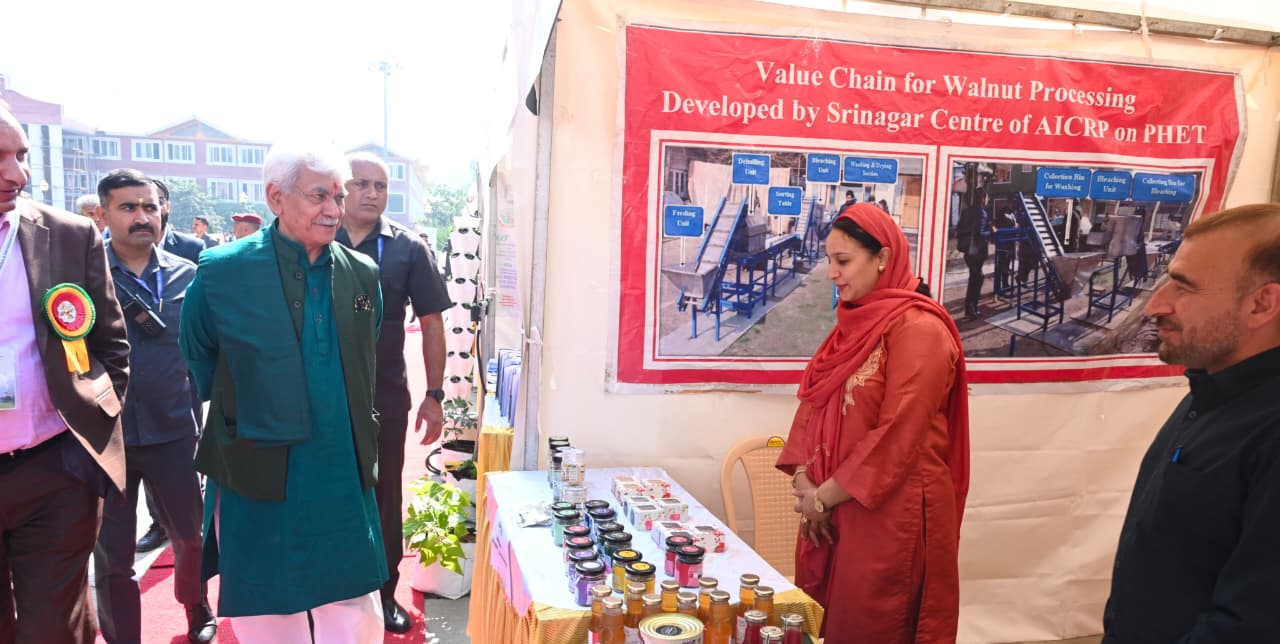
Venture-backed agri-tech often caters to sprawling commercial estates, leaving small and marginal farmers behind. Shifting toward cooperative ownership models and affordable hardware ensures that the digital transition leaves no community stranded.
By Ajaz Rashid
Urging financial institutions, academic bodies, and private-sector venture partners to actively dismantle systemic funding barriers, Lieutenant Governor Manoj Sinha made an impassioned pitch for female entrepreneurship, asserting that engineering colleges and farm universities must intentionally nurture women into top technological leadership roles. Addressing delegates at the 60th Annual Convention of the Indian Society of Agricultural Engineers (ISAE), co-hosted by Sher-e-Kashmir University of Agricultural Sciences and Technology (SKUAST) Kashmir, LG Sinha maintained that frontier agri-tech enterprise cannot afford to leave half its brainpower behind.
“Women-led start-ups in agricultural technology should receive financing with the same confidence with which any other start-up is provided the necessary support and facilities,” the Lieutenant Governor remarked, underscoring that institutional capital has historically been too hesitant to back grassroots female ventures.
The three-day international gathering brought together hundreds of agricultural engineers, scientists, technocrats, policymakers, and industry pioneers from across the globe to deliberate on contemporary farm mechanisation and climate resilience. Pointing to the stark imbalance between academic potential and executive leadership in technology, Sinha insisted that premier institutions must construct deliberate launchpads for innovators hailing from the most remote peripheries of the Union Territory.
“We must ensure that our engineering colleges and agricultural universities actively nurture women to reach positions of technological leadership. Laboratories, fellowships and incubation platforms should be created where a young woman engineer or scientist from a village in Kishtwar or Kupwara can see her idea progress through a credible journey into a market-ready product,” he said.
The Lieutenant Governor drew immediate attention to the sociological paradox that continues to characterise India’s primary sector. Official labour surveys demonstrate that between 64% and 76% of rural female workers are directly invested in farming and allied activities, carrying out some of the most labour-intensive post-harvest, weeding, and dairy operations, yet they remain systematically denied formal land titles, credit access, and fair agricultural wages. Sinha argued that real modernization begins by transforming these invisible contributors from manual labourers into technologically sovereign creators and farm managers. By establishing dedicated incubation hubs, rural design fellowships, and specialized R&D facilities at SKUAST and allied institutes, educational ecosystems can empower female engineers to solve field-level challenges through smart, ergonomically viable machinery and software tools tailored specifically for rural women.
Congratulating the Indian Society of Agricultural Engineers on completing six decades of dedicated service to India since its establishment in 1960, the Lieutenant Governor commended SKUAST-Kashmir for consistently securing top-tier rankings among national agricultural institutions and spearheading patent filings. He underscored that the twin focal themes of the diamond jubilee convention, Women-Led Engineering Innovations in Smart Farming alongside AI and Robotics for Gen-Z Farming reflect an overarching paradigm shift. India, having decisively triumphed over the chronic food deficits of the mid-twentieth century through the Green Revolution, is now transitioning into an export-oriented innovator and standard-setter for global agritech. He observed that Jammu and Kashmir, characterized by high-altitude ecosystems, microclimatic diversity, fractured landholdings, and rugged mountain terrain, offers the ultimate real-world testing ground for advanced hill mechanisation and precision climate-smart agriculture.
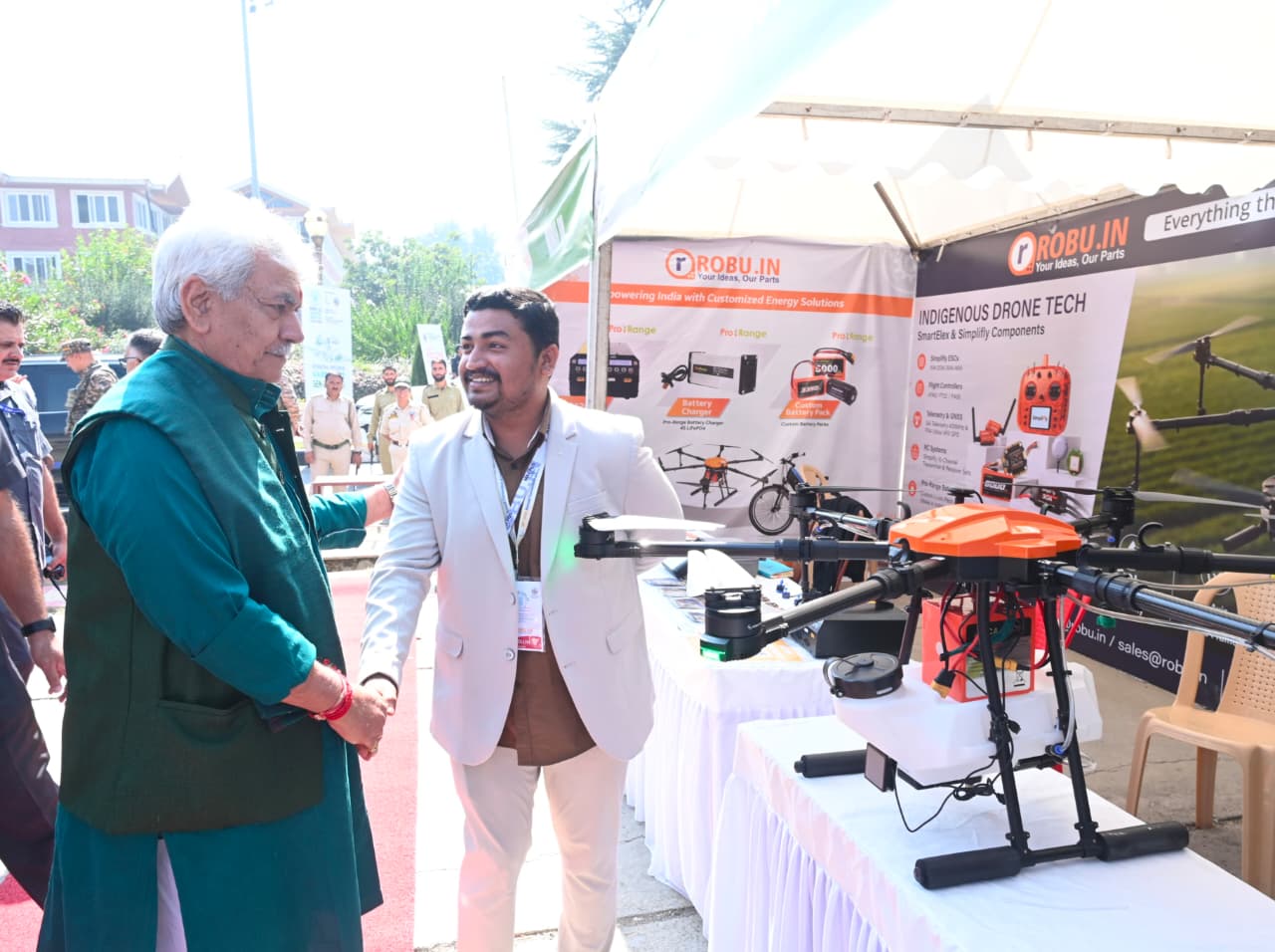
Historical context, Sinha noted, provides a valuable roadmap for current engineers. During the dawn of the Green Revolution, indigenous mechanical and civil engineers pioneered canal irrigation grids, customized threshers, and storage facilities that curbed post-harvest wastage and saved millions from starvation. However, the contemporary horizon introduces far more multifaceted shocks, including erratic weather anomalies, shifting snowlines, acute groundwater depletion, and declining soil carbon. To confront this era of polycrisis, the Lieutenant Governor called on young researchers to combine traditional ecological knowledge with high-end digital architecture, insisting that cutting-edge automation must not exacerbate rural inequality.
Artificial intelligence, sensory perception, and autonomous robotics, Sinha cautioned, will trigger severe market distortion if engineered exclusively for capital-intensive commercial conglomerates. Small and marginal holders, who comprise over 86% of the Indian farming community and manage average plots smaller than two hectares, must remain the principal beneficiaries of digital transformation. He urged developers to build lightweight, low-footprint applications that do not require high-end graphics processing units or 5G connectivity to function effectively.
“I urge the Indian Society of Agricultural Engineers, SKUAST-Kashmir, and every young engineer and innovator to develop tools with affordability and access at their core. Create instruments that work not only on cloud infrastructure, but also on an ordinary smartphone in a low-bandwidth village in Reasi. Develop robotic instruments that can be leased through Farmer Producer Organisations or collectively owned by farming communities. I believe that this is the true meaning of developing technology for Gen-Z farming, technology that progresses alongside small and marginal farmers,” he said.
Sinha insisted that the practical value of precision tools like artificial intelligence yield-prediction models, Internet of Things (IoT) soil moisture probes, and drone sprayers lies entirely in their field endurance rather than their elegance in controlled environments. Urging technologists to step out of comfortable institutional laboratories, he warned against chasing hollow metrics of academic prestige that offer zero utility to farmers struggling against unseasonal rains and pest outbreaks.
“Create technology that can endure in real fields, under real monsoon conditions, and within the limited budgets of real farmers. Do not measure your success solely by patents or published research papers. Measure it by whether, five years later, a small farmer in Anantnag, Amritsar or Akola is genuinely better off because of your tools,” the Lieutenant Governor said.
Highlighting regional interventions, Sinha noted that Jammu and Kashmir’s ambitious Holistic Agriculture Development Programme (HADP), a multi-year initiative involving 29 specialized projects backed by substantial public investment has established an integrated blueprint for agricultural modernization across India. By linking high-density apple orchards, saffron value addition, seed sovereignty, and digital market linkages directly to Farmer Producer Organisations, HADP has illustrated how precision agronomy can double farm incomes while conserving fragile mountain ecosystems.
During the inaugural plenary, the Lieutenant Governor formally presented prestigious national honours and fellowships to distinguished agricultural engineers on behalf of the ISAE. The landmark convention was attended by Agriculture Production, Rural Development, Panchayati Raj, Cooperative and Election Minister Javid Ahmad Dar; Additional Chief Secretary (Agriculture Production) Dr. Ashish Chandra Verma; SKUAST-Kashmir Vice-Chancellor Prof. Nazir Ahmad Ganai; ISAE President Dr. S.N. Jha; Prof. V.P. Singh of Texas A&M University; ISAE Secretary General Dr. P.K. Sahoo; Convention Convener Prof. Rohitashw Kumar; Organising Secretary Dr. Mudasir Ali; alongside hundreds of researchers, international academicians, student innovators, and agro-industry executives.
Leave a Reply