Governance, Gaps, and Grievance in J&K’s Fractured Assembly
The air inside the Jammu & Kashmir Legislative Assembly chamber on first day of Autumn session carried the crisp chill of a valley autumn, but the temperature within the House was incendiary.
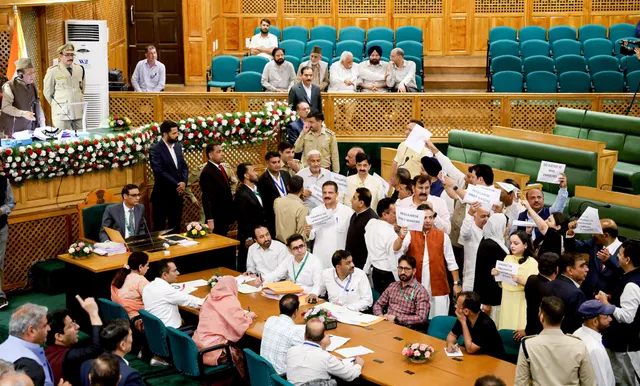
Moments after Speaker Abdul Rahim Rather concluded reading the customary obituary references, the semblance of parliamentary decorum dissolved. Opposition benches erupted in choreographed fury. Lawmakers from the Bharatiya Janata Party, spearheaded by Leader of Opposition Sunil Kumar Sharma, bolted from their seats, waving papers and shouting cadence-driven slogans into the central floor: “Jo Sarkar Na De Sakhe Bijli Pani, Woh Sarkar Nakami” (A government that cannot deliver water and power is a failure), followed by impassioned appeals for the thousands of daily-wagers and National Health Mission staff languishing without regularisation.
Within minutes, the protest surged into the Well of the House. Counter-slogans echoed back from the Treasury benches. National Conference and Congress members retaliated not merely with administrative defenses, but with political counteroffensives centering on historical autonomy, chanting demands for the immediate restoration of Jammu and Kashmir’s statehood. Amid cries of “Bharat Mata Ki Jai” met by shouts from regional benches, Speaker Rather repeatedly pleaded: “Go to your seats.” His gavel offered little leverage against years of pent-up political tension. Within an hour, the House was adjourned for the day.
To an outside observer, the spectacle could be dismissed as the standard theatre of South Asian democracy. But in Jammu and Kashmir, a territory governed under a complex, hybrid administrative structure following the historic reorganization and subsequent return of an elected assembly, the day’s ruckus was not mere drama.
Behind the barricaded well, the shouting matches, and the marshals holding back agitated legislators lay a staggering paper trail laid out across official tabled responses. Written answers and committee reports presented during that truncated sitting revealed a territory caught between two diverging realities: a high-decibel constitutional stalemate at the top, and a deep, systemic administrative paralysis on the ground.
Uproar in Assembly
The opposition’s fury was calibrated, targeting palpable consumer and working-class anxieties: spiraling electricity tariffs, austerity mandates, and the precarious fate of an estimated army of ad-hoc government workers.
Yet the Treasury benches saw a coordinated strategy of deflection. Ministers and ruling party members argued that the uproar was engineered precisely to derail the tabling of an explosive legislative report examining the centrally funded Jal Jeevan Mission (JJM).
“The House should have been used for people’s expectations. No doubt the time was less; however, it should have been utilised for the people,” Deputy Chief Minister Surinder Choudhary remarked sharply outside the chamber. Choudhary pointedly accused the opposition of preferring social media virality to parliamentary rigor: “They don’t want to run the House but only to be in headlines and reels. This drama won’t be allowed to continue.”
Choudhary further alleged that the disruption was an intentional maneuver to bury findings concerning legacy infrastructural projects. “The opposition knew the Jal Jeevan Mission report was to be submitted. The irregularities pertain to their tenure and were committed by them. If they want an inquiry, they should raise the matter before the government and the Assembly instead of creating a hue and cry.”
From the benches of the broader alliance, other voices weighed in with equal acrimony. CPI(M) veteran Muhammad Yousuf Tarigami confronted the protesting opposition directly on the floor, arguing that their outrage omitted the fundamental constitutional grievance of the electorate: “Another slogan should be raised here that despite two years of an elected government having taken over, statehood has not been restored.”
National Conference legislator Nazir Gurezi echoed that sentiment, urging opposition figures to “protest in Delhi rather than here” if they genuinely wished to resolve the union territory’s structural limitations. Meanwhile, Jammu and Kashmir Pradesh Congress Committee president Tariq Hameed Karra framed the disruption as a calculated bid to subvert national political conversations: “The BJP should have answered questions on issues such as restoration of statehood, paper leaks, and financial accountability instead of disrupting proceedings.”
Yet, the collateral damage of the clash was the parliamentary process itself. Outside the chamber, Doda MLA Mehraj Malik offered a scathing indictment of both sides:
“It was a mockery. They should have continued the House as people had expectations, but they made a mockery of the proceedings as the House ran for only an hour. Those who were questioning my behaviour and called it ill-mannered, what about these leaders who ruined people’s expectations within one hour? They sought votes on promises of a policy for casual and daily wagers and employment for youth. If they fail, it reflects their incompetence.”
40,000 Vacancies, 899 Jobs
While the political floor fight captured television chyrons, the most sobering realities of the day were quietly cataloged in the Assembly’s written annexures. The documents laid bare an institutional vacuum spanning vital public sectors.
In a comprehensive written submission responding to queries from legislators Sajad Gani Lone and Irfan Hafiz Lone, the government formally revealed that 40,672 posts sit vacant under the direct recruitment quota across various departments. The granular breakdown paints an alarming picture:
- 3,318 Gazetted vacancies
- 24,427 Non-Gazetted vacancies
- 12,927 Multi-Tasking Staff (MTS) positions
The single deepest deficit is in the Health and Medical Education Department, which accounts for 12,797 vacancies including over 2,100 gazetted medical officers and specialists, and more than 8,000 non-gazetted technical personnel. The Agriculture Production, Animal/Sheep Husbandry, and Horticulture sector follows with 4,939 vacant roles; Housing and Urban Development records 2,741; the Public Works Department stands at 2,190; and School Education has 1,364 unfilled positions.
| Department / Sector | Gazetted Vacancies | Non-Gazetted Vacancies | MTS Vacancies | Total Vacant Posts |
| Health & Medical Education | 2,125 | 8,064 | 2,608 | 12,797 |
| Agriculture, Animal & Horti. | 84 | 1,925 | 2,930 | 4,939 |
| Housing & Urban Development | — | — | — | 2,741 |
| Public Works (R&B) | — | — | — | 2,190 |
| Finance | — | — | — | 1,829 |
| Industries & Commerce | — | — | — | 1,787 |
| Forest, Ecology & Env. | — | — | — | 1,619 |
| School Education | — | — | — | 1,364 |
| Power Development | — | — | — | 1,264 |
| Jal Shakti | — | — | — | 1,019 |
Against this cavernous deficit, the pace of state-led job creation has slowed to a virtual standstill. In an admission that provided devastating ammunition to the opposition, the government disclosed that only 899 new posts had been created across all departments since mid-October 2024. More than half of those (485) belonged to Health and Medical Education, followed by 266 in Housing and Urban Development, with marginal single-digit additions in rural cooperatives and transport.
Peoples Conference president and Handwara MLA Sajad Gani Lone seized upon the disparity, mounting a blistering statistical critique of the National Conference’s core campaign commitments.
“The election manifesto is nothing but a litany of lies,” Lone asserted, pointing to the ruling party’s flagship promise to generate 100,000 new jobs and clear the recruitment backlog within 180 days. “Till date they have created 899 jobs. It means that at the current rate it will take them 222.46 years to create 100,000 jobs. What a joke. The bigger joke is on those people who bought this lie. Today, it was revealed that only 7,580 vacancies have been filled through recruitment boards in two years, while 40,672 posts remain vacant. At this pace, it will take decades to clear the backlog.”
The government’s formal defense centers on procedural bottlenecks, ongoing scrutiny, and fiscal guardrails. While the administration noted that over 14,270 posts have been referred to recruiting agencies (the Public Service Commission and the Services Selection Board) since late 2024, institutional expansion has been hobbled by strict austerity directives.
A key impediment highlighted in departmental replies such as the rejection of proposed expansion blocks and parking infrastructure at Srinagar’s Gousia Hospital is Finance Department Order No. 198-F of 2026, issued on May 22, 2026, which strictly prohibits the creation of new administrative posts.
On the volatile issue of regularising temporary workers, casual laborers, and seasonal staff a grievance that fueled Monday’s well-storming, the government maintained that it is navigating an administrative tightrope.
A high-powered committee constituted via Government Order No. 384-JK(GAD) on March 19, 2025, continues to examine a uniform regularisation framework. The administration stated that any viable mechanism must balance “humanitarian considerations” against severe financial implications, statutory service rules, and constitutional recruitment standards, an answer that signals caution, but promises little immediate relief to thousands of striking contractual workers.
The ₹7,000-Crore Tap Water Scandal
If recruitment data exposed an administrative logjam, the House Committee report on the Jal Jeevan Mission (JJM) uncovered outright systemic breakdown.
Tasked with investigating widespread irregularities in the rollout of the central flagship initiative designed to provide piped, potable drinking water to every rural household, the House Committee presented a scathing, 63-page evaluation based on seven separate sittings, extensive audits, and field inspections across Poonch, Udhampur, Reasi, and Budgam.
The report’s top-line finding is devastating: of 3,253 Water Supply Schemes undertaken at an expenditure of approximately ₹7,000 crore, a staggering 63 percent were found to be completely non-operational. Furthermore, the committee noted that even among the remaining 37 percent categorized by the Jal Shakti Department as functional, several schemes were operating only partially, intermittently, or supplying untreated surface water through defunct filtration units.
The findings tore through the department’s official claims regarding Functional Household Tap Connections (FHTCs):
- Pipes in the Open: The committee discovered vast caches of High-Density Polyethylene (HDPE) pipes lying scattered, abandoned, and unrecorded in forested and rural areas of Udhampur, Reasi, and Poonch, exposing public assets to weathering and widespread theft.
- The HDPE Pivot: The report challenged the controversial 2023 administrative decision to abruptly substitute Galvanized Iron (GI) pipes with HDPE pipes in the Jammu Division without revising Detailed Project Reports (DPRs), estimating the procurement cost at roughly ₹600 crore and linking it directly to delayed execution and capital waste.
- Structural Failures: Civil engineering projects were repeatedly executed without hydrological validation. In sites like Lalpora Chatlam, Munpora, and Parigam, infrastructure was built where water source sustainability was non-existent. Elsewhere, massive service reservoirs were constructed directly on riverbeds without structural piling, and distribution pipelines were laid above ground rather than buried to prescribed depths.
- Administrative Oversight Breakdown: Despite a multi-tiered monitoring apparatus spanning an Apex Level Committee, an Executive Committee, the Mission Directorate, and District Missions, the committee recorded “gross negligence,” noting that monitoring bodies failed entirely to cross-verify contractor claims.
The legislative panel recommended immediate, forensic physical and financial audits of all schemes, independent NABL-accredited laboratory testing of laid pipes, mandatory geo-tagging, and the referral of documented lapses to criminal investigating agencies.
For an administration operating under intense public scrutiny, the JJM revelations represent an acute governance liability, one inherited across shifting bureaucratic regimes, but now demanding decisive accountability.
Healthcare Distress
Beyond the capital’s macro-level political duels, the legislative records reflected a fragmented healthcare delivery system struggling to serve its peripheral populations.
In Budhal, a remote and topographically severe constituency in the Pir Panjal range, the government acknowledged that seven out of ten Primary Health Centres (PHCs) and New Type PHCs operate without a single qualified doctor. Communities are forced to rely on monthly rosters of visiting mobile units and emergency ambulances.
In Karnah, situated along the Actual Line of Control in northern Kupwara, the local administration reported that basic PHCs at Teetwal, Chiterkote, and Panzgam have had to substitute allopathic medical officers with AYUSH practitioners to keep doors open. In Budgam, situated right on the doorstep of the summer capital, 73 out of 161 sanctioned paramedical positions remain unfilled, even as a modern 128-slice CT scanner sits awaiting commissioning.
The government sought to offer reassurance, noting that an intake of 335 newly appointed Medical Officers (from a recently finalized selection list of 416) is being processed under Government Order No. 663-JK(HME) of September 2, 2026. Health Minister Sakina Itoo reiterated that these doctors are being assigned explicitly to peripheral, underserved, and border locations to plug crippling deficits.
Concurrently, the Health Department outlined targeted infrastructural investments: the procurement of an advanced MRI machine for Government Medical College (GMC) Baramulla through the SASCI capital investment scheme, a newly floated tender for a specialized Cath Lab scheduled for final award by October 10, and the prioritized establishment of dedicated dialysis centers at Sub-District Hospitals in Shangus and Seer Hamdan.
Yet, as the replies repeatedly noted, physical brick-and-mortar additions routinely run into legal hurdles, land acquisition disputes, and austerity ceilings, leaving specialized secondary care concentrated in tertiary hubs.
Climate Shocks
Against these institutional bottlenecks, the Assembly was provided an authoritative account of the physical and climatic vulnerabilities continually reshaping rural governance in the region.
Chief Minister Omar Abdullah presented a comprehensive damage and rehabilitation report detailing the aftermath of devastating flash floods and landslides that tore through Rajouri district in mid-2026.
The executive response revealed a massive logistical mobilization: all disrupted arterial roads, drinking water schemes, and primary power circuits were temporarily operationalized within 30 days of the disaster.
Yet, the Chief Minister’s report highlighted the escalating capital requirements of building climate resilience in high-altitude terrain, noting that permanent reconstruction across Rajouri alone demands ₹185 crore in public works financing, alongside comprehensive realignment of electrical corridors to withstand recurring hydrological shocks.
Simultaneously, the administration offered a progress report on basic infrastructure along the frontier. Under the Revamped Distribution Sector Scheme (RDSS), an intensive electrification drive is underway across 29 un-electrified habitations and 1,936 households in the border reaches of Kupwara district including isolated pockets in Keran, Machil, Tangdar, and Teetwal.
With ₹14.74 crore awarded across 10 blocks, engineering surveys finalized, and an initial ₹86 lakh spent on foundational work across five blocks, the administration has set an operational completion deadline of October 2027. The project stands as a testament to what the state machinery can achieve when capital resources, administrative will, and statutory clearance align.
As the autumn session progresses, the legislative calendar promises further friction.
The government has scheduled a pivotal resolution moved by School Education Minister Sakina Masood Ittoo, seeking an amendment to Section 23 of the Right of Children to Free and Compulsory Education (RTE) Act to permanently exempt veteran teachers appointed before January 1, 2019, from the mandatory Teacher Eligibility Test (TET).
Concurrently, a bill amending the Jammu and Kashmir Cooperative Societies Act of 1989 is slate to repeal the legacy Self-Reliant Cooperative Act of 1999, restructuring transitional agricultural credit networks.
Yet, legislative policy initiatives cannot easily escape the shadow of the territory’s wider existential contest. Monday’s opening session encapsulated the defining paradox of Jammu and Kashmir’s contemporary polity: an elected legislature possessing heightened popular expectations, yet operating under constrained regional authority; an opposition determined to leverage daily economic grievances while evading accountability for systemic legacy lapses; and an electorate caught between lofty political promises and the quiet, crushing reality of 40,000 vacant jobs, broken water pipes, and rural hospitals without doctors.
If the opening day of the autumn sitting proved anything, it is that noise is easy to manufacture inside the Assembly. The far harder task, one that neither slogans in the Well nor ministerial dismissals can bypass is governing a territory where the institutions of the state remain critically under-resourced, deeply scrutinized, and fundamentally unfinished.
Leave a Reply