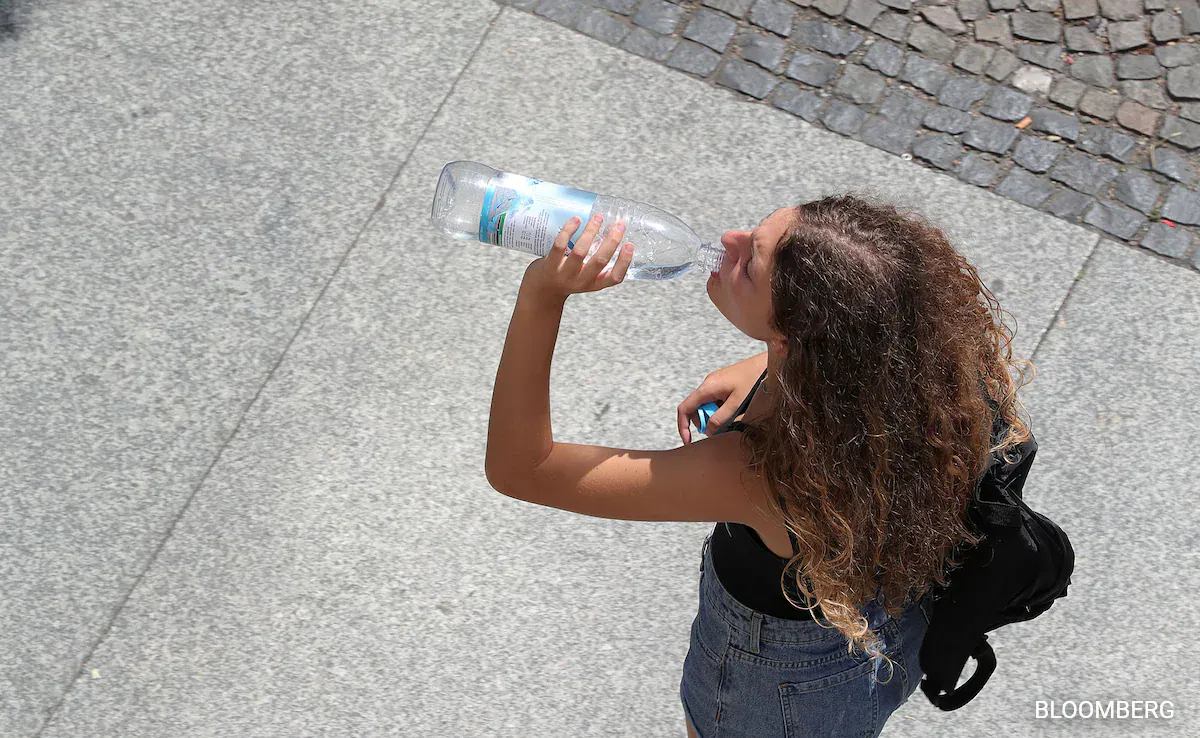
Nanoplastics pose a greater threat to human health than microplastics because they’re small enough to penetrate human cells, enter the bloodstream and impact organs
A typical one-liter (33-ounce) bottle of water contains some 240,000 plastic fragments on average, according to a new study. Many of those fragments have historically gone undetected, the researchers determined, suggesting that health concerns linked to plastic pollution may be dramatically underestimated.
The peer-reviewed study, published Monday in the journal Proceedings of the National Academy of Sciences, is the first to evaluate bottled water for the presence of “nanoplastics” – plastic particles under 1 micrometer in length, or one-seventieth the width of a human hair. The findings show that bottled water could contain up to 100 times more plastic particles than previously estimated, as earlier studies only accounted for microplastics, or pieces between 1 and 5,000 micrometers. A 1-Litre Bottle Of Water Contains Some 2,40,000 Plastic Fragments: Study
Nanoplastics pose a greater threat to human health than microplastics because they’re small enough to penetrate human cells, enter the bloodstream and impact organs. Nanoplastics can also pass through the placenta to the bodies of unborn babies. Scientists have long suspected their presence in bottled water, but lacked the technology to identify individual nanoparticles.
To overcome that challenge, the study’s co-authors invented a new microscopy technique, programmed a data-driven algorithm and used both to analyze roughly 25 1-liter bottles of water purchased from three popular brands in the US. (The researchers declined to specify which brands.) They found 110,000 to 370,000 tiny plastic particles in each liter, 90% of them nanoplastics.
“This study provides a powerful tool to address the challenges in analyzing nanoplastics, which holds the promise to bridge the current knowledge gap on plastic pollution at the nano level,” says Naixin Qian, the study’s lead author and a graduate student of Columbia University in chemistry.
“Previously this was just a dark area, uncharted. Toxicity studies were just guessing what’s in there,” adds Beizhan Yan, the study’s co-author and an environmental chemist at Columbia University. “This opens a window where we can look into a world that was not exposed to us before.”
The researchers targeted seven common plastic types, including polyethylene terephthalate (PET), which many water bottles are made from, and polyamide, often used in filters to purify water before it’s bottled. But they also discovered many unidentified nanoparticles in the water. If any of those are also nanoplastics, the prevalence of plastic in bottled water could be even higher.
The world produces more than 450 million tons of plastics each year, much of which eventually ends up in landfills. The vast majority of plastic does not degrade naturally, but breaks down into smaller pieces over time. Tiny plastic bits are also routinely shed from plastic-containing products while they’re in use, including many synthetic fabrics.
While plastic pollution exists everywhere on Earth, bottled water is of particular interest to scientists because of its potential to introduce plastic particles to the human body. A study published in 2022 found that the concentration of microplastics in bottled water was higher than in tap water. A report from 2021 warned that simply opening and closing the cap on a plastic bottle of water can release tiny plastic bits into the liquid.
The co-authors of the latest study say their research won’t stop at bottled water. They also plan to investigate nanoplastics in tap water and snow samples collected from western Antarctica. “There is a huge world of nanoplastics to be studied,” said Wei Min, another co-author and a biophysicist at Columbia University. “The smaller things are, the more easily they can get inside us.”
Courtesy NDTV