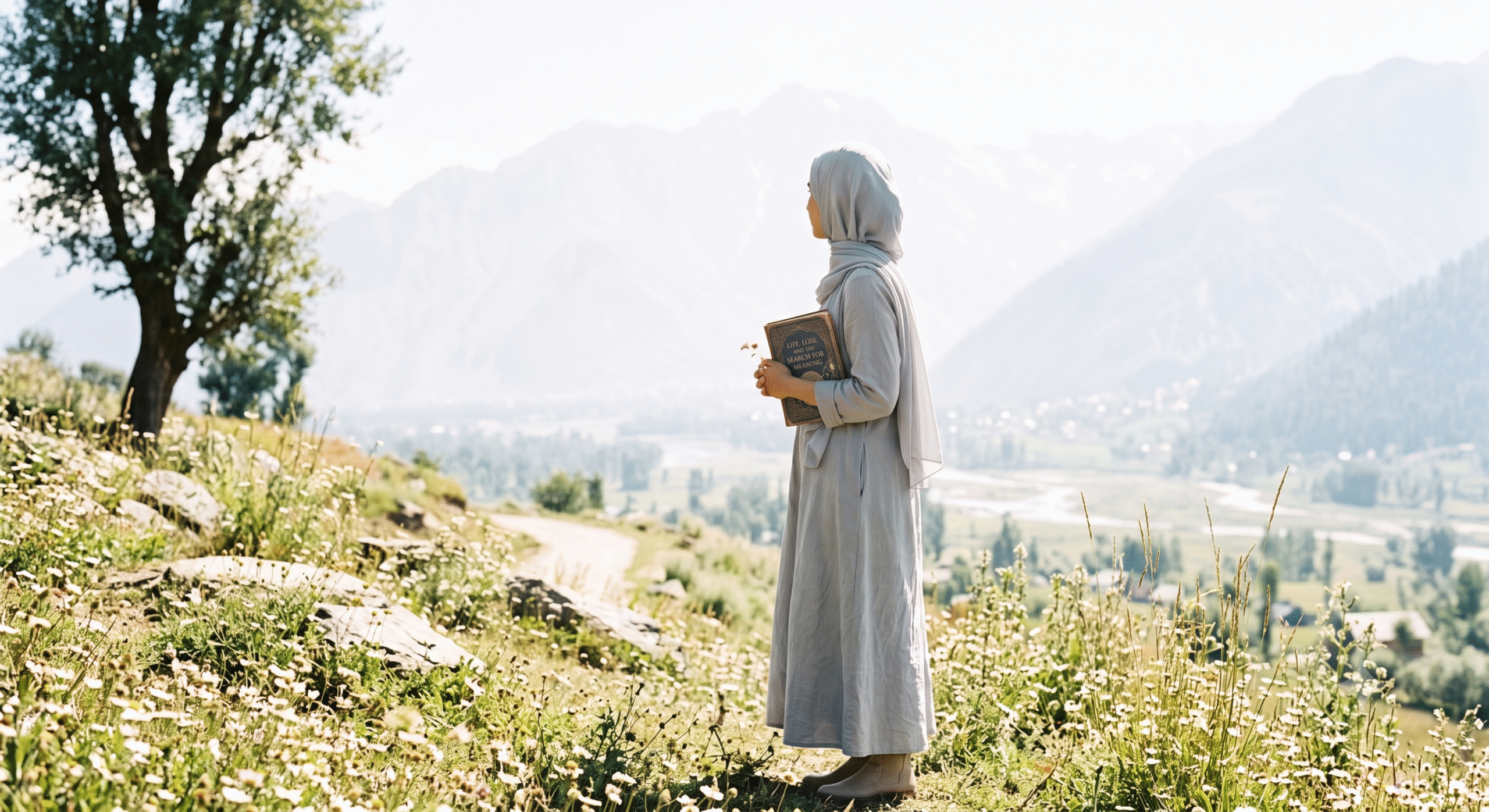
Grief strips away life’s illusions and forces us to confront what truly matters. In the quiet space of loss, we discover that true peace comes from within, not from material success.
By Nighat Mushtaq and Syed Mustafa Ahmad
There was a time when I believed, like so many others, that I would live forever. In the bright innocence of youth, death seemed like an abstract event, a shadow that fell only on distant lives. Young, naive, and unformed by real experience, I could neither grasp the fragility of existence nor the absolute certainty of its end. My world was small, safe, and uncomplicated, and I naively assumed it would remain that way indefinitely.
As a child, I misunderstood the fundamental nature of loss. Whenever a person in our neighborhood passed away, I quietly believed they were merely away on a brief journey and would return after a few days. Observing adults weeping at funerals, I wondered why their grief was so overwhelming. To my young mind, the departure was temporary; the door would surely open again.
Then, reality intervened with a force I was entirely unprepared for. Someone very close to my heart died.
Even after the final rites, I waited. I held onto the silent expectation that they would walk back into the room. But days stretched into weeks, and the slow, heavy weight of truth settled in. Death was not a brief pause; it was the ultimate, irreversible reality of human existence. Those who leave this world do not walk back through the door. They exist only in the quiet spaces of our memories.
That single loss fundamentally reshaped who I was. It did not merely take away a person I loved; it permanently altered the lens through which I viewed the world. Questions that had never previously crossed my mind suddenly became impossible to quiet. Why do we suffer? Why are joy and sorrow so intricately intertwined? Why do we spend so much of our finite lives agonizing over trivialities that hold no weight in the end?
Life, in its totality, is an irreducible mystery. It cannot be fully comprehended through academic texts or inherited advice. It demands to be lived. It reveals its nature solely through raw experience through moments of triumph and disappointment, unexpected joy and intense despair. Life rarely honors our carefully constructed plans. It follows its own unpredictable rhythm, moving forward according to a logic we can seldom control.
Sometimes I wonder whether this mystery is meant to be solved at all. Existence resembles a tangled web of countless delicate threads. The moment we feel we have unraveled one knot, several others tighten. Every clear answer yields three new questions; every experience pushes us into unmapped terrain. Perhaps the true dignity of life lies not in solving every puzzle, but in honoring the journey with patience, restraint, and humility.
Living remains the only true way to understand life. Every experience, whether comforting or painful carries an instruction. Every setback houses a hidden lesson, and every hardship possesses the quiet potential to deepen our wisdom.
In the aftermath of grief, I made a conscious choice to focus inward. This was not a retreat into selfishness or a rejection of others, but a commitment to self-understanding over endless comparison, and inner stillness over external validation. With every passing day, another small corner of life’s vast universe reveals itself to me, even as I realize how infinitely much remains unknown.
Having learned to inhabit my own quiet center, I have come to accept myself completely. I am the sum of all I have endured. Every fleeting joy, every bitter disappointment, every unresolved question, and every profound loss has carved out the person I am today.
Yet, grief is rarely linear. Even now, fleeting moments arise when a part of me expects the person I lost to reappear. The mind grasps the finality of death, but the heart is stubbornly slow to surrender hope. Memories possess a quiet, persistent power. They remind us that love does not dissolve simply because a physical presence has vanished.
After that loss, I grew noticeably quieter. The ease with which I once expressed my emotions vanished. Sometimes I ask myself whether my heart has simply grown numb, or whether deep grief merely teaches a person the utility of silence. Some wounds leave no visible mark on the body, yet they remain carried within us for a lifetime.
This personal transformation inevitably shifted how I observe society. Around me, I see people consuming their lives in the relentless pursuit of wealth, prestige, and social recognition. While these achievements can secure physical comfort, they are entirely incapable of conferring lasting meaning. Material success may satisfy our physical needs, but it cannot fill the quiet emptiness of the human soul.
Over time, my social circle naturally diminished. Friendships that once felt central gradually drifted away. Today, I find genuine comfort in solitude. I take long walks alone, lingering with my thoughts, away from the friction of daily chatter. Solitude has offered me insights that noise could never articulate.
In these moments, I often dream of retreating to the silence of the mountains, where the air is sharp, the horizon is broad, and peace feels tangible. Nature serves as an enduring reminder that impermanence is the fundamental law of existence. Every sunrise surrenders to sunset; every season yields to the next; flowers bloom only to fade back into the earth. Neither happiness nor sorrow is built to last forever.
There are times when even home feels less like a sanctuary and more like a space defined by heavy expectations rather than quiet understanding. The habit of comparison has invaded domestic life. I often reflect on why young people are so frequently measured against the achievements of others, rather than valued for their unique temperaments, internal strengths, and individuality.
Returning home often brings a quiet, unspoken anxiety, a hope that the fragile balance will hold, that nothing will go wrong. Such anxieties remain invisible to the outside world, yet they gradually weave themselves into the fabric of daily life.
At my lowest points, the urge to leave everything behind and start anew somewhere far away has been strong. Yet, whenever those thoughts take shape, the image of my family intervenes. I realize that my choices do not exist in a vacuum; they ripple out to affect the people who have consistently cared for me.
Life has also laid bare some uncomfortable truths about human relationships. Many bonds appear to strengthen in the presence of financial wealth and wither in its absence. Far too often, individuals are valued for what they possess rather than who they are, a quiet, painful reality that many experience in silence.
This inequality subtlely infects institutions and spaces that ought to be governed by universal care and basic empathy. Watching this unfold forces a troubling question: Is human connection gradually being supplanted by pure transactional materialism?
Perhaps the greatest crisis of our era is not merely economic disparity, but the steady decline of everyday compassion. In our rush to compete and secure our own positions, we routinely step over those who are struggling. Attributes like kindness, intellectual honesty, humility, and genuine empathy deserve far greater weight than social standing or accumulated wealth.
Life continually invites us to look inward. Every hardship demands personal growth; every disappointment teaches emotional discipline; every loss reminds us that our time here is brief. We enter this world empty-handed, and we depart it precisely the same way. What remains behind is not our bank balances or titles, but the integrity of our character and the good we managed to do for others.
Despite the weight of these reflections, I refuse to abandon hope. Every struggle contains an instruction; every wound can expand our capacity for understanding; every trial can make us more compassionate if we choose to remain open to it.
In the end, our material possessions will stay behind, our titles will fade into irrelevance, and our worldly achievements will become distant memories. What genuinely endures is the kindness we offered, the lives we touched, and the humanity we managed to preserve within ourselves. Perhaps that is the only success that truly matters.
Disclaimer: The views expressed in this feature article are solely those of the author and do not necessarily reflect the official editorial stance or opinions of this publication.
Leave a Reply