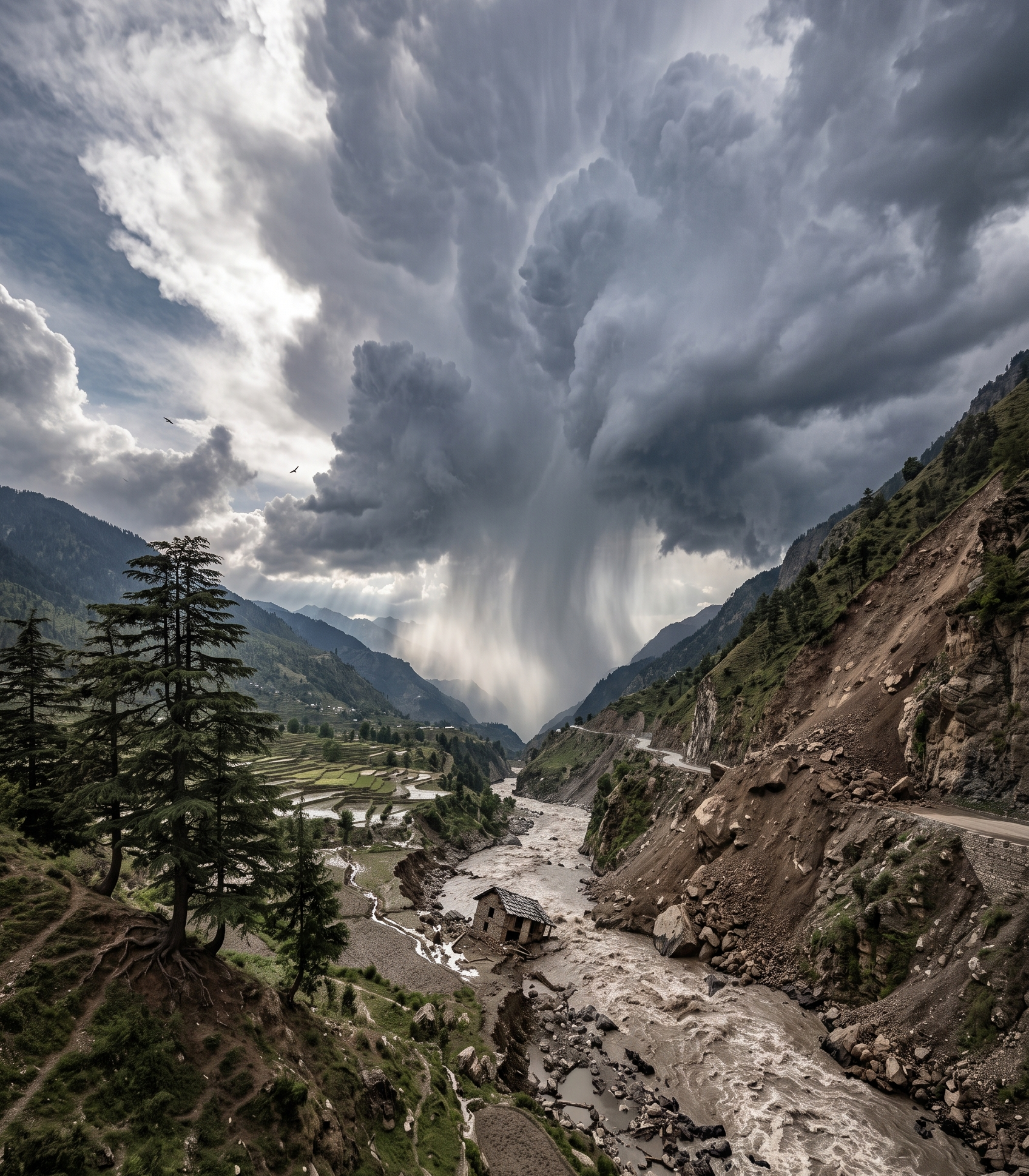
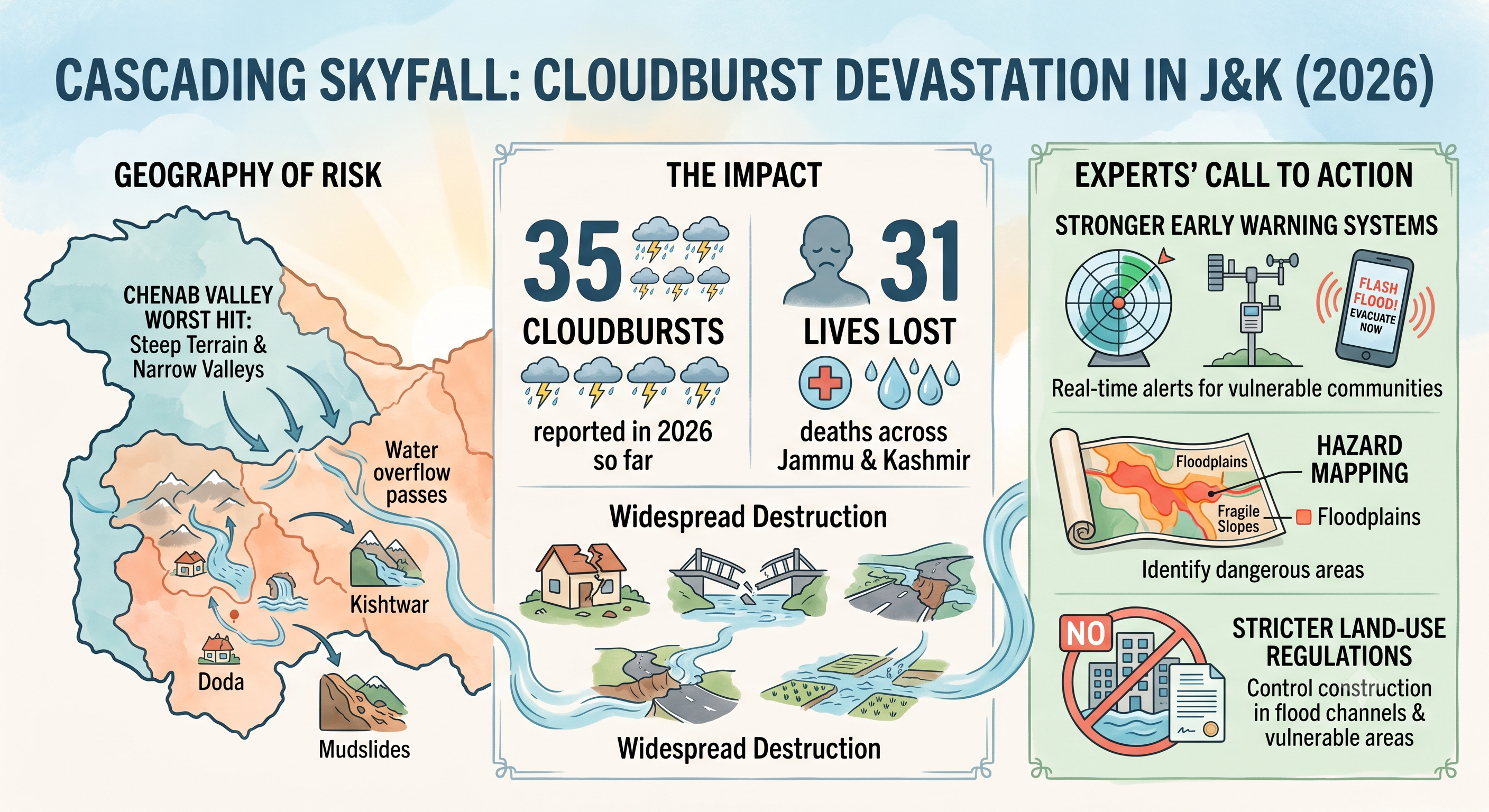
A relentless series of 35 cloudbursts has torn across Jammu and Kashmir, leaving a trail of destruction and claiming 31 lives. From the battered Chenab Valley to isolated mountain villages, communities are now left grappling with the tragic human and ecological cost.
By Ajaz Rashid
Across the steep ridges and narrow valleys of Jammu and Kashmir, the skies have delivered a relentless series of deluges this year. What began as seasonal summer precipitation rapidly transformed into a devastating sequence of micro-storms, leaving a trail of destruction across both the Jammu and Kashmir divisions. Official data reveals that at least 35 cloudburst incidents have struck the Union Territory so far this year, claiming around 31 lives, destroying critical infrastructure, and laying bare the extreme environmental vulnerabilities of the Himalayan landscape.
Between June 1 and mid-July, official records logged at least 22 cloudbursts. Rather than abating, the atmospheric conditions intensified during the latter half of July and early August, triggering a barrage of additional high-intensity rainfall events that pushed the tally beyond 35. The resulting casualties have predominantly stemmed from sudden cloudbursts, fast-moving flash floods, and rain-induced landslides.
While the destruction has touched nearly every district in the region, the Jammu division has borne the heaviest human toll. High-altitude, mountainous districts—including Poonch, Rajouri, Kathua, Doda, and Kishtwar—have experienced catastrophic impacts. Meanwhile, northern and southern pockets of the Kashmir Valley, most notably Shopian and Kupwara, have suffered repeated flash floods that inundate whole communities in a matter of minutes.
Human and Economic Toll
The human cost of these rapid skyfalls was tragically highlighted during a recent atmospheric spell on a Monday, when multiple cloudbursts simultaneously struck disparate corners of the territory including Kupwara, Shopian, Bandipora, and Anantnag. The single day’s storms left two people dead and paralyzed daily life across both divisions.
The physical damage to local communities has been severe:
- Residential Infrastructure: Dozens of residential homes, private commercial establishments, and neighborhood shops have been structurally compromised or entirely swept away.
- Civic Facilities: Local educational institutions, village schools, and civic utilities have suffered physical damage, forcing local administrations to establish emergency shelters.
- Agriculture & Irrigation: Mountain agriculture, the economic backbone of many rural villages, has taken a massive blow as silt, boulders, and fast-flowing torrents flooded crops, ruptured irrigation channels, and washed away topsoil.
- Connectivity: Dozens of vital local bridges and rural feeder roads have been severed, isolating remote settlements and complicating rescue operations.
The strategic Jammu-Srinagar National Highway, the primary overland artery connecting the Kashmir Valley with the rest of the country has faced chronic, severe disruptions. Persistent downpours have repeatedly triggered landslides, thick mudslides, and dangerous shooting stones along critical corridors. The resulting arterial blockages have stalled passenger movement for days at a time and halted logistics chains carrying essential food and fuel supplies.
In the hardest-hit mountain settlements, sudden stream overflows forced emergency evacuations. Local administrations and disaster response units continue to deploy search, rescue, and relief operations under treacherous weather conditions.
Geography of Disaster
Disaster management officials point out that the geographical layout of Jammu and Kashmir creates stark differences in vulnerability. The high-altitude terrain of the Chenab Valley, encompassing the rugged districts of Kishtwar and Doda, stands as one of the most hazardous zones in the region.
Together with the upper mountain reaches of Shopian, Kupwara, and neighboring high-elevation belts, these regions share common physical vulnerabilities:
- Extreme Topography: Shear vertical slopes create immediate, high-velocity runoff when rain hits.
- Proximity to Seasonal Streams: Human settlements historically situated near dry riverbeds or seasonal mountain streams are directly in the path of unexpected torrents.
- Erosive Soil Structure: Loose glacial till and fragile slope material easily liquefy into fast-moving mud flows when saturated.
When cloudbursts strike these elevated regions, the water does not absorb into the ground; instead, it funnels violently downward through narrow ravines, collecting trees, boulders, and debris as it hurtles toward human habitations below.
Understanding the Meteorology
To understand the sudden nature of these disasters, meteorologists define a cloudburst as an exceptionally intense, highly localized rainfall event where precipitation exceeds 100 millimeters within an hour over a compact geographic footprint of roughly 20 to 30 square kilometers. Because this volume of water falls in such a short window, it almost instantaneously triggers flash flooding, severe debris flows, and sudden slope failures, leaving residents virtually no window for early evacuation.
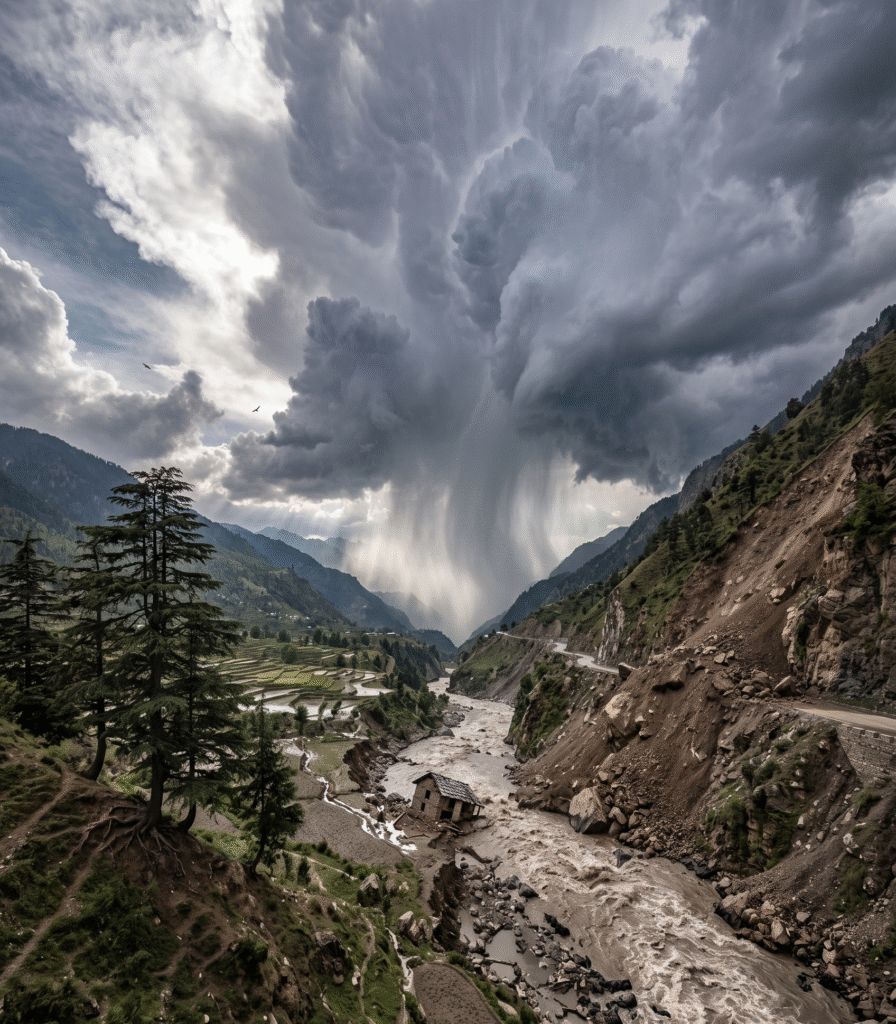
Meteorological experts explain that the recent surge in cloudburst frequency across Jammu and Kashmir is driven by a volatile meteorological interaction: the collision of moisture-laden southwest monsoon winds with mid-latitude western disturbances over the high Himalayan range.
Orographic Lifting: As moist air masses hit the steep mountain barriers, they are forced rapidly upward into higher, cooler altitudes.
- Vertical Cloud Growth: This rapid rise causes swift condensation, giving birth to massive, deep-convective cumulonimbus clouds.
- Topographical Trapping: Narrow alpine valleys frequently trap these massive cloud structures, preventing them from dispersing and forcing them to continuously draw in excess moisture from surrounding air currents.
- Atmospheric Instability: Intense upward air currents (updrafts) inside the cloud act like a giant invisible elevator, holding immense quantities of growing water droplets aloft in the upper atmosphere.
When these supporting thermal updrafts eventually weaken under the sheer, unmanageable weight of the accumulated moisture, the cloud system collapses instantly. The stored atmospheric water drops to the earth in a single, devastating torrent.
Mitigation and Early Warning
Recent scientific assessments conducted by official weather authorities and geological surveys emphasize that mountain hazards are trending upward in both frequency and severity across the Himalayan belt. To prevent localized weather events from repeatedly turning into human catastrophes, experts advocate for a comprehensive overhaul of disaster management, land planning, and early warning infrastructure.
| Action Domain | Recommended Measure | Intended Impact |
| Early Warning | Deployment of X-band Doppler weather radars & Automated Weather Stations (AWS) | Detect localized convective cloud formation in real time and provide micro-level alerts. |
| Community Safety | Real-time community alert mechanisms | Provide immediate 15-to-30-minute evacuation warnings directly to vulnerable villages via local networks. |
| Land-Use Planning | Comprehensive hazard mapping of slopes and natural flood channels | Identify unsafe zones and restrict construction on unstable gradients and dry riverbeds. |
| Environmental Conservation | Controlled urban development, large-scale afforestation, & wetland preservation | Restore natural ecological buffers that absorb surface runoff and stabilize mountain soil. |
Geological experts stress that technology alone cannot solve the crisis without enforcing strict land-use regulations. Prohibiting commercial and residential construction on floodplains, enforcing ecological guidelines on slope development, and protecting natural wetlands are essential steps to absorbing surface runoff. Without these combined structural and non-structural interventions, the delicate Himalayan ecosystem will remain increasingly vulnerable to the extreme weather realities of the modern era.
(With inputs from KNO)
Leave a Reply