At the inaugural International Film Festival of Jammu & Kashmir, Srinagar lays the groundwork to turn cinema from mere postcard escapism into an indigenous creative economy.
By Ajaz Rashid
The September sun dips behind the Zabarwan range, casting long, amber silhouettes across the manicured lawns of the Sher-i-Kashmir International Convention Centre. Below the terrace, the still waters of Dal Lake mirror the evening sky, punctuated by the occasional silhouette of a shikara gliding past the perimeter. For decades, this exact composition served as the premier visual shorthand for Indian cinematic romance: snow-crested ridges, floating houseboats, and weeping willows.
On this autumn evening, the red carpet laid along the lakefront carries a distinctly different imperative.
With the formal inauguration of the first International Film Festival of Jammu & Kashmir (IFFJK), Srinagar is staging a high-stakes cultural gambit. Across four days, the festival brings together filmmakers, delegates, actors, and technicians from over 40 countries, screening more than 130 films across venues spanning Srinagar, Jammu, and Gulmarg. Organised under the theme “Rang-e-Cinema,” the event serves as an audacious declaration of intent: to formally transition Jammu & Kashmir from a passive, pictorial backdrop into an active, self-sustaining hub of global cinematic storytelling.
An Evocative Reclamation
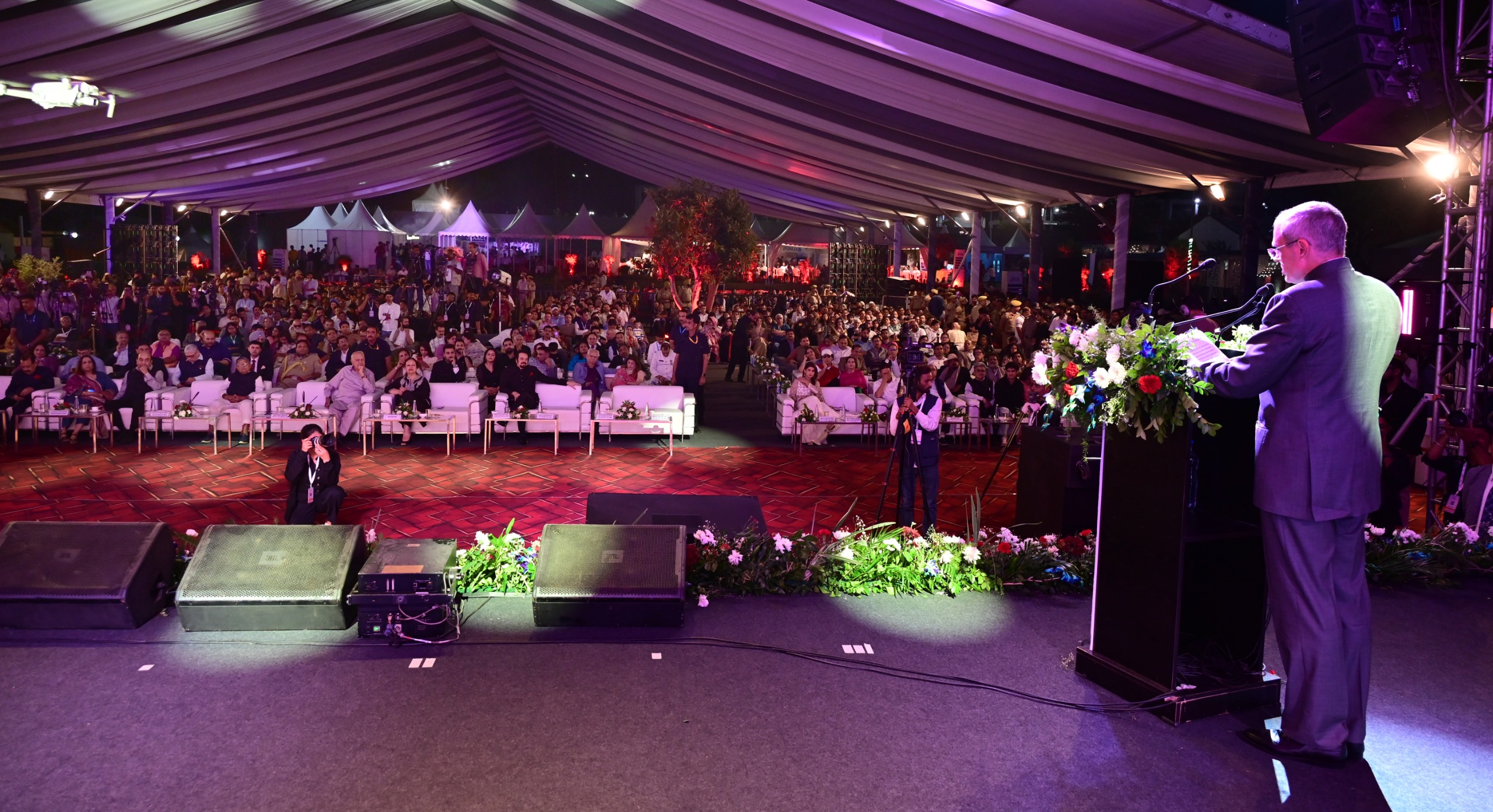
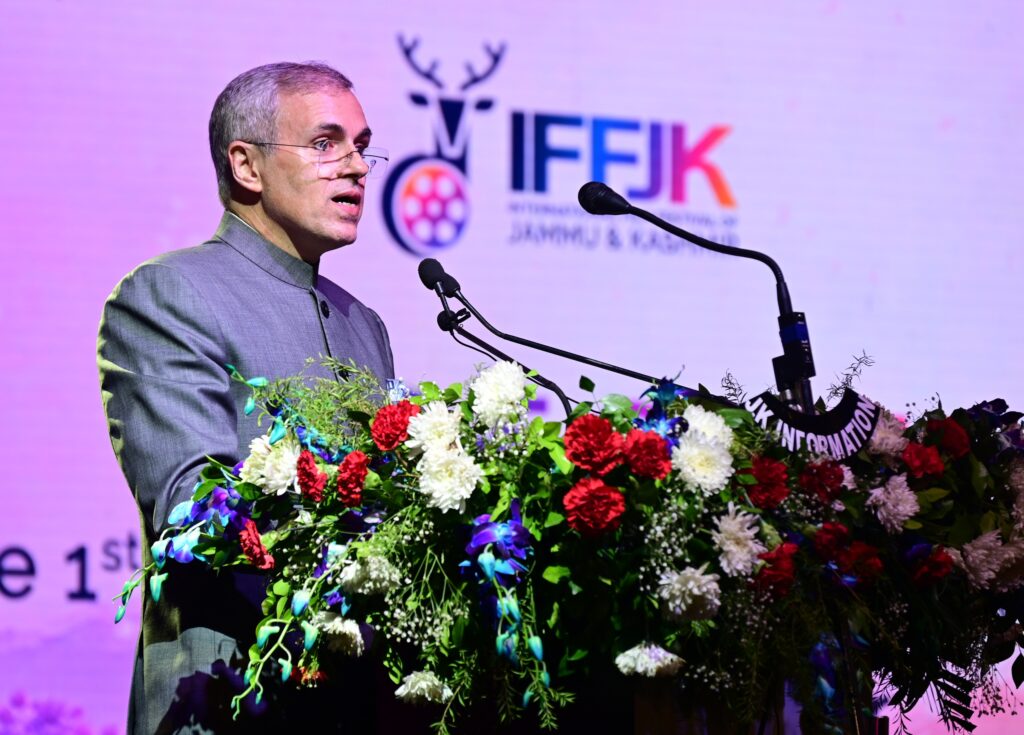
Taking the podium beneath the towering shade of the Chinar trees, Chief Minister Omar Abdullah did not merely open a cultural festival; he articulated a philosophy of cinematic re-engagement. Facing a hall filled with veteran directors, international jury members, students, and global delegates, Abdullah leaned directly into the region’s complex, mythologised relationship with the lens.
“Today, as we launch this festival, bringing together filmmakers from over 30 countries and showcasing over 130 extraordinary films, we are not just opening a cinema event. We are opening a new chapter in the longstanding romance between Jammu & Kashmir and the silver screen,” the Chief Minister said.
Looking out across the water toward the Himalayan foothills, he challenged the longstanding convention that has long treated the valley as an interchangeable stage prop.
“To stand here today, under the majestic shade of the Chinar trees, surrounded by the sentinel peaks of the Himalayas, is to be reminded that some places on earth do not merely host stories, they are born of them,” Abdullah said. “We are declaring to the world that Kashmir is not just a location on a call sheet; it is a creative sanctuary, a home for global storytellers, and a voice that is ready to speak to the world.”
For generations of moviegoers, the visual grammar of popular Indian cinema was forged on these very slopes. Long before affordable commercial aviation whisked production crews across the Swiss Alps or the Austrian Tyrol, Hindi cinema discovered its emotional zenith in Gulmarg, Pahalgam, and Sonamarg.
Abdullah revisited those indelible cultural markers, recalling how Shammi Kapoor sliding down powdery inclines in Junglee, bellowing an uninhibited “Yahoo!” came to embody an entire post-independence generation’s discovery of modern exuberance and liberation. He charted the lineage through Sharmila Tagore’s quiet presence amidst the floating gardens of Dal Lake in Kashmir Ki Kali, through Rajesh Khanna and Sharmila Tagore in Aradhana, to the youthful rebellion of Rishi Kapoor and Dimple Kapadia in Bobby, immortalising the small wooden cottage in Gulmarg that to this day bears the film’s name.
Particular reverence was reserved for the late Yash Chopra, the auteur who transformed Kashmir’s topography into an intimate vocabulary of longing and poetic memory across classics like Kabhi Kabhie, Silsila, and Jab Tak Hai Jaan.
“Directors like Yash Chopra did not just film here, they built a visual language around this land,” Abdullah observed, noting that the valley’s changing seasons, the electric greens of spring, the molten bronze of autumn chinars, and the austere hush of winter snows provided directors with an organic mirror to the full spectrum of human vulnerability.
Yet, as the decades turned and the regional reality grew fraught, the screen began reflecting deeper, more fragmented truths. The Chief Minister pointed to the evolving visual registers in works like Vidhu Vinod Chopra’s Mission Kashmir, Vishal Bhardwaj’s Shakespearean adaptation Haider, Imtiaz Ali’s Rockstar and Highway, and Kabir Khan’s cross-border human drama Bajrangi Bhaijaan. These productions, he noted, pushed past pristine picture-postcard surfaces to grapple with alienation, fracture, innocence, and emotional survival.
“Do Not Just Film Our Mountains”
The crux of the opening address, however, was not an exercise in historical nostalgia. It was a direct appeal to the gathered international fraternity to redefine their gaze.
“Cinema is more than landscapes; cinema is culture. And the true beauty of Jammu and Kashmir lies in its soul, its cultural ethos, built on Kashmiriyat, warmth, hospitality, and a rich artistic tradition,” Abdullah said.
He spoke of the complex oral narratives native to the land, the classical cadences of the Santoor and Rabab, the spiritual depth of Sufiyana Kalam, and the celebratory rhythms of Rouff. He pointed to the hands that shape walnut wood into delicate filigree, the generational patience embedded in hand-knotted silk carpets, the early morning mist rising over the purple saffron beds of Pampore, and the quiet comfort of brewing Kahwa.
Turning squarely toward the visiting directors and cinematographers, Abdullah delivered the evening’s most resonant charge:
“When you bring your cameras to Jammu and Kashmir, do not just film our mountains. Seek out our stories. Talk to our artisans, listen to our musicians, walk through our old city lanes, and let the living, breathing culture of this land infuse your narratives.”
The sentiment struck an immediate chord with one of the valley’s most celebrated cinematic sons in attendance: acclaimed director Vidhu Vinod Chopra.
For Chopra, returning to Srinagar for the festival was a deeply emotional homecoming. Standing on the fringes of the venue, Chopra spoke candidly about his upbringing in Srinagar’s downtown, tracing the arc of his artistic journey back to the narrow alleys of Amira Kadal and the lecture halls of Sri Pratap College.
“I am from Kashmir, as you know. I studied at SP College and for me, it is a homecoming,” Chopra said.
Reflecting with characteristic self-deprecation on his early artistic ambitions, he remembered the friction that met his unconventional path: “When I told my father that I used to study at SP College, my father slapped me.”
Yet, as he looked out across the auditorium at hundreds of aspiring local students and media practitioners, Chopra was unequivocal in his appraisal of the valley’s latent creative capital.
“I want to tell Kashmir: don’t let yourself down. I see such talent here. My request is, show the world what you can do. The film festival is a great appreciation of that talent,” he insisted. “For me, this is an emotional moment. I travelled from Amira Kadal to where I am sitting here.”
Chopra stressed that the world cannot understand Kashmir if its narrative remains outsourced to outsiders who only visit for brief shooting schedules:
“It is an opportunity for youngsters. I see this festival as an opportunity. So many films and filmmakers can come here. There is such talent here. Please understand, I am speaking English and I learnt it in school in Kashmir. And here I am. This is an opportunity for all. I am here. I have made many films. If a festival like this happens in Kashmir, then the stories of Kashmir will be told. We have our own stories. I come from Amira Kadal. I am a Kashmiri. I know Kashmiri. There is hope.”
Constructing an Industry
While emotional resonance and heritage formed the opening night’s rhetorical heart, the regional administration knows well that artistic goodwill quickly dissipates without institutional backing, logistics, and legal ease.
“As an administration and as a society, we recognise that nostalgia alone cannot build an industry. To welcome the future of filmmaking, we must build a world-class ecosystem, and that is precisely what we are doing,” the Chief Minister stated plainly. “Under our comprehensive Jammu & Kashmir Film Policy, we have transformed J&K from a beautiful location into one of the most filmmaker-friendly destinations in the world.”
Historically, international and domestic crews navigating Jammu and Kashmir faced multi-layered bureaucratic hurdles, security verifications, and fragmented departmental jurisdictions that frequently pushed high-budget projects toward more accessible international locales.
To dissolve these bottlenecks, the administration’s film policy centres on an integrated single-window clearance mechanism. Managed via a dedicated digital portal, the platform coordinates location clearances, drone permissions, departmental verifications, and security logistics under designated nodal officers, enforcing time-bound approvals.
Complementing administrative simplification is a framework of financial incentives:
- Production Subsidies: Graded financial support tied directly to the number of shooting days spent within the Union Territory and quantifiable local operational expenditure.
- Independent & Regional Film Support: Dedicated grants to offset production friction for indie directors, regional languages, and debut filmmakers.
- Local Employment Mandates: Tiered bonus subsidies for productions that recruit a substantial percentage of their on-screen cast, technical crew, line production units, and support staff locally.
- Cultural Representation Clauses: Financial incentives for scripts that engage meaningfully with regional heritage, history, folklore, and indigenous crafts.
The ultimate objective, Abdullah underlined, is to end the practice of “fly-in, fly-out” productions that import every technician, light, camera lens, and caterer from Mumbai or New Delhi, leaving behind little more than hotel bills and trampled grass.
“We are building a robust local workforce of cinematographers, line producers, sound engineers, and actors so that you can arrive with a script and find everything else right here,” he said.
The roadmap includes capital investment in post-production and colour-grading suites, regional equipment banks carrying industry-standard cameras and lighting gear, designated sound stages, and institutional partnerships for film and technical education across both divisions of the region.
Bridges, Beats, and New Horizons
The physical footprint of the festival underscores this ambition. Across the week, screenings, roundtables, and masterclasses are distributed between the historic halls of SKICC, the INOX multiplex in Srinagar, where Chief Secretary Atal Dulloo formally launched the daytime cinematic screenings alongside the Directorate of Information and Public Relations (DIPR) as well as targeted venues in Jammu and high-altitude settings in Gulmarg.
The roster of visiting and participating cinema personalities bridges distinct eras and genres: veteran commercial director Ramesh Sippy, visionary auteurs Vidhu Vinod Chopra and Imtiaz Ali, method actor Pankaj Tripathi, alongside younger faces including Fatima Sana Shaikh, Sadia Khateeb, and Vedang Raina.
For actor Fatima Sana Shaikh, best known for her portrayal of wrestler Geeta Phogat in Dangal, cultural congregations of this scale serve a humanising function that transcends industry networking.
“It has been a long time since I attended a festival like this, so I am very excited. There are so many things happening. Cultural events like this are very important because they bring people together,” Shaikh reflected during the opening proceedings.
Shaikh stressed that access remains the greatest hurdle for regional talent, arguing that bringing the film world to Srinagar democratises an industry that often feels insular and distant.
“It is very important for the youth. People come from outside and they deserve these opportunities,” she said. “People often look at things from the wrong perspective, but I am so proud that this is happening, that the youth are moving forward and participating in cultural activities. It makes me very happy to see people progressing.”
Addressing the wider role of non-mainstream cinema, Shaikh pointed out how celluloid preserves living identity:
“Regional cinema is important. Through cinema, poetry, culture and artistry can be showcased. These things have existed for centuries. Spoken words, artistry and all of this are part of our heritage. It will open doors for international filmmakers. Film shootings happened here earlier and they are happening now as well. It depends. With an international festival taking place, they will also understand what can be done here and what the people are like.”
When asked about her former co-star Zaira Wasim, the Srinagar-born actor who earned critical acclaim before stepping away from the film industry, Shaikh offered a graceful reflection: “No, I haven’t spoken to her for several years. I really enjoyed working with her. It is nice to see people find their own path.”
Taking in the tranquil evening expanse, Shaikh looked out across the shoreline with unmistakable wonder: “There is water everywhere here. What is it about the water here that makes it different?”
As the formal addresses concluded, the evening transitioned from policy into pure sensory celebration. Under open skies, the convention centre’s lawns were illuminated with warm amber lanterns. Playback singer Rani Hazarika took the stage, threading traditional regional heritage with popular memory.
Hazarika opened her set with an evocative performance of ‘Salami Wazwaani’, grounding the gathering in regional celebratory rhythms, before shifting into soaring, soulful Bollywood ballads like ‘Mahi Ve Mohabbata’ and ‘Zindagi Mein Koi Aaye Na Rabba’. The crowd—a mix of seasoned international festival programmers, local university students, veteran character actors, and regional officials—swayed in unison against the quiet backdrop of Dal Lake.
The Gaze Turns Inward
Ultimately, the festival’s enduring legacy will not be measured by the sparkle of its opening-night red carpet, nor by the number of visiting dignitaries who pose beside the chinars. It will be decided by whether the young men and women occupying the rear rows of the auditorium can pick up cameras and tell their own unvarnished truths to an international audience.
In his closing remarks, Omar Abdullah directed his gaze directly at that younger demographic:
“Look at the young boys and girls in the audience. Passionate, creative, beautiful natives whose eyes are filled with dreams of writing, directing and acting. This festival belongs to them as much as it belongs to our distinguished international guests. Over the next four days, as you watch films from every corner of the world, engage in master-classes, panel discussions, and casual conversations over tea, I urge you to look beyond the screen.”
The valley has spent more than half a century being projected through other people’s lenses. For decades, it was framed either as an unattainable, idyllic Eden of blossoming orchards and romantic songs, or as a shuttered, brooding terrain of checkpoints and perpetual grief.
By demanding that global cinema look past the majestic contours of the Pir Panjal and listen to the human cadence of the Old City’s timber-framed lanes, Srinagar is asking for something fundamentally radical: to be seen in its full, complex humanity.
“Tell your fellow filmmakers that Jammu and Kashmir is open, safe, vibrant, and eager to welcome your crews,” Abdullah said to the visiting international fraternity. Then, turning finally to the aspiring local writers and directors gathered in the hall, he issued a simple, unmistakable challenge:
“Your stories matter. Your voices matter. The world is listening, and now, the world’s screen is right here in your home.”
As the final notes of the evening’s rabab faded into the cool lake air, the silver screen lit up across Srinagar. The mountains were still there, watching over the valley as they always have, but this time, the camera was finally turning around.
Leave a Reply