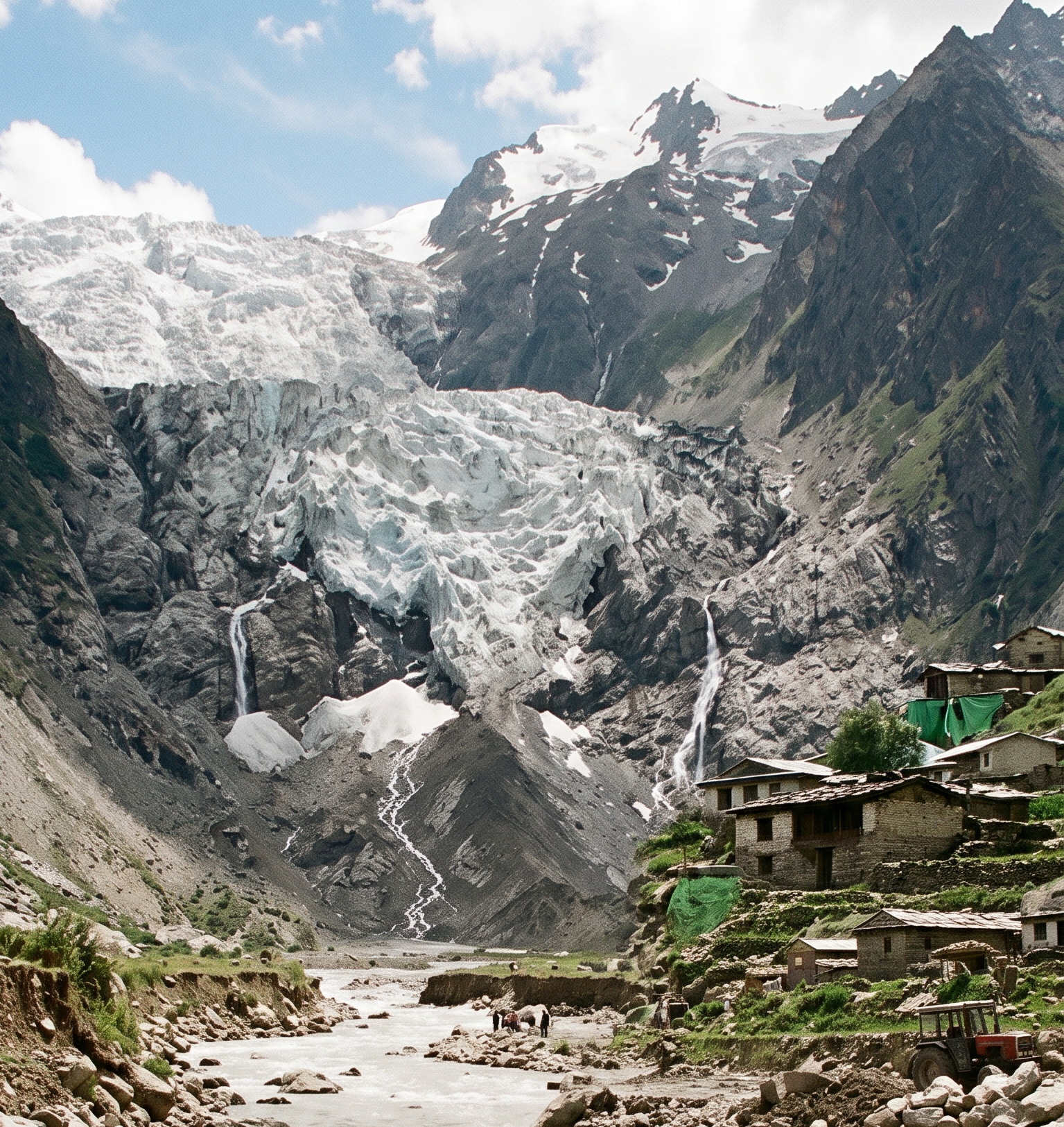
Researchers at IIT Kharagpur found that key alpine areas like Gulmarg and Pahalgam have warmed by nearly 1°C over the past two decades. This relentless elevation-dependent heating disrupts natural nightly freeze cycles and accelerates snowmelt across the Western Himalayas.
By Prof. Jayanarayanan Kuttippurath
A landmark study published in Scientific Reports, entitled “Warming of the high-mountainous climate sensitive Jammu and Kashmir during the period 1980–2024,” reveals severe and accelerating warming trends across the Himalayan ranges of Jammu and Kashmir. Mountain terrains are heating up at rates far exceeding those of lowland plains, with several high-altitude zones recording an increase of nearly 1°C in just the last two decades. This accelerated elevation-dependent warming poses an immediate threat to perennial glaciers, snow-fed river basins, and the primary freshwater security of hundreds of millions of people across northern India and the wider Indus basin. The findings outline an unmistakable dynamic: the higher the elevation, the steeper and more relentless the temperature trajectory.
Conducted by atmospheric scientists at the Indian Institute of Technology (IIT) Kharagpur’s Centre for Ocean, River, Atmosphere and Land Sciences (CORAL), the comprehensive investigation was led by Prof. Jayanarayanan Kuttippurath alongside co-researchers GS Gopikrishnan and VM Pranav Chandran. The team synthesized high-resolution in-situ observations from ground meteorological stations with extensive multi-decadal satellite datasets and reanalysis products spanning a rigorous 44-year window from 1980 to 2024. This extensive chronological baseline allowed the researchers to isolate topographical variables and evaluate precisely how thermal trends diverge across distinct vertical strata of the Western Himalayas.
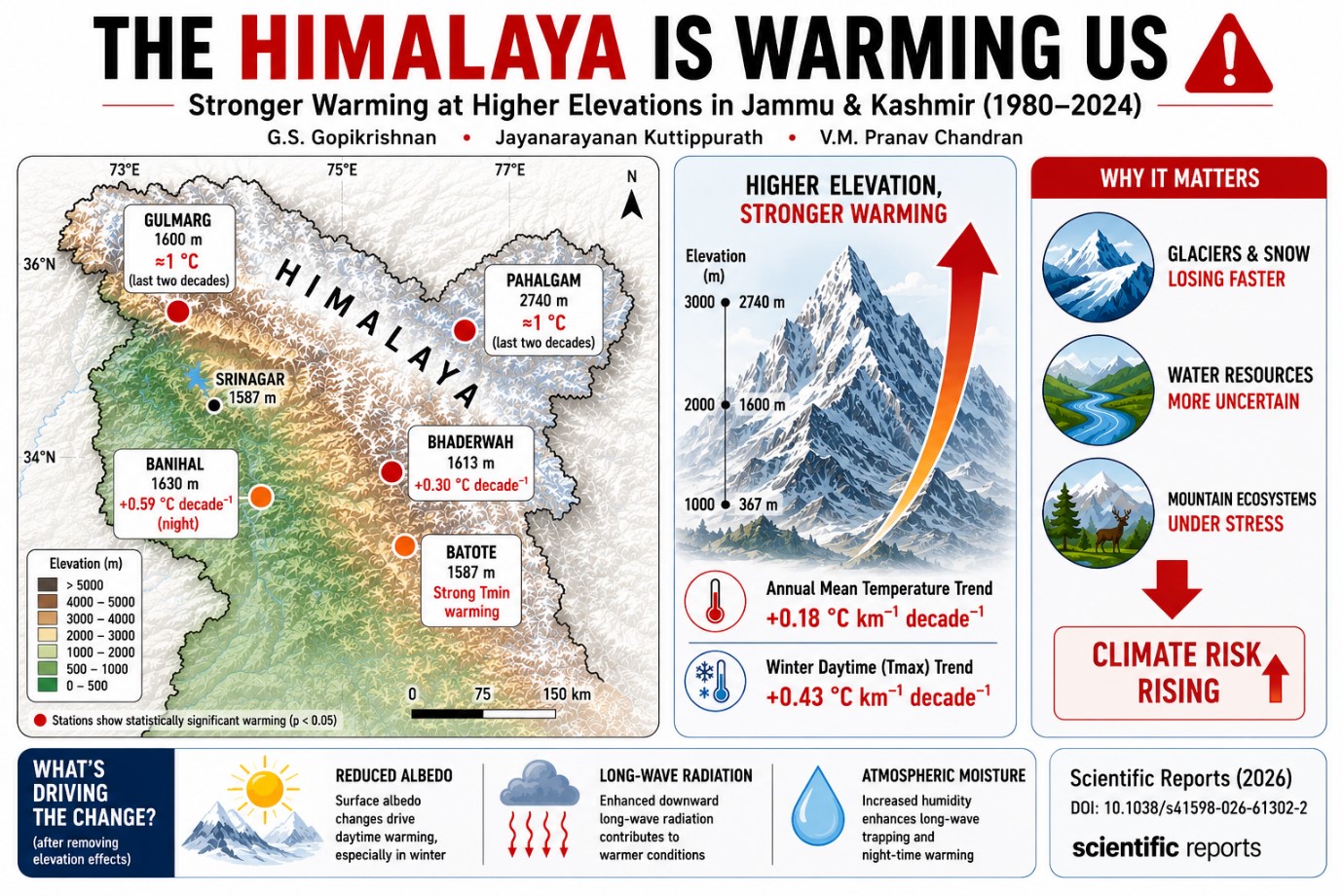
The research establishes a pronounced pattern of elevation-dependent warming (EDW), demonstrating that alpine and sub-alpine belts are bearing the brunt of climatic shifts compared to the plains. Meteorological stations situated at moderate to high altitudes, such as those in Bhaderwah, Pahalgam, and Gulmarg, recorded steep and sustained increases in ambient temperatures. In stark contrast, low-altitude urban valleys and plains, including the city of Jammu, exhibited a considerably slower pace of warming. Crucially, the data revealed an alarming asymmetry between diurnal cycles: minimum nighttime temperatures are climbing significantly faster than maximum daytime temperatures. This nocturnal heating anomaly is particularly intense during the pre-monsoon spring months, signaling a profound alteration in the region’s traditional seasonal rhythms and microclimatic stability.
A granular look at the data underscores the magnitude of these climatic shifts. At mid-elevation observation posts, mean annual temperatures have been climbing at an average rate of approximately 0.3°C per decade. However, nocturnal spring temperatures have surged at double that velocity, registering increases of up to 0.6°C per decade. This sharp nocturnal rise is driven by a web of localized and atmospheric feedback mechanisms. At upper altitudes, diminishing snowpack and the steady retreat of glacial ice trigger a positive snow-albedo feedback: as reflective white surfaces are replaced by darker, heat-absorbing bare rock and soil, solar radiation is retained rather than reflected back into space. Concurrently, increasing atmospheric moisture and high concentrations of suspended aerosols enhance downward longwave thermal radiation, preventing heat from escaping into the upper atmosphere after sunset.
Prof. Kuttippurath warns that the fragile Himalayan landscape is operating on borrowed time. “The Himalayas represent one of Earth’s most ecologically fragile and climate-sensitive environments, and our findings demonstrate that warming across this landscape is far from uniform,” he stated. “The accelerated heating of high-mountain zones poses immediate risks to structural glacier mass balances, seasonal snow accumulation cycles, perennial river discharge, and endemic biodiversity, generating socio-economic repercussions that extend far beyond the immediate geographical boundaries of the Kashmir valley.”
Lead investigator GS Gopikrishnan emphasized the acute hydrological implications of the study’s nocturnal warming discoveries. Because surface temperatures fail to drop sufficiently during the night, the natural freeze-thaw equilibrium that sustains mountain snowfields is fundamentally disrupted. “When nights remain unusually warm, the cryosphere loses its natural recovery window,” Gopikrishnan explained. “This uninterrupted thermal forcing accelerates the continuous melt of seasonal snow and permanent ice reserves, altering the timing and volume of runoff in headwater tributaries and destabilizing the downstream river architectures that sustain agricultural and urban populations.” The 44-year dataset provides researchers with critical empirical ground-truthing to refine regional climate models, sharpen downscaled predictive tools, and formulate actionable adaptation roadmaps tailored to rugged terrain.
The implications of continued, unchecked heating across Jammu and Kashmir extend across hydrological, agricultural, and hazard-management domains. In the agricultural sector, the shortening of the traditional winter cold period and abnormal spring heatwaves have already begun disrupting the chill-hour requirements necessary for temperate fruit cultivation, notably impacting Kashmir’s iconic apple and saffron production. In the high valleys, altered hydrological regimes threaten to shift peak streamflow earlier into the spring, leaving downstream agricultural networks vulnerable to severe late-summer water deficits right when irrigation demands are highest.
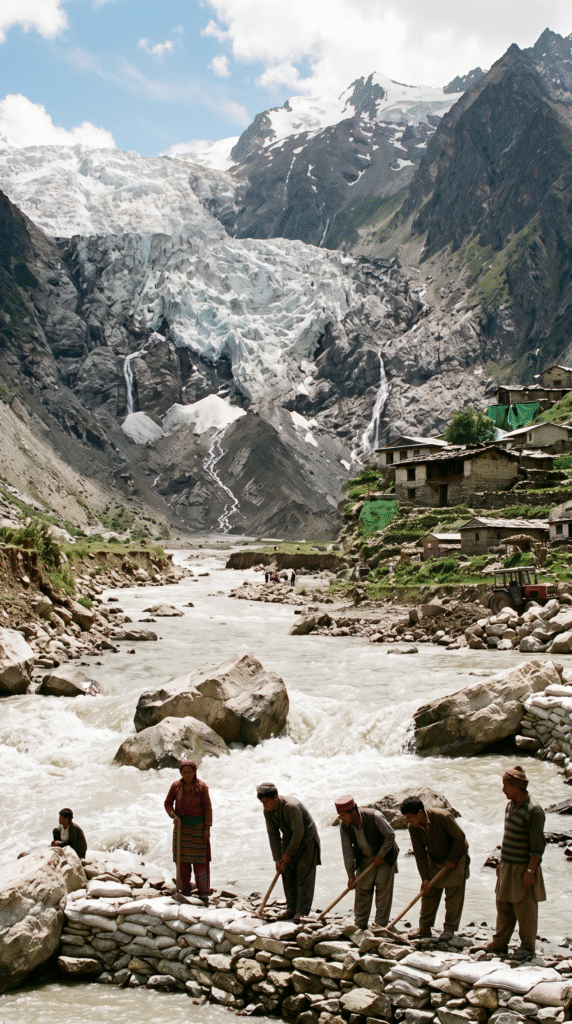
Simultaneously, the destabilization of alpine permafrost and rapid glacial thinning heighten the probability of compound geohazards across high-relief valleys. Warming slopes and irregular precipitation bursts increase the frequency of catastrophic glacial lake outburst floods (GLOFs), structural slope failures, rockfalls, and sudden debris flows that threaten vital mountain transport arteries, hydroelectric infrastructure, and remote settlements. The regional ecological footprint is equally concerning, as alpine flora and fauna face uphill habitat compression, squeezing specialized species into narrower altitudinal corridors with no higher ground left to colonize.
Addressing these systemic vulnerabilities requires an integrated shift in regional policy and environmental monitoring. Prof. Kuttippurath emphasized that deciphering these physical interactions is essential for proactive disaster preparedness. “Mountain warming is driven by an intricate convergence of high-altitude radiative forcing, reduced surface albedo, rising atmospheric humidity, and changing thermal distribution patterns,” he noted. “Understanding the exact mechanics governing these processes is the only way to build realistic climate resilience frameworks and mitigate the threat of future climate-driven emergencies across the Himalayan belt.”
To prevent irreversible ecological degradation, the IIT Kharagpur research team advocates for immediate multi-tier interventions. These priorities include expanding the density of automated high-altitude weather stations across inaccessible ridgelines, institutionalizing continuous cryospheric and permafrost monitoring programs, and enacting climate-resilient land-use and water-governance policies tailored specifically to fragile montane ecosystems. Without urgent, scientifically grounded policy execution and coordinated climate mitigation strategies, Jammu and Kashmir’s vital role as a primary water tower and biodiversity sanctuary for South Asia faces mounting and irreversible peril.
Disclaimer: The views expressed in this feature article are solely those of the author and do not necessarily reflect the official editorial stance or opinions of this publication.
Leave a Reply