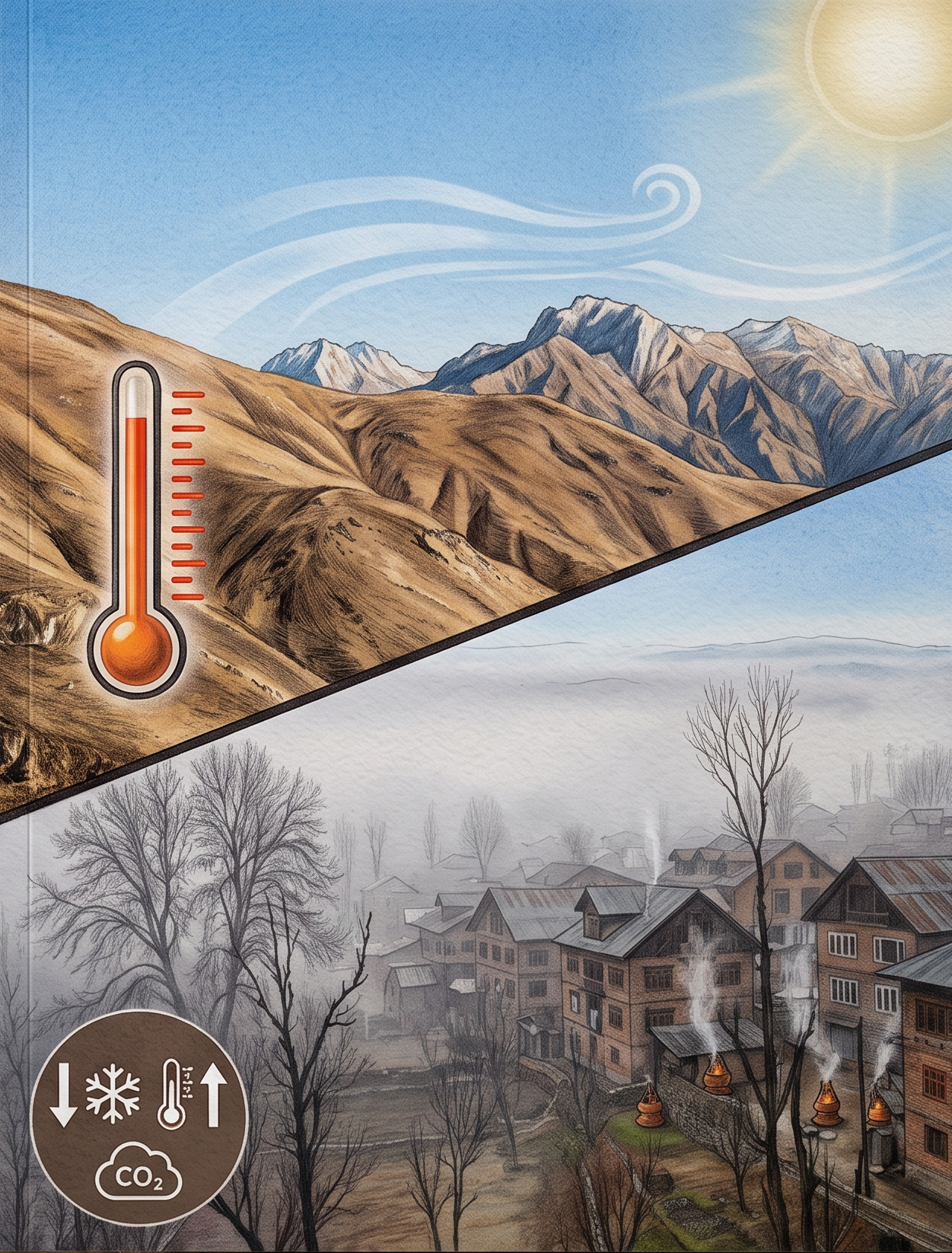
How El Niño and Global Warming Are Rewriting Kashmir’s Winter Script
Across the Kashmir Valley, where generations have marked time by the first heavy snowfall and the bitter forty-day freeze of Chillai Kalan, the coming winter is shadowed by a growing climate paradox.
Director of the Meteorological Department Srinagar Dr. Mukhtar Ahmad while talking to a local agency said that Jammu and Kashmir is likely to experience a relatively mild and dry winter this year under the influence of El Niño, though one or two major spells of snowfall during the peak winter months cannot be ruled out.
Addressing concerns over social media reports claiming that winter may not occur in India this year, Ahmad, said, “Such claims were unscientific. The winter is a natural seasonal phenomenon that will occur, although its intensity may vary.”
“Winter will definitely come. Sometimes winters are severe and sometimes mild. What we have been seeing for the last few years is a relatively mild winter,” he added.
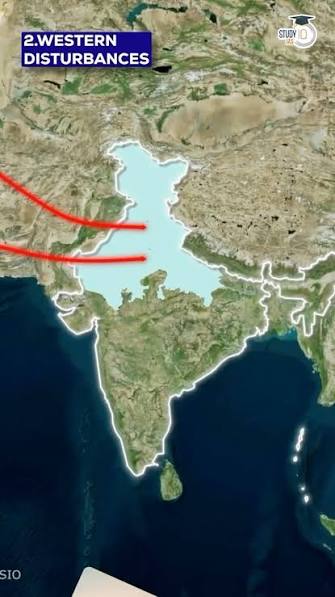
His remarks cut straight through sensationalist digital rumors, offering instead a sober scientific reality: winter is not going away, but its character, consistency, and ecological predictability are undergoing a profound transformation across the Western Himalayas.
El Niño Effect
Ahmad said the World Meteorological Organisation (WMO) indications suggest that the latter part of 2026 and the beginning of 2027, particularly the peak winter period, could be somewhat warmer and drier because of the El Niño effect.
El Niño, the periodic warming of sea surface temperatures in the equatorial central and eastern Pacific ripples across the planet’s general atmospheric circulation. For the northern Indian subcontinent, this teleconnection frequently manifests as altered jet stream configurations and shifted synoptic low-pressure tracks.
He, however, cautioned against making a definitive forecast this far in advance, saying weather conditions are dynamic and can change significantly with even small shifts in atmospheric patterns.
“If there are one or two good spells during peak winter, especially if the moisture supply is good or a major Western Disturbance occurs, it can be helpful,” Ahmad said.
He said Jammu and Kashmir had experienced a similar pattern in recent years, with prolonged dry periods followed by one or two snowfall spells that were generally weaker than expected.
| Climatic Factor | Historical Norm (Past Decades) | Present Pattern & Projection | Regional Implication |
| Peak Winter Precipitation | Regular, deep snowpack (Chillai Kalan) | Extended dry spells, episodic bursts | Rapid melt, reduced glacial feeding |
| Western Disturbances (WDs) | Moisture-laden, slow-moving systems | Frequent but feeble, shallow troughs | Inadequate snow cover across mid-altitudes |
| Precipitation Form | Solid snowfall across plains and slopes | Shifting snowlines; higher rain-to-snow ratio | Accelerated ablation and runoff |
| Valley Fog & Inversions | Dense fog coupled with sub-zero chill | Cold air pooling beneath warmer ridges | Severe surface chill despite higher regional means |
The Agony of the ‘Feeble’ Western Disturbance
The engine of the Himalayan winter is the Western Disturbance (WD), an extra-tropical cyclonic system originating over the Mediterranean, Black, or Caspian Seas that gathers moisture as it tracks eastward across the Middle East, Iran, and Pakistan before hitting the high ramparts of the Pir Panjal and Greater Himalayas.
Without robust WDs, the Valley remains starved of snow.
The MeT director said frequent but feeble Western Disturbances (WDs) were currently affecting the region, generally arriving every third or fourth day but producing little significant weather activity.
“These are mostly feeble Western Disturbances. In the mountainous areas of North Kashmir, we may see some light snow or cloudiness, but there has been no major weather activity,” he said.
Ahmad said a strong Western Disturbance, particularly during the beginning or peak of winter, would be important for the region.
When WDs arrive without deep atmospheric troughs connecting into the Arabian Sea, they lack the precipitable water column necessary to dump snow across the valley floor. Instead, they merely veil the skies in cirrus and altostratus, creating mild, overcast days and blocking nocturnal radiation, which disrupts the crisp freezing cycle without yielding an ounce of water.
Timing of Precipitation in Himalayan Region
The phenomenon of the “drying winter” is not an isolated seasonal anomaly; it is an acute symptom of a destabilized regional climate engine.
He also linked the changing snowfall pattern to climate change and rising temperatures, saying warmer conditions were altering the form and timing of precipitation in the Himalayan region.
Over the past four to five years, he said, Kashmir has not consistently received snowfall during the peak winter period, resulting in shorter-lasting snow cover and longer dry spells.
“Timely snowfall, especially in hilly states like Jammu and Kashmir and other Himalayan regions such as Himachal Pradesh and Uttarakhand, is as important as rainfall during summer,” Ahmad said.
He explained that snowfall during the peak winter months has a longer-lasting impact because lower temperatures allow snow to remain on the ground and contribute to glacier recharge. Snowfall occurring later in February or March can also be beneficial, but warmer temperatures can cause it to melt more rapidly.
“Due to rising temperatures, the snow melts quickly. So timely snowfall is very important for the Himalayan region,” he said.
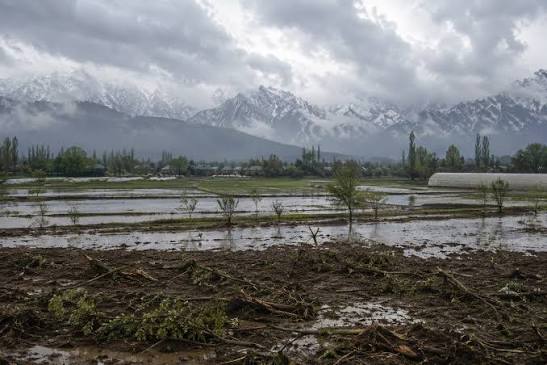
Glaciologists working in the upper Indus Basin echo this concern. The cryosphere depends upon deep thermal consolidation. Snow deposited in December and January compacts into dense firn under sustained sub-zero temperatures, forming the multi-year mass that feeds perennial glaciers like Kolahoi and Machoi. Late-season spring snow, by contrast, sits atop warming ground, behaving more like a flash hydrological event than a perennial reservoir—yielding quick seasonal runoff and vanishing before summer truly arrives.
The Ecological and Economic Domino Effect
The downstream implications of a mild, dry winter ripple across every sector of Jammu and Kashmir’s socioeconomic fabric:
- The Saffron and Horticulture Backbone: Kashmir’s apple and almond orchards demand critical winter chilling hours (temperatures between 0°C and 7°C) to break dormancy and set healthy buds. Without adequate snow cover, soil moisture evaporates early, leaving root systems susceptible to desiccation and increasing spring pest proliferation.
- The Summer Water Reservoir: The Jhelum river system, which sustains millions in the Kashmir valley before flowing into Pakistan, relies on gradual snowmelt to maintain base flows during the hot months of May, June, and July. A snowless peak winter triggers spring floods followed by acute summer droughts, parching paddy crops.
- Hydropower Deficits: The Union Territory’s run-of-the-river hydroelectric projects face severe winter power-generation deficits when stream flows run abnormally low, forcing greater reliance on the national grid during peak heating demand.
- Vulnerable Winter Tourism: Gulmarg, Pahalgam, and Sonamarg have become global winter-sports and leisure magnets. A delayed or meager snow cover slashes ski seasons, hits hotel occupancy rates, and undermines livelihoods for thousands of sledge pullers, ski instructors, and pony wallahs.
Severe Cold in the Absence of Snow
While upper elevations may register above-normal daytime temperatures during mild winters, Ahmad noted that the plains could continue to see severe cold during foggy periods.
This is the atmospheric paradox of the Kashmir basin. Surrounded by high mountain ridges, the valley functions as a topographically enclosed sink. Under clear, stable, dry anticyclonic conditions, typical of a mild El Niño pattern cold, heavy air drains from the mountains and settles over the plains at night.
Without active weather systems to mix the troposphere, strong thermal inversions trap humidity, vehicle exhaust, and smoke from domestic kangris and hamams beneath a stubborn layer of dense radiation fog.
The result is a bitter, piercing, bone-dry chill in Srinagar and adjoining plains, even as mid-altitude ski slopes bathed in sunshine register unusually mild readings.
Precipitation Situation Currently Near Normal
Despite anxiety surrounding the coming winter, the hydrological ledger for the ongoing year is not entirely parched.
On the precipitation situation in Jammu and Kashmir, Ahmad said the overall seasonal scenario was currently near normal despite significant variations between individual months.
He said July recorded 35 per cent excess rainfall, although the early monsoon period also caused considerable losses. August, however, recorded around 25 per cent rainfall deficit, with some spells occurring during the month but without consistent or widespread activity.
“Overall, the precipitation scenario for the season is almost near normal,” he said.
Yet meteorologists emphasize that “normal” statistical averages frequently mask erratic, high-volatility extremes. Concentrated torrential bursts in mid-summer do not compensate for the slow, sustained, high-altitude snow accumulation that winter uniquely provides.
Hope, Science, and the Shifting Sky
Ahmad also dismissed claims that February or winter itself would somehow be absent this year, saying such conclusions could not be drawn from seasonal forecasts.
He advised people to remain positive, saying snowfall and rain were still expected even though the overall winter could be milder than normal.
“Let us see what happens. It is very difficult to say from now. These things are very dynamic. There will be snow, God willing, and there will be rain,” he said.
As autumn sets its golden glow upon the Chinar trees of the Valley, Kashmir prepares to watch the skies. The traditional winter of chest-deep drifts and month-long blizzards may be yielding to an unpredictable, climate-stressed era, but the story of the coming season remains unwritten until the first great winter storm crosses the mountains.
(With inputs from KNO)
Leave a Reply