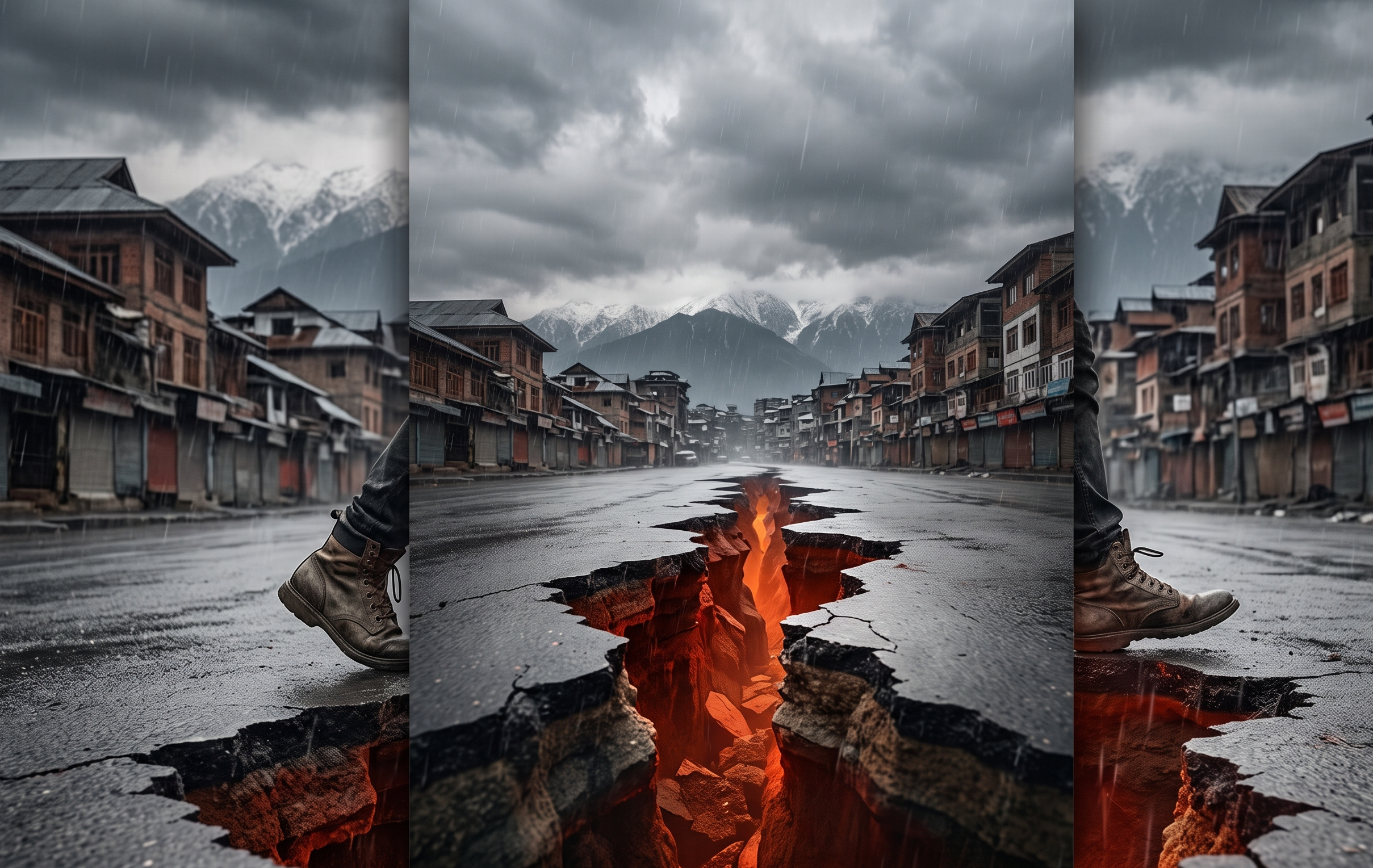
Beneath the serene waters of the Jhelum and the postcard valleys of Kashmir, a colossal geological engine is grinding into silence. Deep underground, pressure is mounting along silent fractures and above ground, millions inhabit concrete traps built over quicksand.
By Ajaz Rashid
Across the bowl of the Kashmir Valley, life unfolds against an idyllic canvas of snow-tipped ridges, chinars, and sprawling urban lanes. Yet miles below the surface, an inexorable collision between two continental giants, the Indian and Eurasian tectonic plates is relentlessly coiling a continental spring.
For decades, the Valley has lived in the shadowed memory of October 2005, when a magnitude 7.6 tremor tore through northern Kashmir, claiming over 80,000 lives, injuring 200,000, and orphaning a generation as 19,000 children perished under the debris of collapsed masonry. Two decades later, a succession of rigorous scientific assessments published in 2026 makes one thing chillingly clear: Kashmir is running out of borrowed time.
The threat is not a matter of if, but when. And when the earth inevitably gives way, the Valley may find itself entirely unprepared for the shock.
The Anatomy of a Locked Fault
At the core of the danger lies a fundamental geological truth: Kashmir sits atop an ominous “seismic gap.”
According to an exhaustive review published in the Proceedings of the Indian National Science Academy in January 2026 by researchers Waseem Qader, Irfan Maqbool Bhat, and Mehran Qurashi, the Valley rests on a dense network of major thrust systems. These include the Himalayan Frontal Thrust, the Main Boundary Thrust, the Main Central Thrust, the Main Mantle Thrust, the Kishtwar Fault, and the local Balapur Fault that cuts directly beneath the basin floor.
Within this compressed corridor, decades of locked strain have accumulated without substantial release. Historical records show an ancient lineage of catastrophe: violent temblors shook the basin in 1555, 1669, 1736, 1779, 1784, 1828, and 1885, when a major shock shattered Baramulla.
Statistical modeling in the review paints a sobering picture: there is approximately a 40 percent probability of an earthquake measuring magnitude 7.6 or greater striking the region within a 100-year window. The estimated recurrence interval stands at roughly 200 years for an M7.6 event, and approximately 380 years for an M8 or greater mega-earthquake. With each passing year of silence, the probability ticks higher.
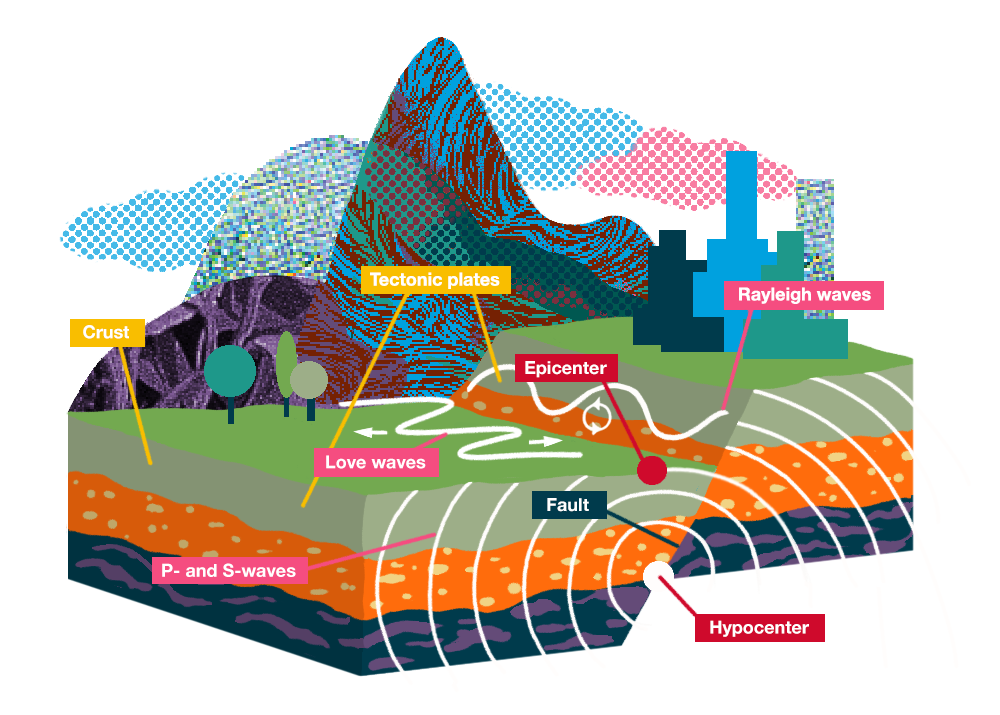
Complementing these findings, a companion investigation by Ayaz Mohmood Dar published in Physics and Chemistry of the Earth charted roughly 1,000 earthquakes exceeding magnitude 3 since 1905, including approximately 150 events surpassing magnitude 5. Cluster maps reveal distinct seismic activity concentrated along the north-northwest and south-southeast extensions of the basin. Using total magnetic intensity surveys, Dar identified magnetic minima and linear low-magnetic zones along the Balapur Fault telltale geophysical signatures of active crustal deformation.
The topography and geological setting mean that when this accumulated stress ruptures, it will subject buildings on the surface to ferocious lateral loads.
Sinking Soils
The danger is amplified not just by the energy traveling through the bedrock, but by the very ground underfoot.
Much of the Kashmir Valley rests upon thick Quaternary lacustrine (lake-bed) and fluvio-deltaic sediment deposits. In districts like Srinagar, Baramulla, and Kupwara, these loose silt and sand layers sit atop remarkably shallow water tables.
When strong seismic waves tear through water-saturated, uncompacted earth, solid ground can behave like a dense liquid within seconds a catastrophic phenomenon known as soil liquefaction. As pore-water pressure spikes, the soil loses all shear strength. Instead of holding upright, foundations tilt, subside, or buckle completely, while lateral spreading tears roads and utility lines apart. The loose sediments do not merely fail; they resonate and amplify the shaking, transmitting violent kinetic forces straight into building footings.
A Concrete Monolith on Unstable Ground
While the subterranean hazard is primeval, Kashmir’s most lethal vulnerability is entirely man-made: the built environment.
For centuries, indigenous Kashmiri builders adapted intuitively to seismic reality. Traditional construction methods such as Taq, a system of timber-laced masonry piers and Dhajji Dewari, characterized by timber framework braced with light masonry infill, offered high flexibility. During strong lateral shaking, these timber-caged walls flexed, dissipated kinetic energy, and shed weight without catastrophic structural collapse.
In recent decades, however, rapid modernization and urban sprawl have swept these resilient traditions aside. In their place stands an expanse of unreinforced masonry, poorly engineered concrete frames, and unanchored multi-storey dwellings built with shallow foundations and devoid of basic seismic detailing.
Simulations cited by Qader and his co-authors demonstrate the magnitude of the problem: a typical three-storey institutional or commercial structure in the Valley can experience lateral loads reaching up to 749 kilonewtons in a single direction, with combined base shears exceeding an astonishing 11,000 kilonewtons.
Yet an overwhelming majority of structures are not engineered to resist even a fraction of these horizontal loads. A peer-reviewed vulnerability assessment co-authored by Professor Shakil Ahmad Romshoo revealed that roughly 98 percent of the buildings in Srinagar are masonry structures characterized by extremely poor seismic resistance.
The historic, labyrinthine districts of Downtown Srinagar represent ground zero of vulnerability. Hemmed in by hyper-dense construction, narrow streets that preclude emergency vehicle access, and an absence of open refuge grounds, any widespread collapse here would instantly paralyze rescue efforts. Worse still, the vulnerability extends to vital lifelines: critical public infrastructure, including schools and hospitals across the region, remains largely non-earthquake-resistant.
The Culture of Denial
Scientific warnings mean little if they fail to pierce the public consciousness. For earth scientists who have tracked the Valley’s structural vulnerabilities for decades, the pervasive social indifference is the most agonizing hurdle.
Professor Shakil Ahmad Romshoo, Vice-Chancellor of the Islamic University of Science and Technology and an earth scientist, has spent years sounding the alarm over Jammu and Kashmir’s acute vulnerability.
“We do not have a culture of disaster preparedness here. We talk very little about this, for whatever reasons. Our politicians, Imams and community leaders do not talk much about this,” he said.
“I think this is a very important issue for us, any disaster. We need to create disaster consciousness in our society,” he said.
Romshoo argues that disaster resilience cannot be treated as the exclusive domain of state bureaucratic machinery or academic seminars. True resilience requires grassroots ownership from town squares to the pulpits. He has specifically advocated for Imams and religious scholars to harness their moral authority during Friday congregational prayers to instruct citizens on seismic safety, retrofitting, and family emergency drills.
“Earthquakes cannot currently be predicted,” he said. “Reducing casualties therefore depends on preparedness measures, including strict implementation of earthquake-resistant building codes, regular public drills and greater disaster awareness.”
The Race Against the Clock
Official institutions have started to recognize the sheer scale of the crisis. In submissions to the Legislative Assembly, the Jammu and Kashmir administration acknowledged that the entire Union Territory has been placed under Seismic Zone VI, the highest risk classification under the updated IS 1893 (Part 1):2025 standard. The revised mandate treats every district across the territory with uniform, non-gradated urgency.
Initial steps have commenced. Structural safety audits have surveyed more than 11,600 school buildings following the 2025 floods, and a specialized committee has been formed to conduct a comprehensive Hazard, Vulnerability, and Risk Assessment (HVRA). Yet critical counter-measures most notably an Earthquake Early Warning (EEW) network capable of providing precious seconds of advance alert remain in early development.
The threat facing Kashmir is not a singular flaw, but a compounding web of hazards: active faults straining toward breaking point, liquefiable valley floor soils, and millions living within rigid, non-ductile concrete structures.
Preventing a catastrophic humanitarian crisis will require strict enforcement of seismic building codes, massive retrofitting campaigns for schools and hospitals, granular neighborhood escape routes, and an urgent shift from passive fatalism to active civic preparedness.
The clock beneath the Valley is ticking. The faultlines will not wait. (With inputs from KNO)
Leave a Reply