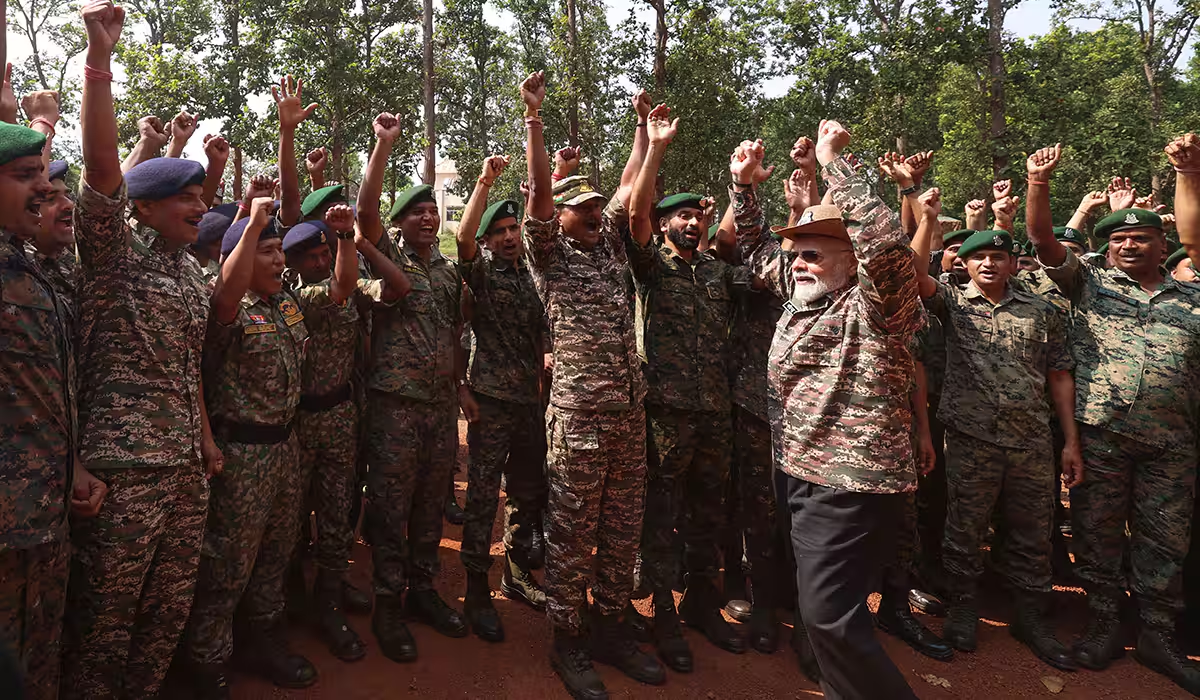
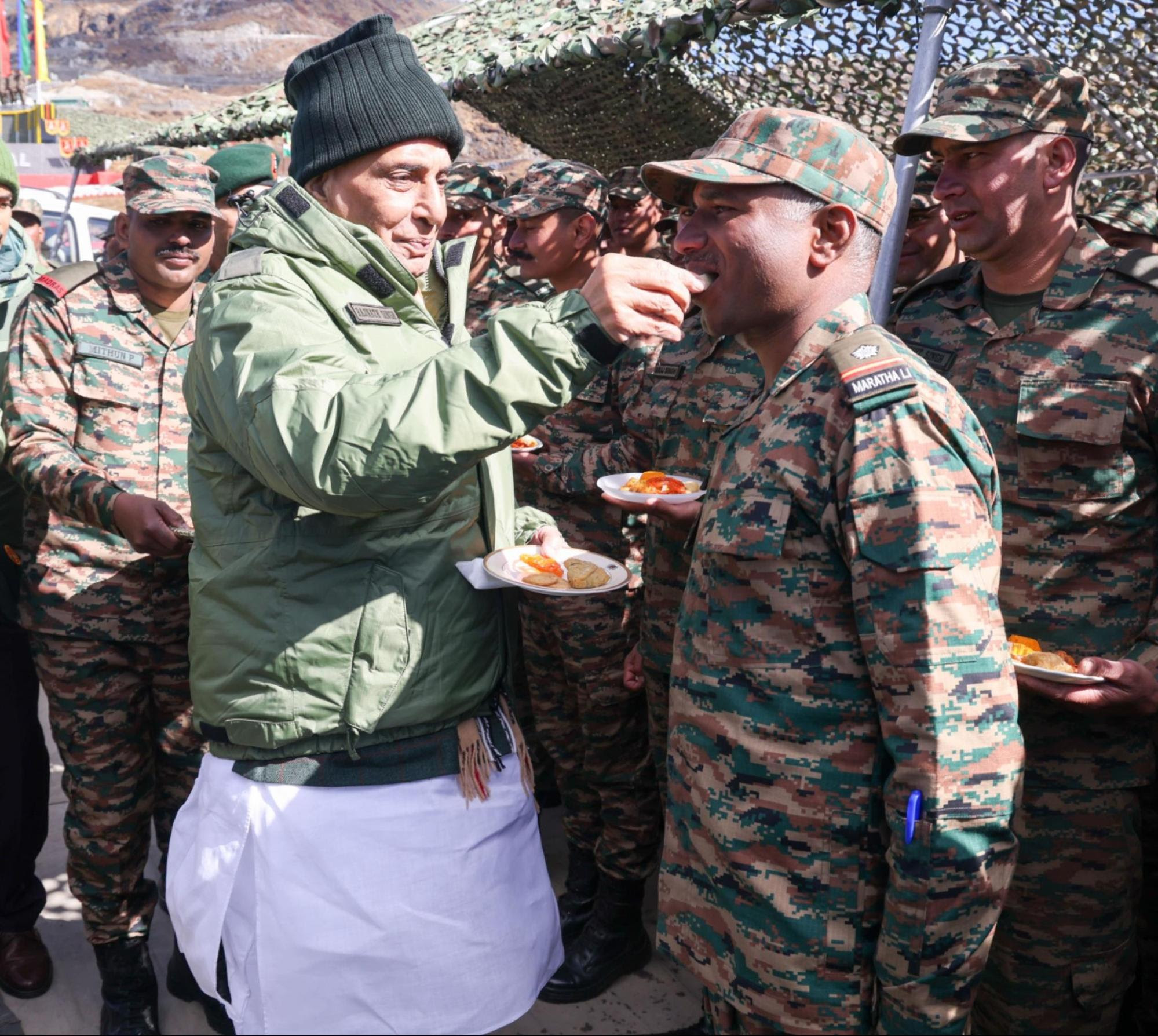
Prime Minister Narendra Modi celebrated Deepavali with CoBRA commandos in Bastar to mark a historic victory over Naxal terror across India. In the freezing heights of Sikkim, Raksha Mantri Rajnath Singh stood shoulder to shoulder with the soldiers of the Trishakti Corps guarding the Himalayan frontier.
By Ajaz Rashid
When darkness gathers over the sub-continent on Deepavali night, millions of clay lamps flicker into life along courtyards, high-rise balconies, and village verandas from Kashmir to Kanyakumari. Sweets are distributed, temple bells ring across ancient towns, and families embrace in warmth and laughter. Yet this vast canopy of peace, celebrated by 140 crore citizens across the globe, is never an accident of history. It is an inheritance guarded by steel, sustained by sweat, and purchased with blood. It lives in the frostbitten outposts of the Himalayas where winds howl through mountain passes at 14,000 feet, and it breathes deep in the dense sal forests of central India where silent warriors once traded fire with an insidious enemy in the brush.
On November 8, 2026, as the nation prepared for the sacred festival of lights, the Indian leadership reaffirmed a sacred national covenant: that the sentinel on the frontier and the commando in the jungle are never alone, never forgotten, and forever placed at the beating heart of India’s collective conscience.
In an unprecedented, synchronized gesture of gratitude and solidarity, Prime Minister Narendra Modi landed at the Commando Battalion for Resolute Action (CoBRA) Operations Base at Karanpur in the deep forests of Bastar, Chhattisgarh, while Raksha Mantri Rajnath Singh ascended into the icy crags of East Sikkim to break bread with the soldiers of the Trishakti Corps (33 Corps) at Sherathang. One stood at what was once the lethal crucible of Left-Wing Extremism; the other stood shoulder-to-shoulder with the guardians of the nation’s outer perimeter. Together, they sketched an inspiring portrait of a resurgent republic, one that has simultaneously shattered internal insurrection and fortified its external frontiers with unyielding resolve.
In the Heart of Abujhmad
For decades, the dense woods of Bastar and the enigmatic sprawl of Abujhmad carried a grim reputation. They were synonymous with landmines, ambush zones, and a protracted war of attrition. Over 230 districts spanning twenty states once groaned under what was then termed the nation’s greatest internal security challenge. Between 2004 and 2013, the numbers told an agonizing story: more security forces laid down their lives annually than the extremists they hunted, emboldening subversive elements and casting a long shadow of dread across central India.
No Indian can forget the dark days of 2010 in Dantewada, where 76 Central Reserve Police Force (CRPF) personnel and 44 innocent civilians were brutally massacred in separate, cold-blooded attacks. Countless jawans returned home carrying the permanent scars of improvised explosive devices (IEDs), having lost limbs in the line of duty. More than a thousand security personnel had perished in Chhattisgarh alone.
Yet, this Diwali of 2026 stands apart in the annals of modern India. It is the first festival of lights where every single district across the length and breadth of India stands officially declared free from the menace of Naxalism.
Even more monumental is a milestone that speaks volumes of the forces’ tactical brilliance, operational restraint, and modern logistical backing: for the first time in 47 years, not a single CRPF jawan had to lose their life during duty in the past one year.
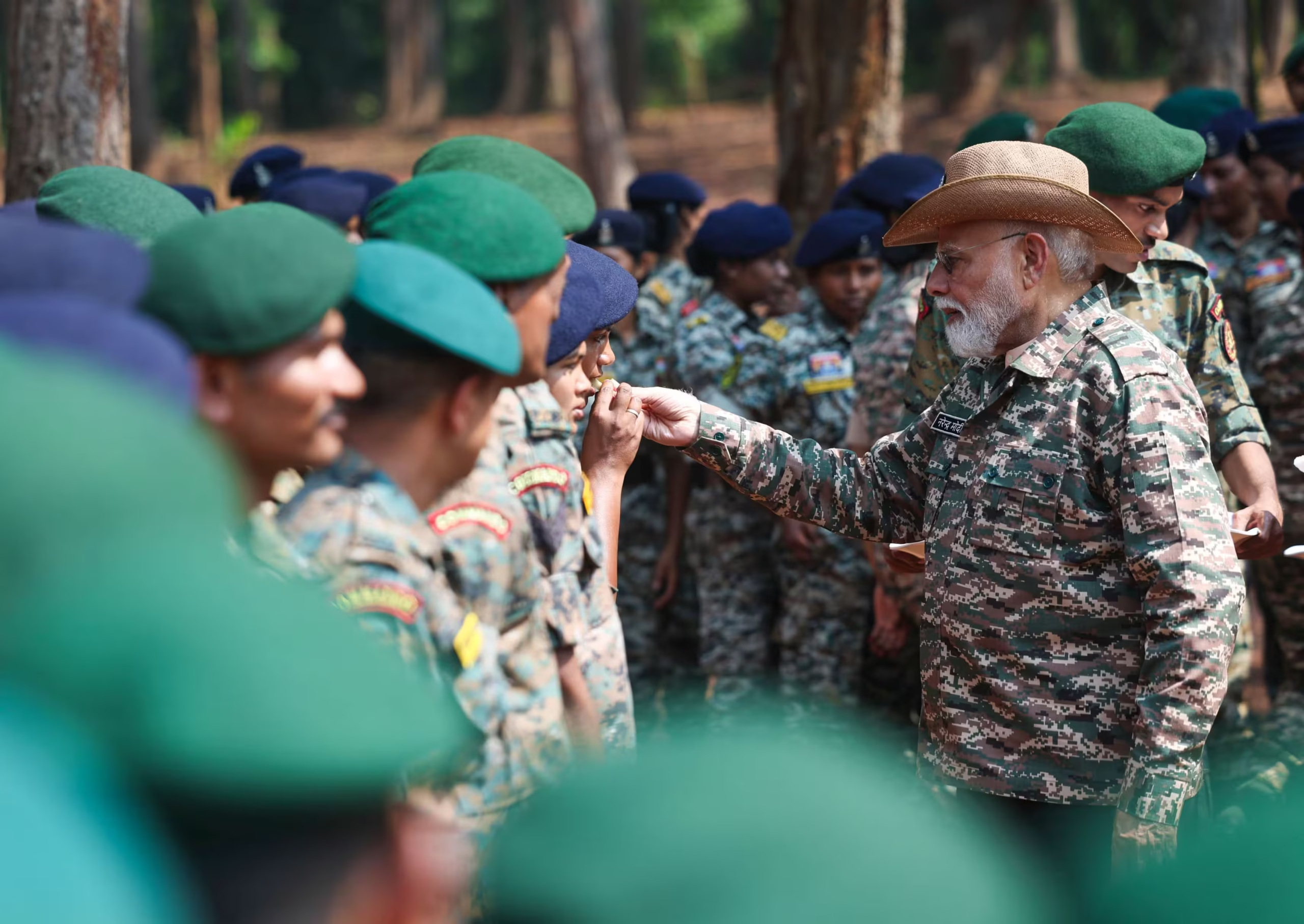
Standing before the elite CoBRA commandos, CRPF jawans, Border Security Force (BSF), Indo-Tibetan Border Police (ITBP), Sashastra Seema Bal (SSB), Indian Reserve Battalion (IRB), state police forces, and the revered, indigenous Bastar Fighters, including its formidable women commandos Prime Minister Modi’s voice resonated with familial warmth and solemn tribute.
Recalling his unbroken tradition of spending Diwali with troops from the frigid ridges of Kargil and Lepcha in the high Himalayas to the blistering salt flats of Sir Creek and the flight deck of aircraft carrier INS Vikrant, the Prime Minister laid bare the emotional bond binding the leadership to the uniform:
“At the borders and within the country, the sentinels of the nation who protect the country, the brave sons of Maa Bharati, all of you are my loved ones, all of you are a part of my family.”
He explained that his journey to Bastar was a pilgrimage of gratitude to the lakhs of security personnel who made this once-unimaginable victory possible:
“Today I have come to express gratitude towards your sacrifice, dedication, and spirit of service.”
Invoking the ancient Sanskrit maxim ‘Aabhyantaram Bhayam Rakshyam, Asaaram Baahyato Bhayam’, the Prime Minister explained the timeless military truth that an external foe cannot destabilize a nation whose internal ramparts remain impregnable. When internal security rots from within, external adversaries feast on the decay. By neutralizing internal terror, India’s security personnel have fortified the entire nation against external blackmail.
“This country is indebted to you for your services, and crores of countrymen are proud of you.”
Policy Meets Valor
Victory in the hinterland was neither swift nor cosmetic; it was the fruit of an iron-clad strategic overhaul. The Prime Minister reminded the gathering that a great nation cannot maintain a passive, defensive crouch against enemies dedicated to its destruction. Such threats must be methodically crushed through superior morale and unflinching tactical clarity.
“This is the victory of the country’s right policies and firm willpower, and this is the victory of your valor, courage, and restraint.”
Behind this transformation lay an aggressive campaign that struck directly at the illicit financial arteries feeding extremism. Decisive, often unheralded national security operations targeted terror financing networks and obliterated the counterfeit currency rackets that sustained guerrilla warfare:
“Not only did this break their economic backbone, rather the entire supply line was choked, stopping the supply of weapons and curbing the movement and recruitment of Naxals.”
Crucially, the operational mandate was handed back entirely to the boots on the ground. Operational freedom was coupled with deep institutional backing. The guiding philosophy was simple yet profound: ensure no mother loses her son, no family is broken, and no young mind is lured into taking up arms against the state.
Security operations were paired with an unprecedented socio-economic push:
“With a spirit of service, we transformed the lives of people in Naxal-affected areas.”
Where extremists once bombed railway lines and blew up schools and clinics to perpetuate cycles of misery, the state moved in with roads, fiber optics, and education. Over the past twelve years, Left-Wing Extremism areas have seen the construction of over 15,000 kilometers of all-weather roads, the erection of more than 9,500 mobile communication towers, and the establishment of nearly 175 Eklavya Model Residential Schools, alongside 50 Industrial Training Institutes (ITIs) and 50 Skill Development Centres. Bank branches, ATMs, and post offices penetrated regions where the Indian state was once completely unseen.
Under the PM JANMAN initiative, basic electricity, piped drinking water, and road connectivity reached particularly vulnerable tribal groups. Surrendered militants were welcomed back into the mainstream, provided dignified livelihoods, and integrated into civic life.
This holistic approach merged effortlessly with India’s broader victory against poverty, underscored by a recent World Bank report confirming that 50 crore Indians have climbed out of extreme deprivation over the past 12 years:
“In the past 12 years, the country has not only won the battle against Naxalism and separatism, rather the country has also won a major war against poverty.”
Comparing this welfare infrastructure to a vibrant Diwali Rangoli, where discrete lines combine to create an intricate masterpiece, Shri Modi listed the convergence of PM Awas houses, Jan Dhan accounts, Mudra loans, SVANidhi collateral-free credits, Ayushman Bharat health coverage, and clean tap water under Har Ghar Jal:
“The poor families whose entire lives used to be spent only in worry have now received the assurance of the government, and a new self-confidence has come into them.”
The most moving testimony to this change is visible on the dusty fields of Bastar itself. Where children were once coerced into handling crude assault weapons, the Bastar Olympics are now in full swing, with tribal youth competing for athletic honors:
“Today in this very Bastar, the Bastar Olympics are taking place, and children are trying their hand at sports, not guns.”
Looking ahead, the Prime Minister urged the jawans to draw inspiration from the revered armed forces motto, ‘Tera Gaurav Amar Rahe Maa, Hum Din Chaar Rahein Na Rahein’ (May your glory remain immortal, Mother India, whether we live for four days or not):
“Now is the time to live for the nation and to take the nation to a new height. Your sacrifices and hard work will become a strong foundation for the grand edifice of a Viksit Bharat.”
Sherathang
While the Prime Minister galvanized the forces in the dry sal groves of central India, 1,200 kilometers to the northeast, Raksha Mantri Rajnath Singh arrived amidst the jagged ridgelines of Sikkim. Accompanied by Chief of the Army Staff General Dhiraj Seth, Eastern Army Commander Lt Gen VMB Krishnan, and Trishakti Corps Commander Lt Gen Man Raj Singh Mann, the Defense Minister stepped into the harsh, thin air of Sherathang to spend Deepavali with the jawans guarding the icy border.
High altitude tests the limits of human endurance. Temperatures regularly plummet below freezing, oxygen is scarce, and the terrain is unforgiving. Yet morale among the troops of the 33 Corps famously known as the Trishakti Corps remains unyielding.
Addressing the troops bundled in their extreme cold-weather gear, the Raksha Mantri looked out at the assembly and described them as the truest embodiment of the festival itself:
“Like a lamp which dispels darkness without seeking attention, soldiers perform their duties silently, ensuring that citizens can celebrate festivals with peace and security.”
Rajnath Singh commended their relentless stamina, steel discipline, and unmatched professionalism, reminding them that while modern armed forces increasingly deploy cutting-edge sensors, automated weapons, and high-tech command networks, machines are only as formidable as the human spirit operating them. Courage, restraint, and mental fortitude remain the decisive elements on the battlefield.
Moreover, the Raksha Mantri noted that the Indian soldier is more than a warrior he is an ambassador of the republic. His demeanor, restraint, respect for civilians, and impeccable uniform forge the indelible image of India among border communities, building an unbreakable wall of mutual trust and respect.
In Sacred Remembrance
A nation that forgets its martyrs soon loses its soul. At Sherathang, the Raksha Mantri paused to pay solemn homage at two hallowed sites: the Sherathang War Memorial and the legendary Baba Harbhajan Singh Memorial, deeply woven into the local martial lore and civil-military tradition of Sikkim.
Laying a floral wreath at the War Memorial, Rajnath Singh gazed upon the inscriptions bearing the names of soldiers who fell defending these rugged peaks. The names told an evocative story of national integration warriors who hailed from Nagaland, Tamil Nadu, Uttar Pradesh, Rajasthan, and Assam, standing shoulder to shoulder in life, resting together in eternal glory.
These monuments, the Raksha Mantri remarked, do far more than merely mark historical clashes. They act as eternal beacons, awakening the collective national consciousness and instilling deep pride in the heart of every Indian:
“Approximately 26,000 names of the fallen heroes have been inscribed in golden letters at the National War Memorial to honour their unmatched valour and sacrifice. Seeing the name of a fallen soldier at the memorial evokes a deep sense of pride among their families, relatives and people from their native villages and regions. These memorials serve as sources of inspiration for the present and future generations.”
The Shield and the Flame
As dusk fell on November 8, 2026, the contrast was both breathtaking and unifying.
In Bastar, where the night once carried the ominous dread of landmines and gunfire, lamps flickered across newly electrified tribal settlements, and jawans laughed alongside local villagers as the Prime Minister shared festive sweets.
In the freezing heights of Sherathang, amidst swirling alpine mists and razor-sharp cliffs, soldiers of the Trishakti Corps stood tall around their Raksha Mantri, holding the line with fingers on their triggers and eyes fixed on the horizon, ensuring that no adversary dares disturb the peace of the motherland.
These two commemorations, separated by geography but fused by purpose, offer a reassuring message to 140 crore Indians. The nation is progressing because its guardians are vigilant. The lights burn bright in homes, markets, and towns because in the highest peaks and the deepest jungles, the sons and daughters of Maa Bharati stand watch unflinching, unbending, and invincible.
Leave a Reply